
Sport and Exercise Psychology
695 resources created by 369 users
This Sport and Exercise Psychology page on GoConqr gathers community-made mind maps, quizzes, flashcards and notes on arousal, attribution, personality, aggression, goal setting and mental skills training. It's built for school students revising a topic, university students and professional candidates filling gaps, and teachers after ready-made material. There are over 680 resources here, including more than 30 quizzes, over 400 mind maps and more than 200 flashcard decks, with A-level PE and GCSE PE revision alongside university-style topics. Pick a topic, try a quiz to find your gaps, then build your own.
Select topic
- Personality and Individual Differences60
- Attitudes and Behaviour in Sport24
- Motivation in Sport42
- Attribution Theory in Sport22
- Confidence and Self-Efficacy in Sport16
- Arousal, Anxiety and Stress in Sport93
- Aggression in Sport31
- Learning and Information Processing in Sport33
- Goal Setting in Sport33
- Mental Skills and Preparation in Sport23
- Leadership and Coaching in Sport22
- Group Dynamics and Team Cohesion37
- Social Facilitation in Sport12
- Athlete Wellbeing and Injury9
- Exercise Participation and Mental Health5
Top Sport and Exercise Psychology resources
Quizzes
See all 36 quizzes-
64 questionsApplied Sports Psychology Exam 2 It is recommended that appropriate goals be:
-
19 questionsArousal, Anxiety and Performance Studying how arousal and anxiety can effect performance.
-
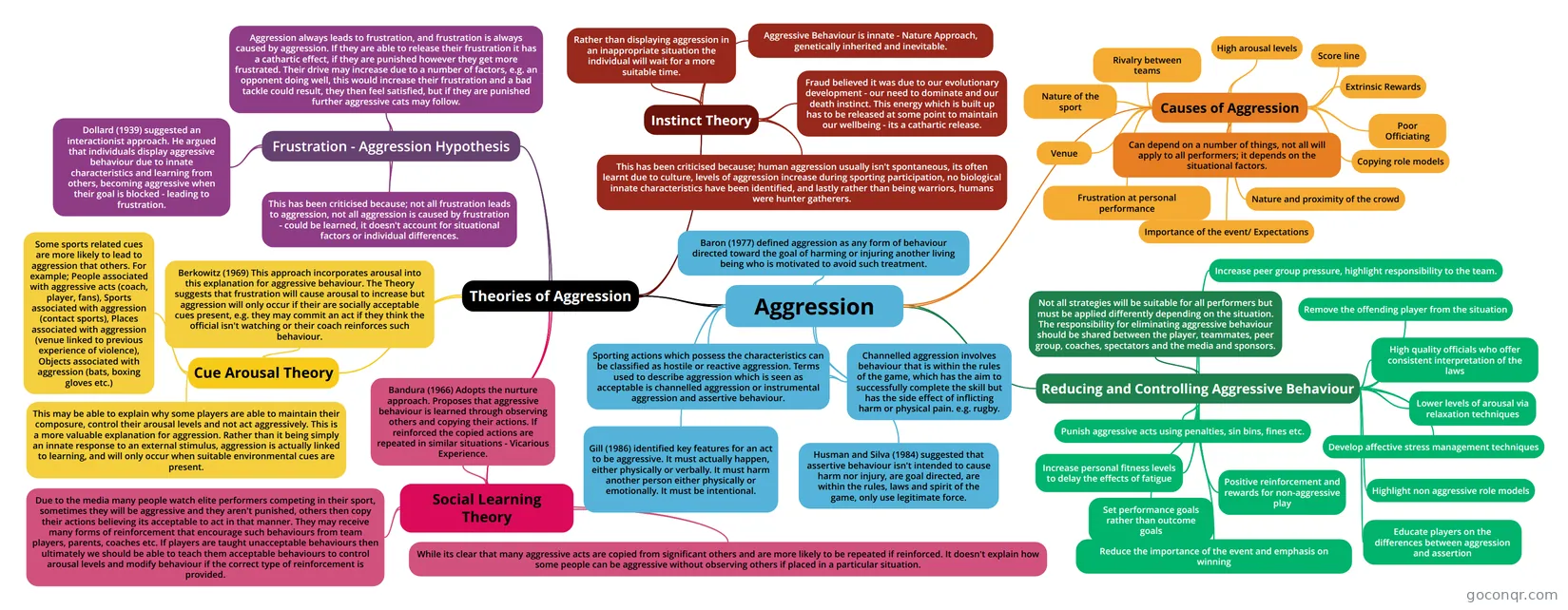
14 questionsAggression Aggression is the intent to harm outside the rules; hostile behaviour
-
14 questionsChapter 2: Principles of Motivation and Adherence Adherence is defined as the psychological drive that gives behavior direction and purpose.
-
6 questionsHome Advantage Quiz Nevill, Balmer and Wolfson (2003) stated that...
Mind maps
See all 421 mind maps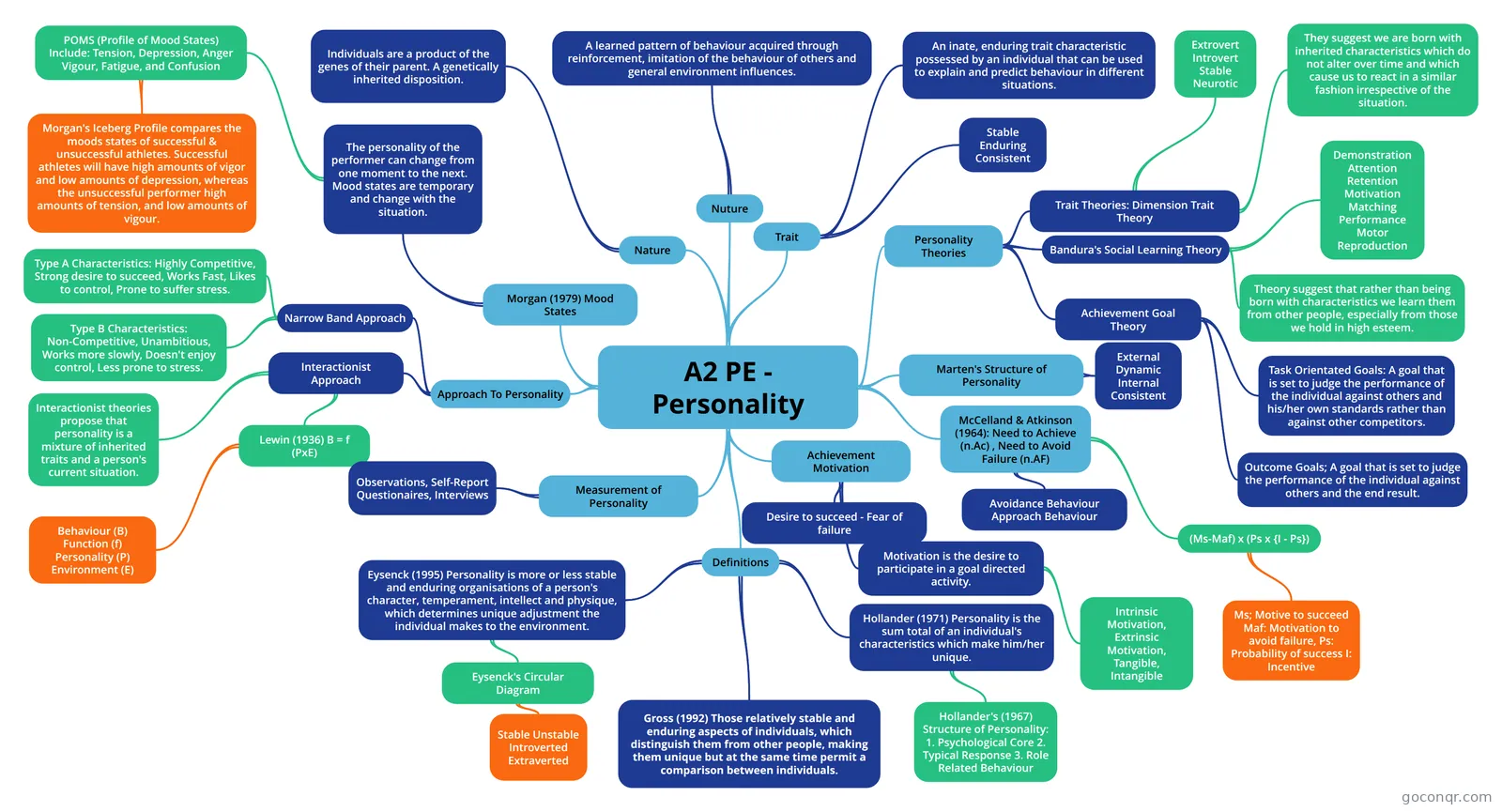
Flashcards
See all 207 flashcards-
21 cardsUnit 11: Personality and Sports Psychology What are the characteristics of an introvert?
-
12 cardsMST Planning
-
23 cardsKroll and Crenshaw what year did kroll and Crenshaw present their paper?
-
22 cardsPE Information Processing What is reaction time?
-
72 cardsSports Psychology
-
15 cardsChanges in Gaze behaviour Give the two types of photoreceptors in the retina and give what they do.
-
42 cardsChapter 4:-Sports Psychology (Paper 2) What is a skill?
-
26 cardsAS Psychology Name the 6 classification continuums
Flowcharts
See all 11 flowchartsNotes
See all 13 notes-
How can psychology affect performance - created from Mind Map Motivation: an internal state that activates, directs and sustains behaviour towards achieving a particular goal.-Positive: occurs when an individual's performance is driven by previous reinforcing behaviour...
-
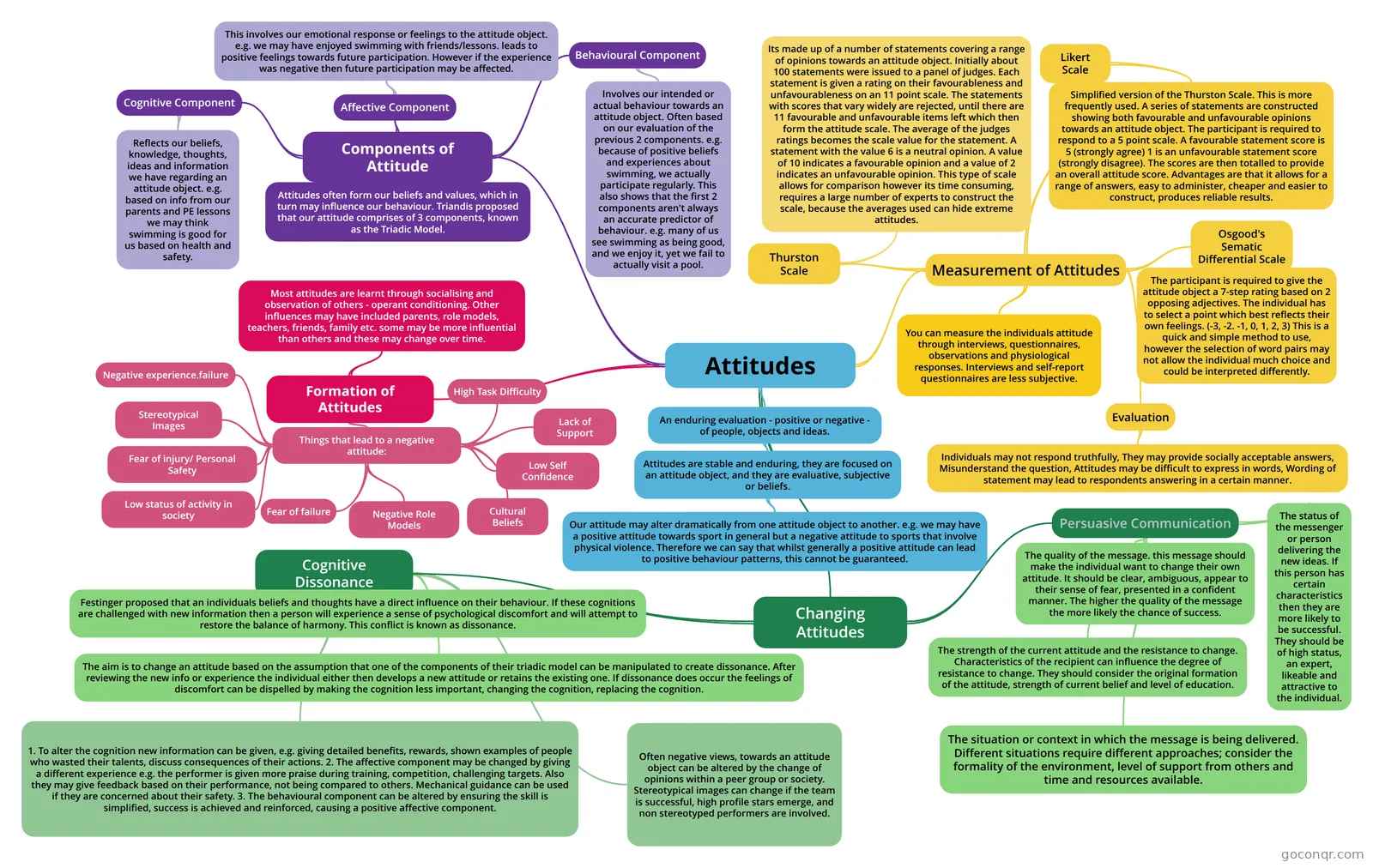
Attitudes Attitude- Learned behavioral predispostion An emotional response that can be enduring
-
A2 PE Attitudes notes ATTITUDES pOSITIVE POSITIVENEGATIVE
Topics in Sport and Exercise Psychology
More Physical education and sport topics
About Sport and Exercise Psychology
GoConqr OriginalWhat this unit covers
This unit sits in the Skill Acquisition, Psychology and Performance strand of Physical education and sport. Most of it is mind maps, and they cover the classic topics of sport psychology. The Arousal map explains arousal as a state of alertness that prepares the body for action, and links it to Drive Theory and the Reticular Activating System. The Attribution map looks at the reasons coaches and players give for successes and failures. The Aspects of Personality map deals with stable traits that make people different from one another.
Where to start
If you are new to the topic, begin with the Sports Psychology mind map for the overall picture. Then move to the topics most courses return to again and again:
- Personality, using A2 PE - Personality for nature, nurture and trait ideas.
- Arousal and anxiety, using the Arousal map and then the Anxiety Quiz.
- Attribution, using the Attribution map.
- Aggression, using the Aggression quiz, which separates hostile aggression from instrumental aggression and assertion.
Using maps and quizzes together
Read a map first, then close it and take the matching quiz. Anything you get wrong tells you which branch to go back to. Flashcards suit the finer detail. The Kroll and Crenshaw deck asks about the aims, design and sports of that study, and MST Planning asks you to define mental skills training and compare mental techniques, skills and qualities.
Going further
Once the core topics feel familiar, the page also lists flashcard decks on burnout, coping, perfectionism, injury and career transitions, plus quizzes on group cohesion, leadership and exercise across the lifespan. Revising for GCSE PE or A-level PE? The notes and maps with those names are a handy way in. Teachers can set a single quiz as a quick check or point a class to a mind map as a starting point.
Choose one topic today, open its map, and then test yourself with a quiz.
Frequently asked questions
Which resource should I open first?
Start with the Sports Psychology mind map for an overview, then pick a single topic. The Arousal and Attribution mind maps are good first steps, and the Aggression quiz is a quick way to check whether the basic definitions have stuck.
What do the mind maps cover?
They cover arousal and Drive Theory, attribution, personality, attitudes, aggression, goal setting, cohesion and choking in sport. Some are short-term and long-term psychological preparation maps. Each one breaks a topic into branches so you can see how the ideas connect.
Are the resources free to use?
Yes. Every resource listed here is free to open, study and take, with no account needed. They were made by GoConqr users, not by GoConqr itself. A free account also saves your quiz scores and lets you make your own quizzes, maps, flashcards and notes.
Which exams do these resources suit?
The listed resources mention A-level PE, A-level Physical Education, GCSE PE and GCSE Physical Education. Most of the material is aimed at school level, and a smaller share suits university students and professional candidates, so check a resource's content against your own course.
What if I can't find the topic I need?
Try a nearby title first. Topics such as anxiety, stress and fatigue appear across several maps, quizzes and notes. If nothing fits, you can make your own mind map, flashcards or quiz with a free account and keep it for revision.