
The Musculoskeletal System: Bones, Joints and Muscles
51 resources created by 47 users
This Physical education and sport page on GoConqr gathers community-made mind maps, flashcards, quizzes and notes on the musculoskeletal system, from the functions of the skeleton and types of joint to muscle names, muscle fibres and how muscles contract. It's built for school students revising a topic, and for teachers after ready-made material. There are over 300 resources here, including more than 20 quizzes and over 190 mind maps, with a few aimed at university study. Pick a topic and try a quiz to find your gaps.
Top The Musculoskeletal System: Bones, Joints and Muscles resources
-
73 cardsNASM Appendix D CPT MODULE 2
-
23 cardsSports studies What Is a voluntary Muscle? examples and how they work.
-
6 questionsOCR Sport Level 3 Skeleton & Joints Quiz Which one of the categories below is not a classification of joints?
-
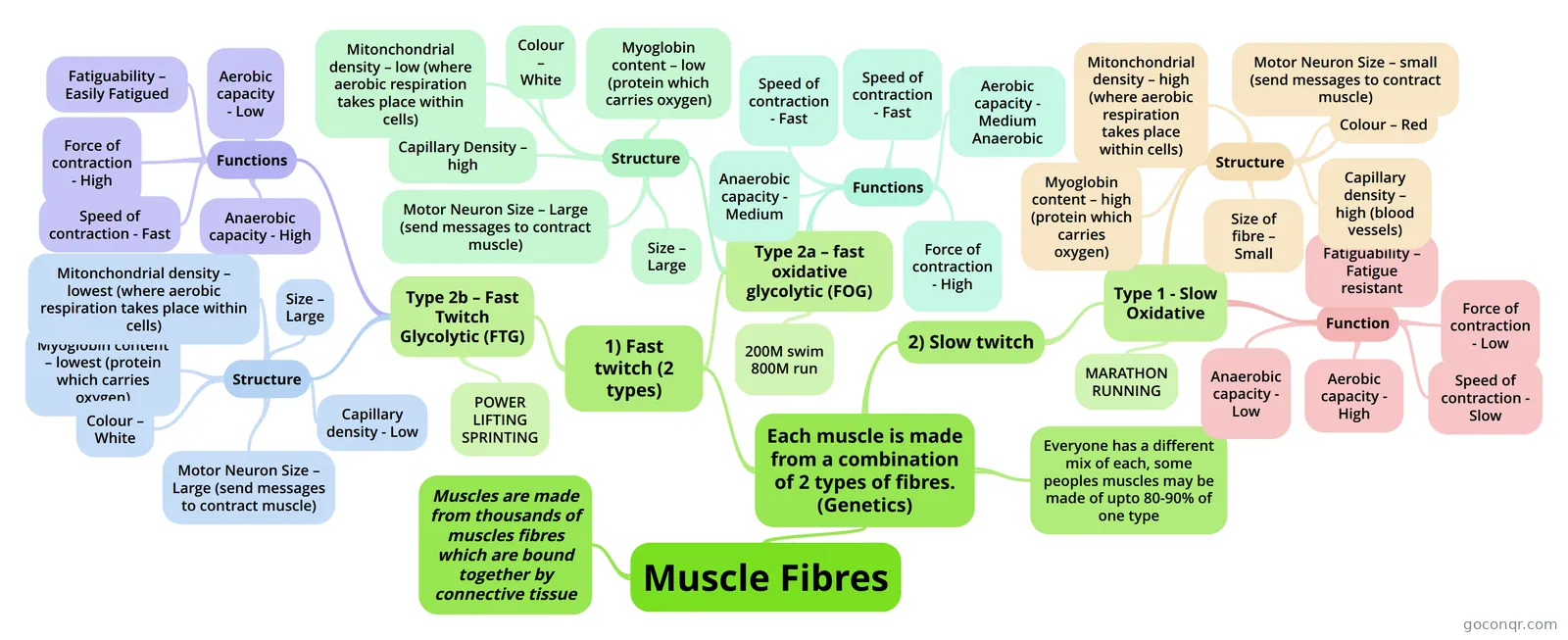 Mind map Muscle Fibres
-
Mind map Muscular System PE
-
4 cardsGCSE PE:Skeletal system Functions of the skeletal system: 1.Protection - the cranium and ribs protect the brain and vital organs in...
-
17 cardsThe Muscular System What is the muscular system?
-
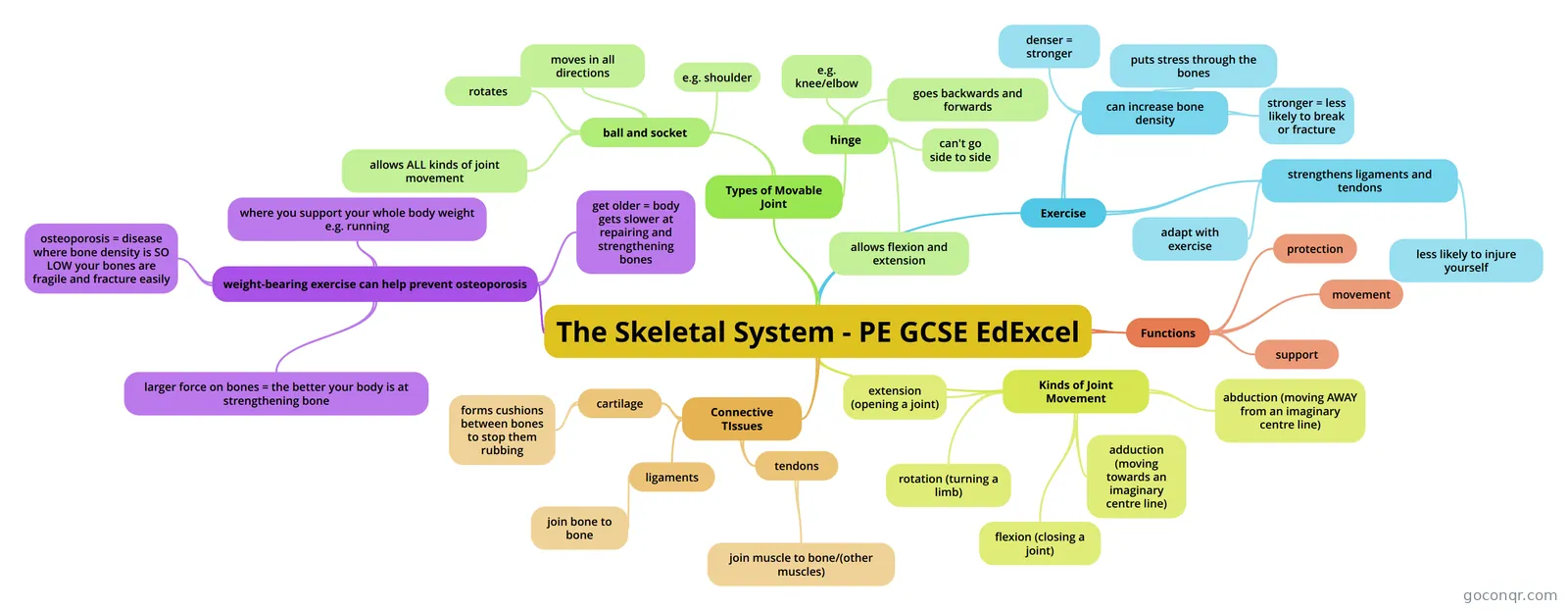 Mind map The Skeletal System - PE GCSE EdExcel Mind map with all the necessary information on the skeletal system for the EdExcel PE GCSE Course.
Quizzes
-
6 questionsOCR Sport Level 3 Skeleton & Joints Quiz Which one of the categories below is not a classification of joints?
-
7 questionsBONES TEST NAME THE FUNTIONS OF THE SKELETON
-
6 questionsSkeletal system What movements occurs in the sagittal plane?
-
6 questionsExam pe The agonist is the prime mover. It is the working muscle that produces the desired movement. It is contract...
-
4 questionsMuscles (Ramón, Nacho, Juan and Santi) Name the muscles
-
2 questionsLEGS MUSCLES PUT THE FOLLOWING NAMES ON THE CORRECT PLACE SERGIO, PABLO AND MARCOS
-
5 questionsThe Muscular System Usain Bolt would use predominantly which muscle fibre type?
Mind maps
See all 25 mind maps-
Muscle Fibres
-
Muscular System PE
-
The Skeletal System - PE GCSE EdExcel Mind map with all the necessary information on the skeletal system for the EdExcel PE GCSE Course.
-
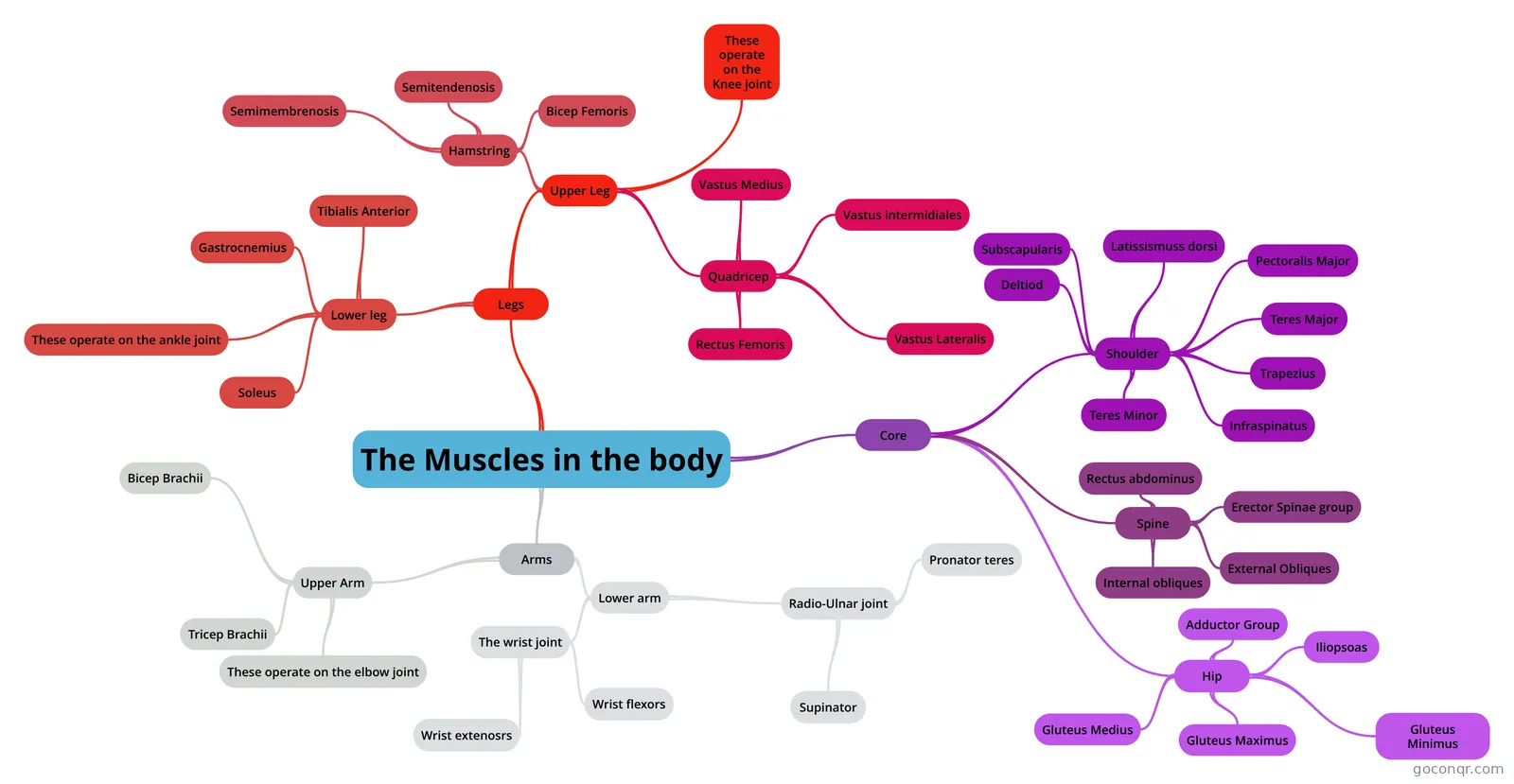 The Muscles in the body This is for an A level student not all the muscles are needed for GCSE. I suggest you copy this to your are...
-
Skeletal System
-
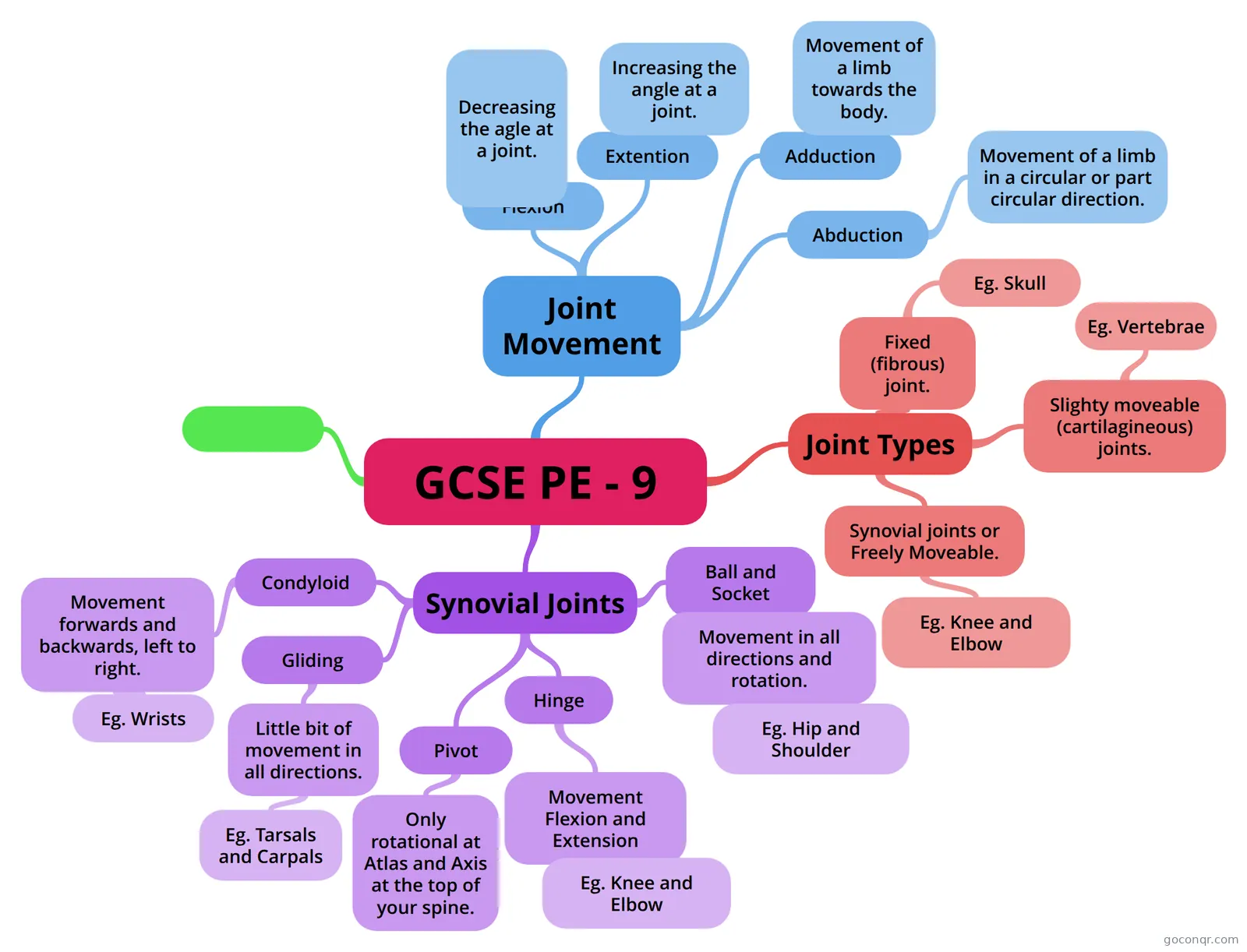 GCSE PE - 9
-
Muscular system Revision
-
MUSCLES Overview -What they do -Characteristics -Functions -Types of muscles -Types of contractions -Functions in m...
Flashcards
See all 16 flashcards-
73 cardsNASM Appendix D CPT MODULE 2
-
23 cardsSports studies What Is a voluntary Muscle? examples and how they work.
-
4 cardsGCSE PE:Skeletal system Functions of the skeletal system: 1.Protection - the cranium and ribs protect the brain and vital organs in...
-
17 cardsThe Muscular System What is the muscular system?
-
11 cardsMuscle tendon interactions and flexibility Give 5 factors affecting range of movement at a joint.
-
25 cardsBones (GCSE PE)
-
3 cardsMUSCLE MAN (P.E Final) P.E Final semester 1 grade 9
-
45 cards2a. Exercise Physio - Part 1 How is exercise fueled?
Notes
More Physical education and sport topics
About The Musculoskeletal System: Bones, Joints and Muscles
GoConqr OriginalWhat the resources cover
The page splits into three strands of content: bones, joints and muscles. On the bones side, the mind map The Skeletal System - PE GCSE EdExcel covers functions such as movement, protection and support. It also explains connective tissues, including how cartilage forms cushions between bones to stop them rubbing. The flashcard deck GCSE PE:Skeletal system lists functions like protection, shape and support.
For muscles, the mind map Muscular System names the main muscles, from the trapezius and deltoids to the hamstrings and gastrocnemius, and sets out the types of muscle. Muscle Fibres looks at how muscles are built from thousands of fibres and the fast twitch and slow twitch types.
Where to start
- Skeleton first. Read The Skeletal System - PE GCSE EdExcel, then work through the GCSE PE:Skeletal system flashcards.
- Then joints. Look at the Joints and their movement types maps and the Movement of Joints flashcards. The quiz OCR Sport Level 3 Skeleton & Joints Quiz asks about joint classification, synovial joints and ankle movement.
- Then muscles. Start with Muscular System, then The Muscular System flashcards, which ask what voluntary and involuntary muscles are.
- Finish with fibres and contraction. Try Muscle Fibres, then Sliding Filament Theory and Muscle contractions.
Using quizzes and maps together
Read a mind map, then close it and take a quiz on the same topic. Whatever you got wrong tells you which branch to reread. Flashcards suit short, repeated recall of names and definitions. Notes such as Antagonistic Pairs and Classification Of Joints help when you want a topic written out in full.
Many resources mention GCSE PE, A-level PE and IGCSE PE, so check the titles and excerpts against the course you follow. A few resources go deeper, covering topics such as muscle disuse and atrophy, and suit university study.
Where it sits
This unit belongs to the strand Applied Anatomy, Physiology and Biomechanics in Physical education and sport. It supplies the body structure that later topics on movement and training build on.
Ready to begin? Choose one topic, open its mind map, and see how much you can recall before you check.
Frequently asked questions
Which resource should I open first?
If you are new to the topic, start with the mind map The Skeletal System - PE GCSE EdExcel, which covers functions, connective tissues and joint movement. Then move to the Muscular System mind map. Once you have read them, a quiz will show what has stuck.
What do the mind maps on this page cover?
There are over 190 mind maps. They cover the skeleton and its functions, joints and their movement types, muscle names, voluntary and involuntary muscle, muscle fibres, the motor unit, and the effects of exercise on bones and muscles. Some are short summaries, while others are detailed branches.
Are the resources free to use?
Yes. Every resource listed here is free to open, study and take, with no account needed. They were made by GoConqr users rather than by GoConqr itself. A free account is optional and lets you save quiz scores and make your own quizzes, maps, flashcards and notes.
Which exams and levels do these resources suit?
Most resources are made for school students, and the titles and excerpts mention GCSE PE, GCSE Physical Education, A-level PE, A-level Physical Education and IGCSE PE. A small number are aimed at university or professional study. Check each resource against your own course.
Are there quizzes on joints and muscle contraction?
Yes. OCR Sport Level 3 Skeleton & Joints Quiz and Type of Joints test joint classification and movement. For muscles, you can try Concentric, Eccentric and Isometric, or Neuromuscular system- 5 stages of muscle contraction. There are more than 20 quizzes in all.
What if I cannot find the topic I need?
Browse the flashcards and notes as well as the maps and quizzes, since a topic may appear under a different title, such as Muscle contractions or Roles of the muscles. If it is still missing, you can make your own resource and build it up as you revise.