
Components of Fitness
120 resources created by 110 users
This Components of Fitness page on GoConqr gathers community-made mind maps, flashcards, quizzes and notes, from health-related and skill-related fitness to VO2 max, flexibility and fitness tests. It's built for school students revising a topic and teachers after ready-made material. There are over 1,300 resources here, including more than 900 mind maps, over 300 flashcards and more than 50 quizzes, mostly pitched at GCSE, BTEC and A-level PE. Pick a mind map to get your bearings, then test yourself with a quiz.
Top Components of Fitness resources
-
Mind map GCSE PE Revision pe revision
-
27 questionsFitness for living well (BYU independent study) Unit 4: Cardiorespiratory fitness The cardiorespiratory system is made up of the
-
27 questionsFitness for living well (BYU independent study) Unit 5: Flexability The ability to move a joint through its full range of motion is called
-
Mind map Unit 1 - BTEC Sport Unit 1 BTEC Sport - Includes Matty's flash cards and mindmap.
-
25 cardsComponents of Fitness Components of Health Related Exercise My Fat Body Might Collapse
-
14 cardsPhysical Activity Vocabulary Freshman/Unit 3/November 2018
-
 Mind map Components of Fitness Components of fitness for AQA GCSE PE
-
16 cardsComponents of Fitness and definitions
Quizzes
See all 15 quizzes-
27 questionsFitness for living well (BYU independent study) Unit 4: Cardiorespiratory fitness The cardiorespiratory system is made up of the
-
27 questionsFitness for living well (BYU independent study) Unit 5: Flexability The ability to move a joint through its full range of motion is called
-
57 questionsHealth Class spring 2014 chapter 4 test 1. Which of the following will occur when you establish a program of regular aerobic exercise?
-
5 questionsSkill Related Fitness Quiz How many skill related fitness components are there?
-
24 questionsFinal Practice Quiz While in physical education class, Joe determined that his average resting heart rate is approximately 60 b...
-
22 questionsPrinciples of Exercise, Fitness and Health Nathan's questions Which of the following will result in weight loss?
-
16 questionsPhysical Education Which one of the following is not a core theme of the healthy schools programme?
-
96 questionsPhysical test Fitness is the movement that some of us can do in the sport of choice
Mind maps
See all 64 mind maps-
GCSE PE Revision pe revision
-
Unit 1 - BTEC Sport Unit 1 BTEC Sport - Includes Matty's flash cards and mindmap.
-
Components of Fitness Components of fitness for AQA GCSE PE
-
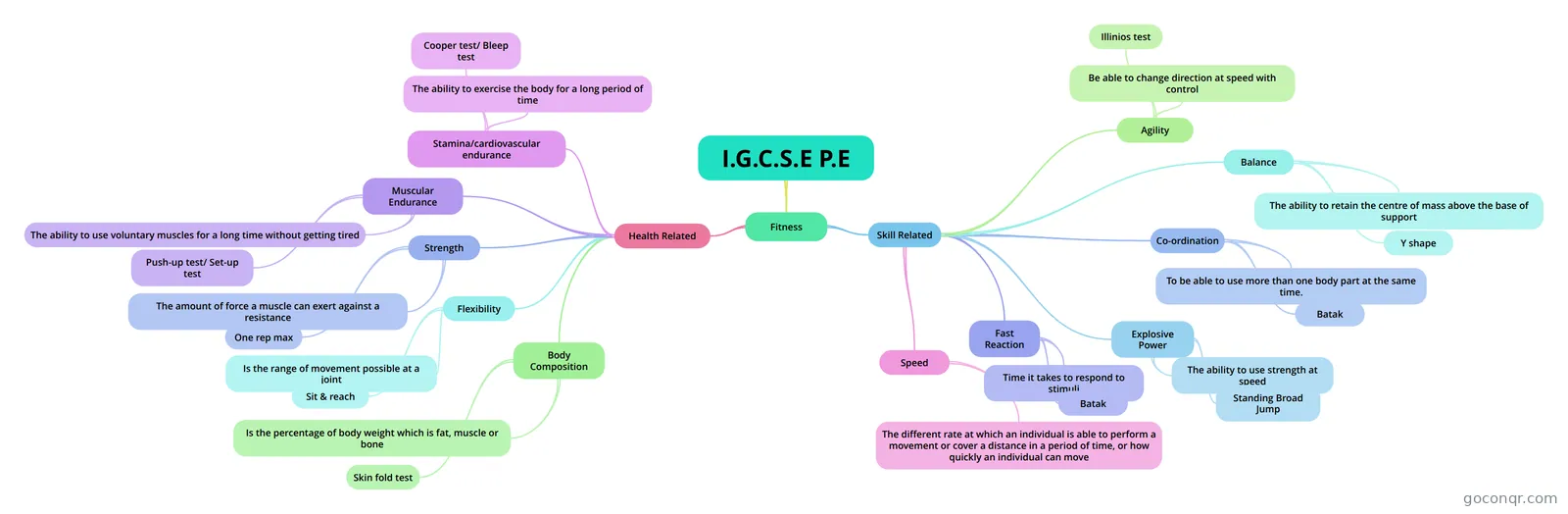 I.G.C.S.E P.E Outline the components of fitness, both health and skill related. Includes Definitions of components, and t...
-
 6 Skill Related Fitness (ABC PRS)
-
 Skill Related Fitness
-
 Health Related Fitness
-
 COMPONENTS OF FITNESS- PE BTEC
Flashcards
See all 34 flashcards-
25 cardsComponents of Fitness Components of Health Related Exercise My Fat Body Might Collapse
-
14 cardsPhysical Activity Vocabulary Freshman/Unit 3/November 2018
-
16 cardsComponents of Fitness and definitions
-
5 cardsHealth and fitness
-
56 cardsHealth 1 Test What is physical activity?
-
70 cardsHealth 1: Exercise & Physical Activity Test Define physical activity
-
42 cardsPE Revision Cards Define Cardiovascular Endurance
-
5 cardsSports Related Fitness Reaction Time "Is the ability to respond to a stimulus quickly. A reaction can be simple or it can involve ...
Notes
-
PE definitions + Health and Skill related fitness Definitions HEALTH, FITNESS, EXERCISE and PERFORMANCEHealth: A state of complete mental, physical and social well being and not merely the absence of a disease or infirmity.Fitness: The ability to meet the demands of ...
-
Conceptual Basis of Training Question 4: How times have changed• Hunter gatherer 90-130 KJ/kg/d • Office worker- 37 KJ/kg/d • Fitness enthusiast- running at 12kph for 60min/d = 82/KJ/dArguing that even the fittest only achieve 6...
-
Settings for exercise PDHPE Settings for exercise play a major role in assisting an individual to become fit. Compare settings used in common fitness programs. When commencing exercise, there are various considerations that need to be taken into...
-
Flexibility The range of motion around a joint or a series of joints Flexibility is sport specific (e.g. rugby player needs less flexibility than a gymnast) Two types of flexibility:StaticDynamic
-
Skill related fitness components - created from Mind Map Balance - the ability to keep the body stable whether still, moving or in a different shape by keeping the centre of gravity over the base. cheerleading - formations netball - footwork gymnastics - the beam Agility - ...
-
Skill related fitness components - created from Mind Map_1 Agility - the ability to change direction quickly and maintain control of your whole body. netball - dodging hockey - dribbling rugby tackling - side stepping Balance - the ability to keep the body stable whether stil...
Slides
More Physical education and sport topics
About Components of Fitness
GoConqr OriginalWhat the resources cover
The unit splits fitness into two families. Health-related fitness covers aerobic or cardiovascular endurance, muscular endurance, muscular strength, flexibility and body composition. Skill-related fitness covers agility, balance, coordination, power, reaction time and speed. The mind map 6 Skill Related Fitness (ABC PRS) sets out the second group with a definition for each part, while Health Related Fitness does the same for the first.
Where to start
- Open the mind map Components of Fitness. It links each component to a definition and a test, such as the Illinois Agility Test for agility.
- Move to Skill Related Fitness and Health Related Fitness to see each family on its own.
- Try the flashcard deck Components of Fitness and definitions to learn the key terms, including dynamic, explosive and static strength.
Exam-specific maps
If you are working towards a particular course, the list includes GCSE PE Revision, which covers warm-ups, stretching and cool-downs, and Unit 1 - BTEC Sport, which lists the aerobic endurance, muscular endurance, flexibility, speed endurance and muscular strength components. Resources also mention GCSE Physical Education, A-level Physical Education and A-level PE, so check which one matches your course.
Using maps and quizzes together
Read a map first, then cover it and write down what you remember. After that, use a quiz or a flashcard deck to check the gaps. The quiz Skill Related Fitness Quiz suits the second family, and the BYU quiz on cardiorespiratory fitness goes deeper into VO2 max and the heart and lungs. Teachers can set a map as a starter task and a quiz as a quick check.
Where it sits
This unit belongs to the Fitness, Training and Testing strand of Physical education and sport. It sits alongside the wider topics of training and testing, so the fitness tests and notes on VO2 max are useful follow-ups.
Choose one map today and see how much you can recall from it.
Frequently asked questions
Which resource should I open first?
Start with the mind map Components of Fitness. It names each component, gives a short definition and links some of them to tests, such as the Illinois Agility Test. Once that feels familiar, move on to the separate health-related and skill-related maps for more detail.
What do the skill-related fitness maps cover?
They cover agility, balance, coordination, power, reaction time and speed, often remembered as ABC PRS. The map 6 Skill Related Fitness (ABC PRS) gives a definition for each one, for example agility as changing body position quickly while staying in control.
Are the resources free to use?
Yes. Every resource on this page is free to open, study and take, with no account needed. They were made by GoConqr users, not by GoConqr itself, so it is worth checking them against your own course materials.
Which exams do these resources suit?
Most are secondary level, and the listed resources mention GCSE PE, GCSE Physical Education, BTEC Sport, BTEC, A-level Physical Education and A-level PE. There is a BTEC Sport revision flashcard deck and an AQA GCSE PE deck on components of fitness.
Can I make my own version if something is missing?
Yes. A free account lets you save quiz scores and build your own quizzes, mind maps, flashcards and notes. That is handy if your course uses a different test or a set of terms that the listed resources leave out.