
Coordinate Geometry
40 resources created by 34 users
This Coordinate Geometry page on GoConqr gathers community-made quizzes, mind maps, flashcards and notes, from midpoints, distance and gradient to straight lines, circles and polar graphs. It's built for school students revising a topic and teachers after ready-made material. There are over 230 resources here, including more than 20 quizzes, over 140 mind maps and more than 40 flashcards, made by over 180 contributors. Many mention GCSE Maths and A-level Maths. Pick a mind map to get your bearings, then try a quiz.
Top Coordinate Geometry resources
-
49 questionsMATH METHODS 2 - COORDINATE GEOMETRY AND LINEAR RELATIONS Find the coordinates of M, the midpoint of AB, where A and B have the coordinates: A(2,12), B(8,4) ( [blank...
-
24 questionsMPM 2D Review Quiz Which is NOT an equivalent equation for 9x-3y=18
-
18 cardsConnecting Algebra and Geometry through Coordinates - Equation of a Circle - Using Coordinates to Prove Geometric Theorems - Slope Criteria for Parallel and Pe...
-
Mind map COORDINATE GEOMETRY
-
5 cardsStraight-Line Graphs Vertical and Horizontal lines: 'x=a' and 'y=a' x=a is a vertical line through 'a' on the x-axis y=a is a ho...
-
10 cardsFormulae
-
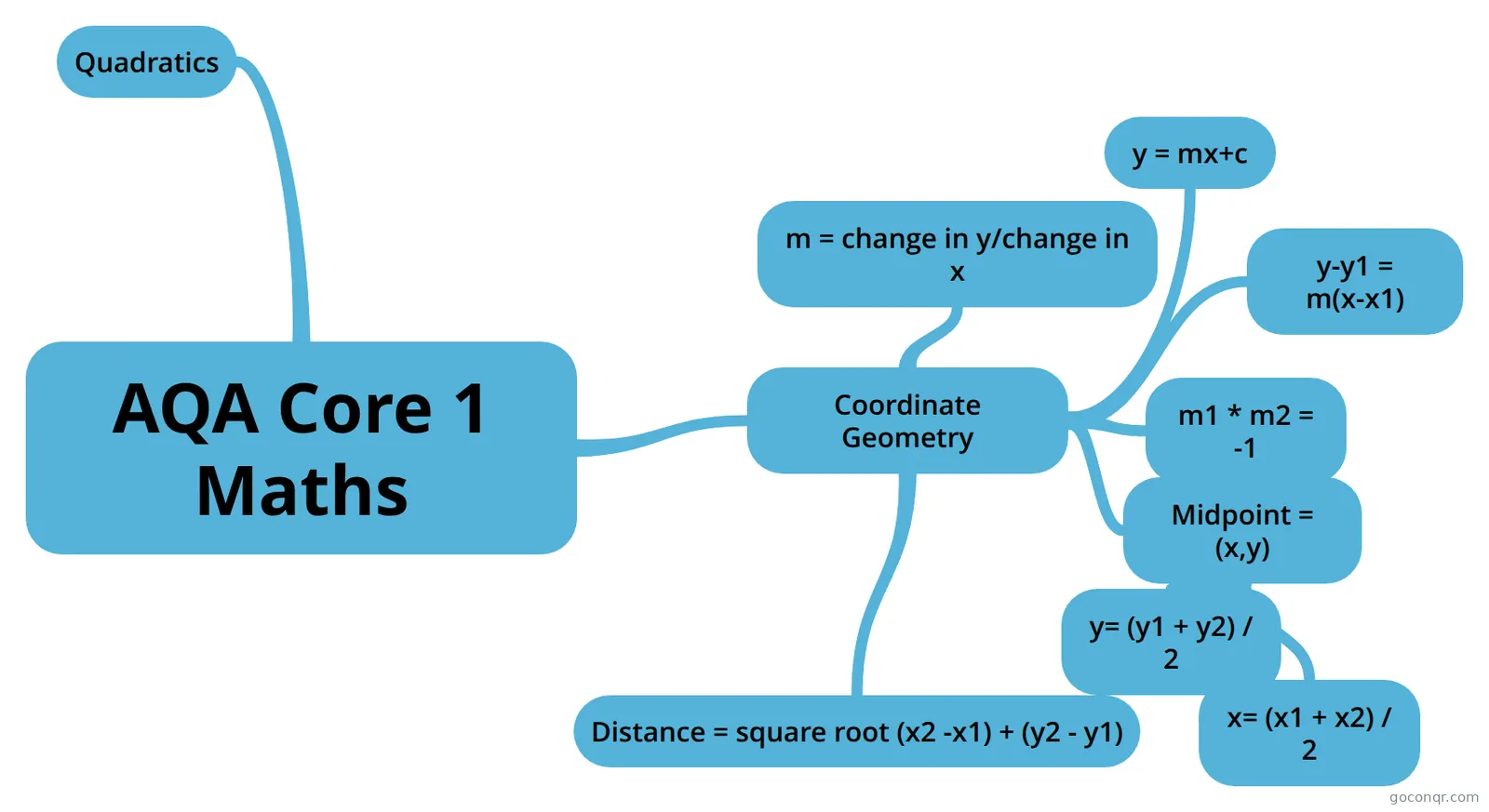 Mind map AQA Core 1 Maths The whole aqa core 1 specification on one sheet
-
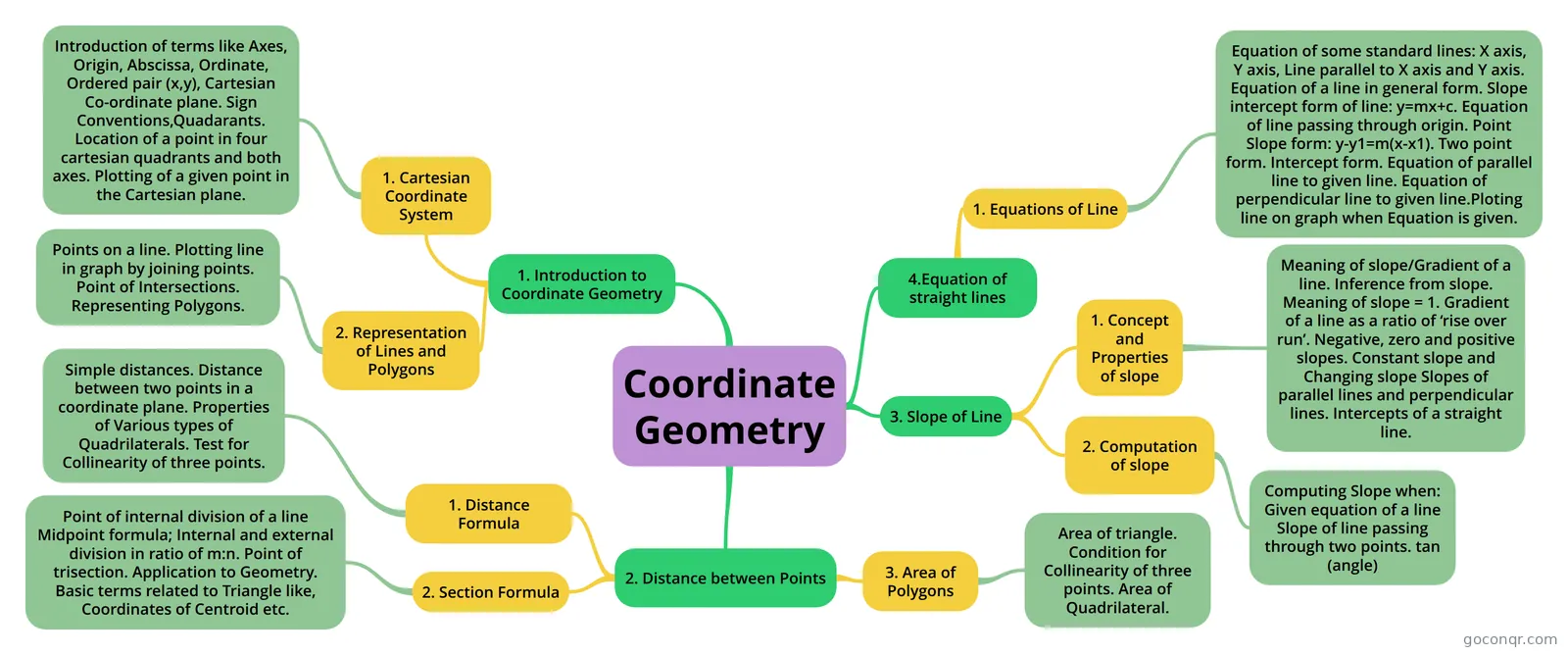 Mind map Coordinate Geometry
Quizzes
-
49 questionsMATH METHODS 2 - COORDINATE GEOMETRY AND LINEAR RELATIONS Find the coordinates of M, the midpoint of AB, where A and B have the coordinates: A(2,12), B(8,4) ( [blank...
-
24 questionsMPM 2D Review Quiz Which is NOT an equivalent equation for 9x-3y=18
-
10 questionsEquation of Circle Review #1 Match each graph with it's equation:
-
3 questionsMissing endpoint practice The endpoint T of the line segment ST is located at (7, 4). Its midpoint is at (-1,-5). Find the coordinate...
-
10 questionsRevision The distance between the point P(1,4) and Q(4,0) IS
-
10 questionsQUIZ OF COORDINATE GEOMETRY Point (-3,5) lies in which quadrant
-
2 questionsQuadrant Names: Drag and Drop Drag the label to the orange dot to correctly identify the quadrant.
Mind maps
See all 12 mind maps-
COORDINATE GEOMETRY
-
AQA Core 1 Maths The whole aqa core 1 specification on one sheet
-
Coordinate Geometry
-
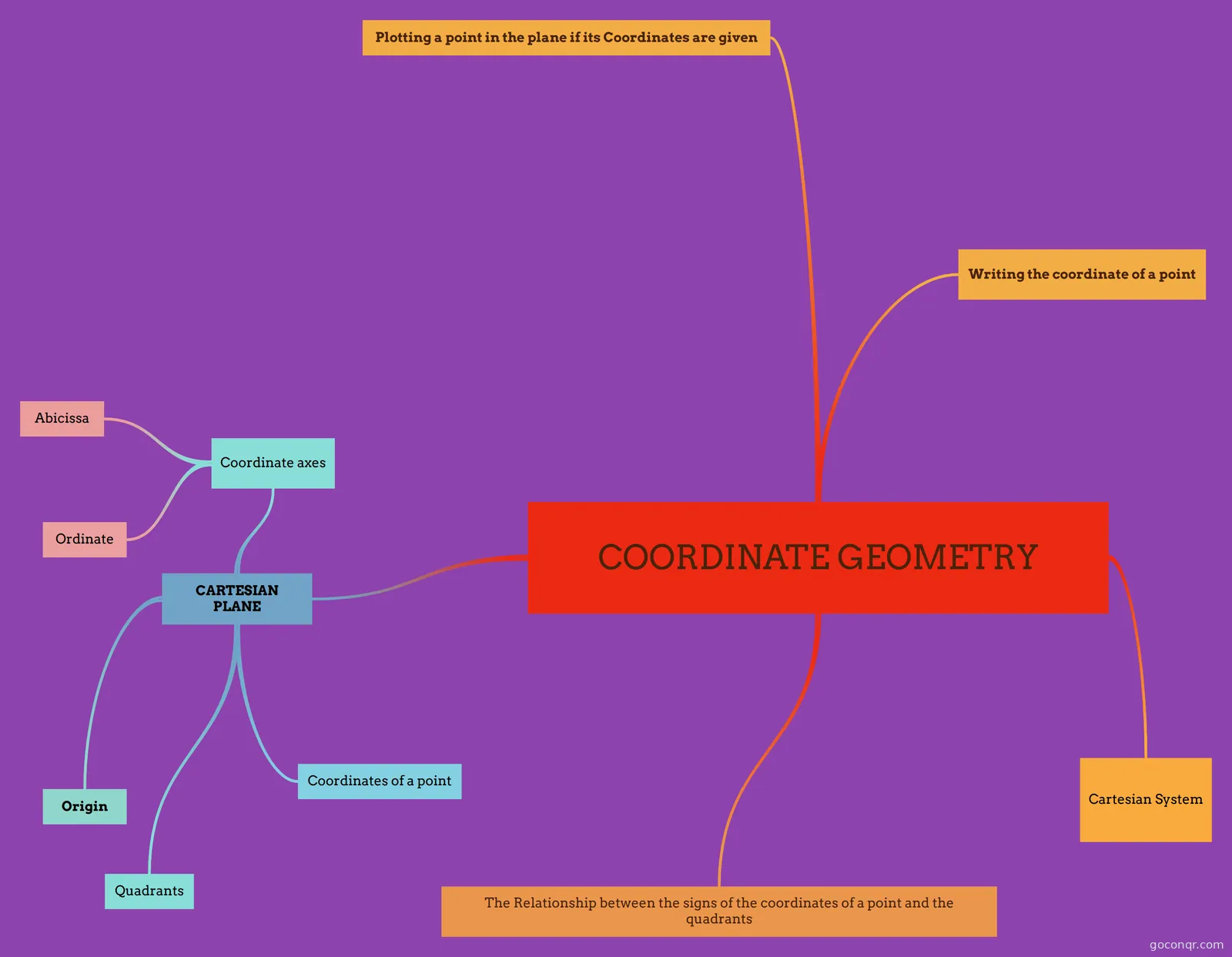 COORDINATE GEOMETRY It is one of the branches of geometry where the position of a point is defined using coordinates.
-
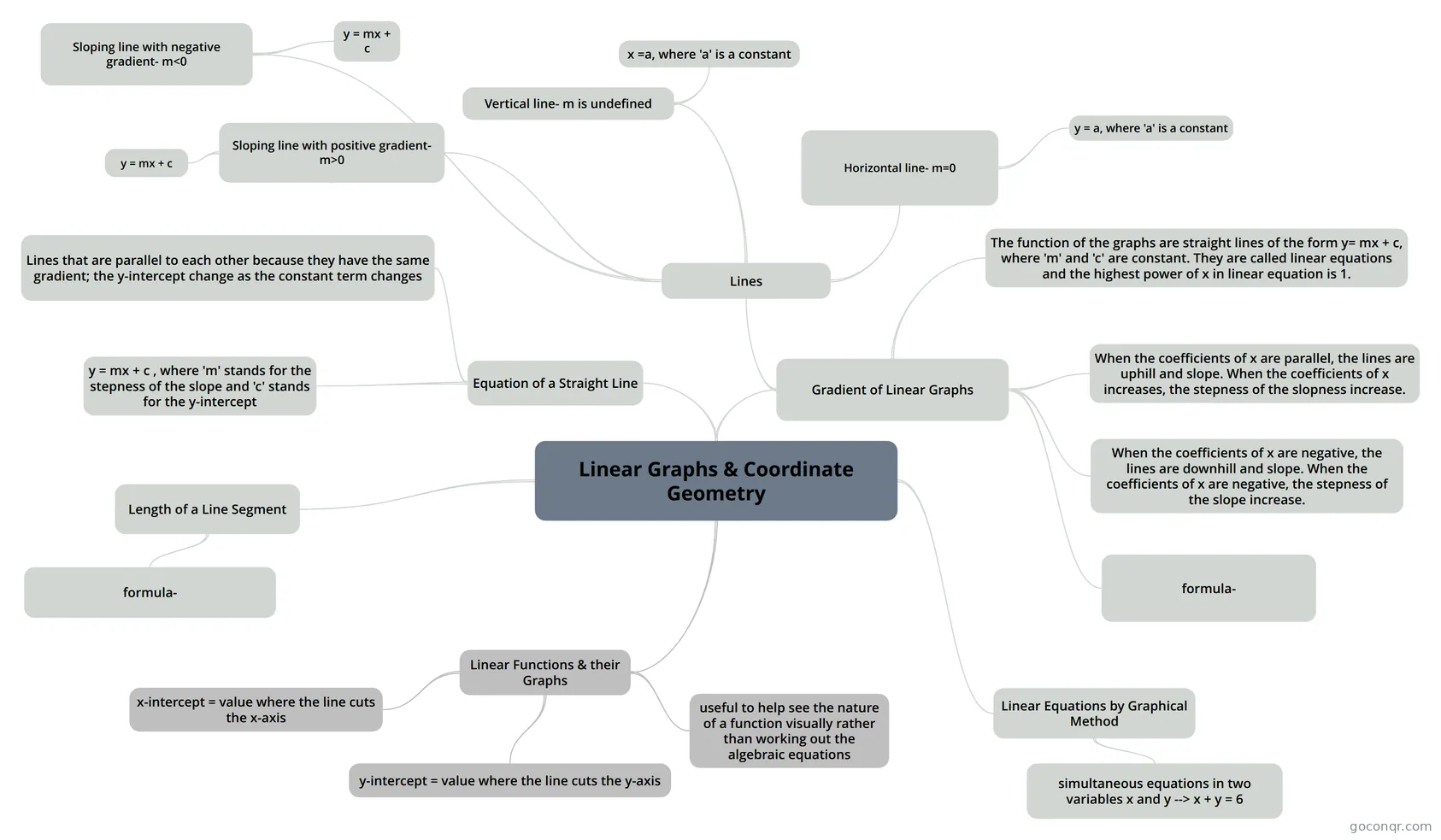 Linear Graphs & Coordinate Geometry
-
Co-Ordinate Geometry Created by Tanmaya Kumar Pradhan of Class 9A Of DAV Public School, Haldia
-
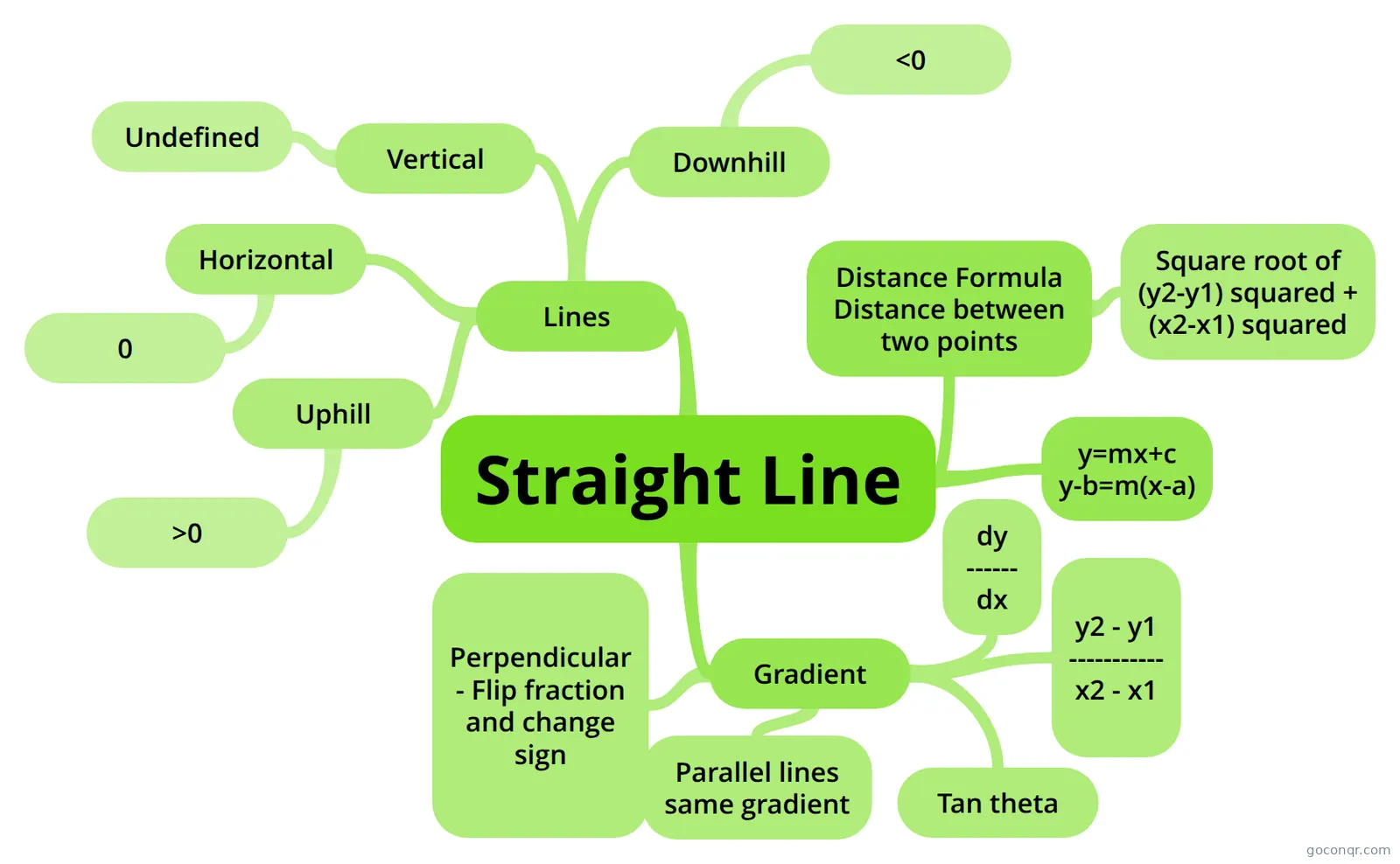 Straight Line
-
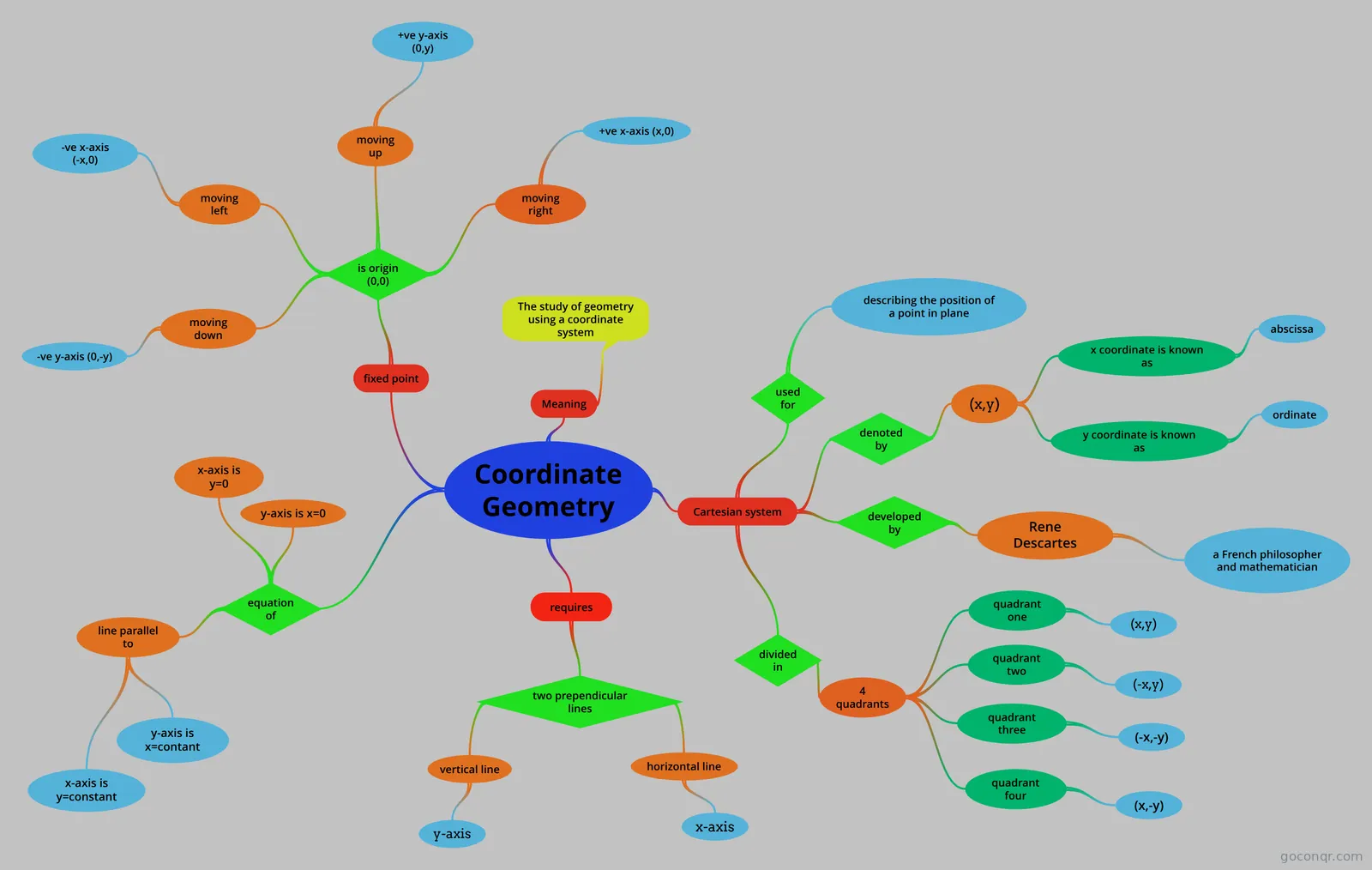 Coordinate Geometry mind map of Anirban Giri class-9 sec-D roll.no.-02
Flashcards
See all 14 flashcards-
18 cardsConnecting Algebra and Geometry through Coordinates - Equation of a Circle - Using Coordinates to Prove Geometric Theorems - Slope Criteria for Parallel and Pe...
-
5 cardsStraight-Line Graphs Vertical and Horizontal lines: 'x=a' and 'y=a' x=a is a vertical line through 'a' on the x-axis y=a is a ho...
-
10 cardsFormulae
-
16 cardsCircles What is the general equation for a circle?
-
9 cardsSymmetry with Polar Graphs Functions of cosθ will be symmetrical about....
-
11 cardsPolar form and Cartesian form What is the notation for a polar coordinate?
-
11 cardsCoordinate Geometry Basics Gradient = ...
-
13 cardsCO-ORDINATE GEOMETRY Junior Certificate Maths
Notes
-
Unit Three-Geometric Properties Unit Three Key Concepts -the medians of a triangle meet at a single point, the centroid. - each median bisects the area of the triangle. - the median from the vertex between the equal sides of an isosceles triangle is...
-
graphs Finding the gradient of a straight-line graph It is often useful or necessary to find out what the gradient of a graph is. For a straight-line graph, pick two points on the graph. The gradient of the line = (change in...
-
Coordinate Geometry in the (x,y) plane t is a label not a point on the graph. A Cartestian Equation is an equation made of x and y onlyA Parametric Equation is an equation with x, y and tSo you can always find t and its cooresponding (x,y) values t is diff...
-
Unit Two- Analytic Geometry Unit Two Key Concepts - you can use the distance formula to find the length of a line segment (d=√[(x1-x2)²+(y1-y2)²) -the midpoint of a line segment can be found by adding half of the run and half of the rise t...
-
Advanced Math
-
Maths- PC1- co-ordinate geometry Perpendicular/ normal gradient=M1xM2=-1 y-y1=M(x-x1) y2-Y1--------X2-X1
Slides
More Mathematics topics
About Coordinate Geometry
GoConqr OriginalWhat the page covers
This unit sits in the Functions and Graphs strand of Mathematics. Most of what is listed is about the basics of the (x,y) plane: plotting points, finding a midpoint, measuring distance and working out a gradient. From there it moves on to the equations of straight lines, parallel and perpendicular lines, and circles. A smaller group looks at parabolas, ellipses and polar graphs.
Where to start
Begin with a mind map to see the whole topic on one screen. The COORDINATE GEOMETRY map opens with everyday questions about locating a position, while the AQA Core 1 Maths map lists the key formulas: gradient, y = mx+c, y-y1 = m(x-x1), the perpendicular rule m1 * m2 = -1, the midpoint and the distance.
- Read one map from top to bottom.
- Move to the Formulae flashcards to learn each rule.
- Use Straight-Line Graphs for vertical and horizontal lines and lines through the origin.
Testing yourself
Quizzes turn the formulas into practice. The first quiz on the page asks you to find the midpoint of AB for A(2,12) and B(8,4). The MPM 2D Review Quiz mixes equivalent equations, midpoints and segment lengths. After each attempt, return to the map and look for the branch that caught you out.
- Study a map or a flashcard deck.
- Take a quiz without looking.
- Check the branch behind every wrong answer.
- Try again a day later.
Going further
Once lines feel comfortable, the deck Connecting Algebra and Geometry through Coordinates moves to circles centred at the origin, and Circle Exam Questions gives you slides to work through. Teachers can pick maps, notes and quizzes to set as revision tasks. Choose one resource that matches where you are and see how far it takes you.
Frequently asked questions
Which resource should I open first?
Start with the mind map called COORDINATE GEOMETRY. It begins with simple questions about position, then builds up to distance, area of polygons, the section formula and slope. When you have the outline, try the quiz on midpoints at the top of the page to test it.
What do the mind maps cover?
The maps run from the Cartesian coordinate system to distance and midpoint formulas, straight lines, and circles. The AQA Core 1 Maths map lists gradient, y = mx+c, point-slope form and the perpendicular rule. Others focus on conics and further coordinate geometry.
Are the resources free to use?
Yes. Every resource listed here is free to open, study and take, with no account needed. They were made by GoConqr users, not by GoConqr. A free account also saves your quiz scores and lets you make your own quizzes, mind maps, flashcards and notes.
Which levels and exams do they suit?
Nearly all of the resources are at secondary level, so they suit school students. Several mention GCSE Maths, A-level Maths or A-level Mathematics. Teachers can use them as ready-made revision material for classes working on lines, circles and the coordinate plane.
Which flashcards help with formulas?
The Formulae deck holds the line equations, the distance and midpoint formulas, the gradient and area expressions. Straight-Line Graphs covers vertical and horizontal lines and lines through the origin. The Core 1 Maths and OCR A-Level Maths C1 Flashcards decks are also listed.
What if I cannot find my exact topic?
Look at the related titles: some maps are named Straight Line, Circles or Conics, and others cover polar graphs or parametrics. If nothing fits, you can make your own map or flashcards on the point you need.