
Infections of the Nervous System
13 resources created by 13 users
This Infections of the Nervous System page on GoConqr gathers community-made mind maps, flashcards, quizzes and a note, from meningitis and encephalitis to CSF interpretation and HIV-related brain disease. It's built for university students revising a topic or filling gaps, and for teachers after ready-made material. There are more than 80 resources here, including more than 60 mind maps, more than 10 flashcard decks and more than 5 quizzes. Pick a mind map to get your bearings, then test yourself with a quiz.
Top Infections of the Nervous System resources
-
Mind map Meningitis
-
Mind map Meningitis
-
Mind map A child with a stiff neck
-
Mind map A child with a stiff neck
-
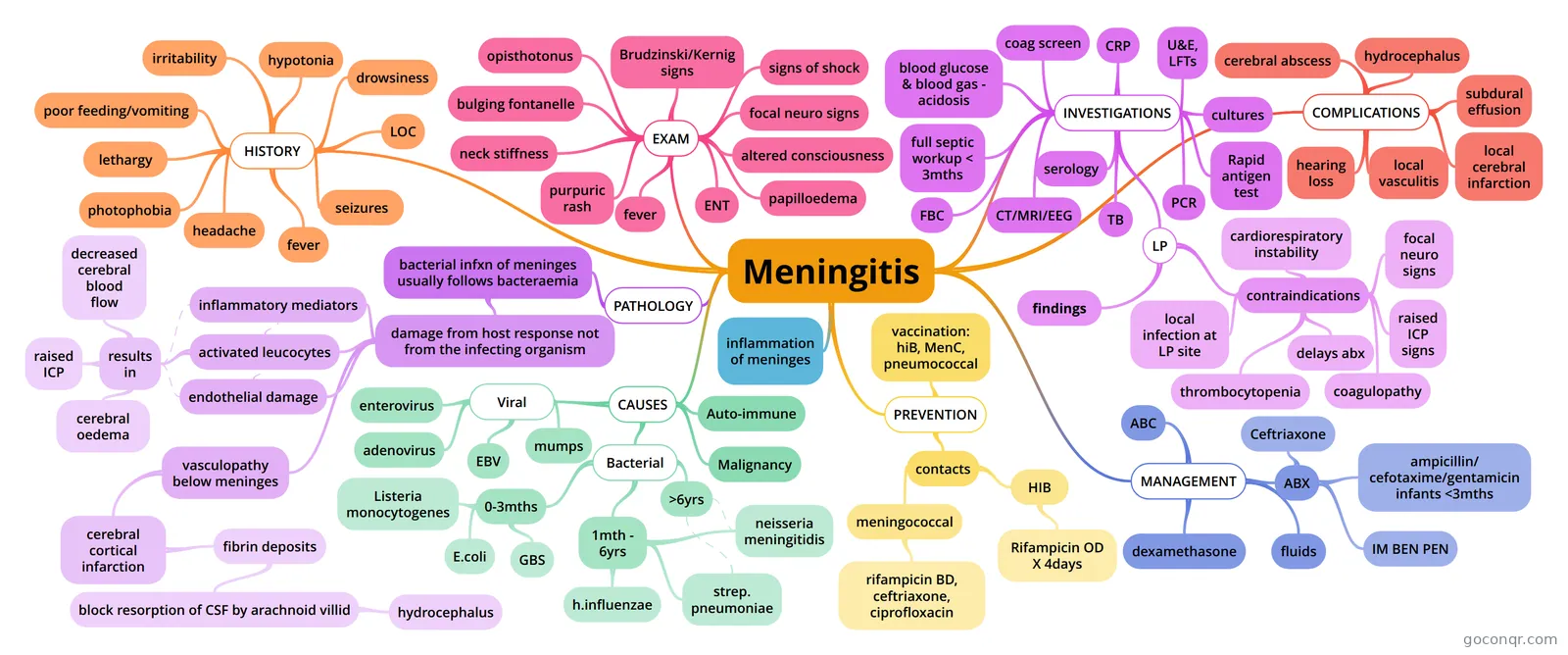 Mind map Meningitis
-
Mind map Th01L02 Meningitis Treatment, symptoms and public health importance of meningitis
-
20 questionsMeningitis and encephalitis which of these is not a viral cause of meningitis?
-
Mind map Meningitis
Quizzes
Mind maps
See all 11 mind mapsNotes
More Internal medicine, pathology and clinical semiology topics
About Infections of the Nervous System
GoConqr OriginalWhat this unit covers
Most of the page is about meningitis, seen from several angles. The mind maps on the anatomy of the scalp, meninges and the blood-brain barrier set the scene: the meningeal layers, dural folds and the role of CSF. Others move on to causes, presentation and treatment.
Beyond meningitis, you will find a mind map on Encephalitis, one on bacterial meningitis and cerebritis, and material on chronic cerebral infection. There are also resources on HIV-related problems, such as the flashcards CNS INF IN HIV and the mind map HIV-dementia.
Where to start
- Open a Meningitis mind map that covers the meninges, the BBB and CSF. It gives you the structure that everything else hangs on.
- Move to Acute Pyogenic Meningitis, which sets out the common capsulated bacterial agents.
- Try the paediatric maps, such as A child with a stiff neck and the one on the epidemiology and pathogenesis of bacterial meningitis in childhood.
- Look at CSF Interpretation and the flashcards CSF changes in meningitis to practise reading results.
Using maps, flashcards and quizzes together
Read a map first, then cover it and recall the branches from memory. The flashcard deck Central Nervous System Infections asks about routes of infection and the difference between meningitis, meningoencephalitis and meningomyelitis, which makes it a good check on the vocabulary.
Then take a quiz. Treatment & Diagnosis, Meningitis and encephalitis and Meningococcal let you test what stuck. Go back to the maps for anything you got wrong. Teachers can use the same sequence to set a short revision task.
Where it fits
This unit sits in the Neurology strand of Internal medicine, pathology and clinical semiology. It pairs naturally with your other neurology topics, as the anatomy and CSF material is shared across them.
Choose one map today, work through it, then see how many of the quiz questions you can answer without looking back.
Frequently asked questions
Which resource should I open first?
Start with one of the Meningitis mind maps that cover the meninges, the blood-brain barrier and CSF. They give you the anatomy and fluid basics. After that, Acute Pyogenic Meningitis covers the common bacterial causes, and the stiff neck maps bring in the paediatric view.
What do the mind maps cover?
Most deal with meningitis: anatomy, CSF, causes, clinical presentation, diagnosis and treatment. Some focus on children, such as the maps titled A child with a stiff neck. Others cover encephalitis, cerebritis, chronic cerebral infection, CSF interpretation and HIV-dementia.
Are there quizzes on this page?
Yes, more than 5. They include Treatment & Diagnosis, Meningitis and encephalitis, and Meningococcal, plus a video quiz and a supplement on CNS infections that is marked unfinished. Use them after reading a map, to see which parts you still need to review.
Are the resources free, and who made them?
Every resource listed here is free to open, study and take, with no account needed. They were made by GoConqr users, not by GoConqr itself. A free account also saves your quiz scores and lets you make your own quizzes, mind maps, flashcards and notes.
Who are these resources for?
They are aimed mainly at university students who want to revise a topic or fill gaps, with a small share of more professional material. Teachers can also use them as ready-made material for classes or revision sessions.
What if I can't find the topic I need?
Check the related topics in the same subject first, as some themes may sit under a different title. If something is still missing, you can build your own mind map, flashcard deck or note on the topic and keep it for revision.