
Prehistory
1,116 resources created by 935 users
This Prehistory page on GoConqr gathers community-made mind maps, quizzes, flashcards and notes, from early humans and the Stone Age to the Metal Age and the Agricultural Revolution. It's built for school students revising a topic, and for teachers after ready-made material, with a few resources pitched at primary pupils. There are over 1,000 resources here, including more than 30 quizzes and over 700 mind maps, mostly at secondary level. Pick a mind map to get your bearings, then test yourself with a quiz.
Top Prehistory resources
-
20 questionsPrehistory (Uni5 5 4EP Anaya Social Science) Build the timeline of Spanish history
-
 Mind map Life of Early Man Palaeolithic age, Mesolithic age, Neolithic age, stone age, archeologist, excavation, Chalcolithic period
-
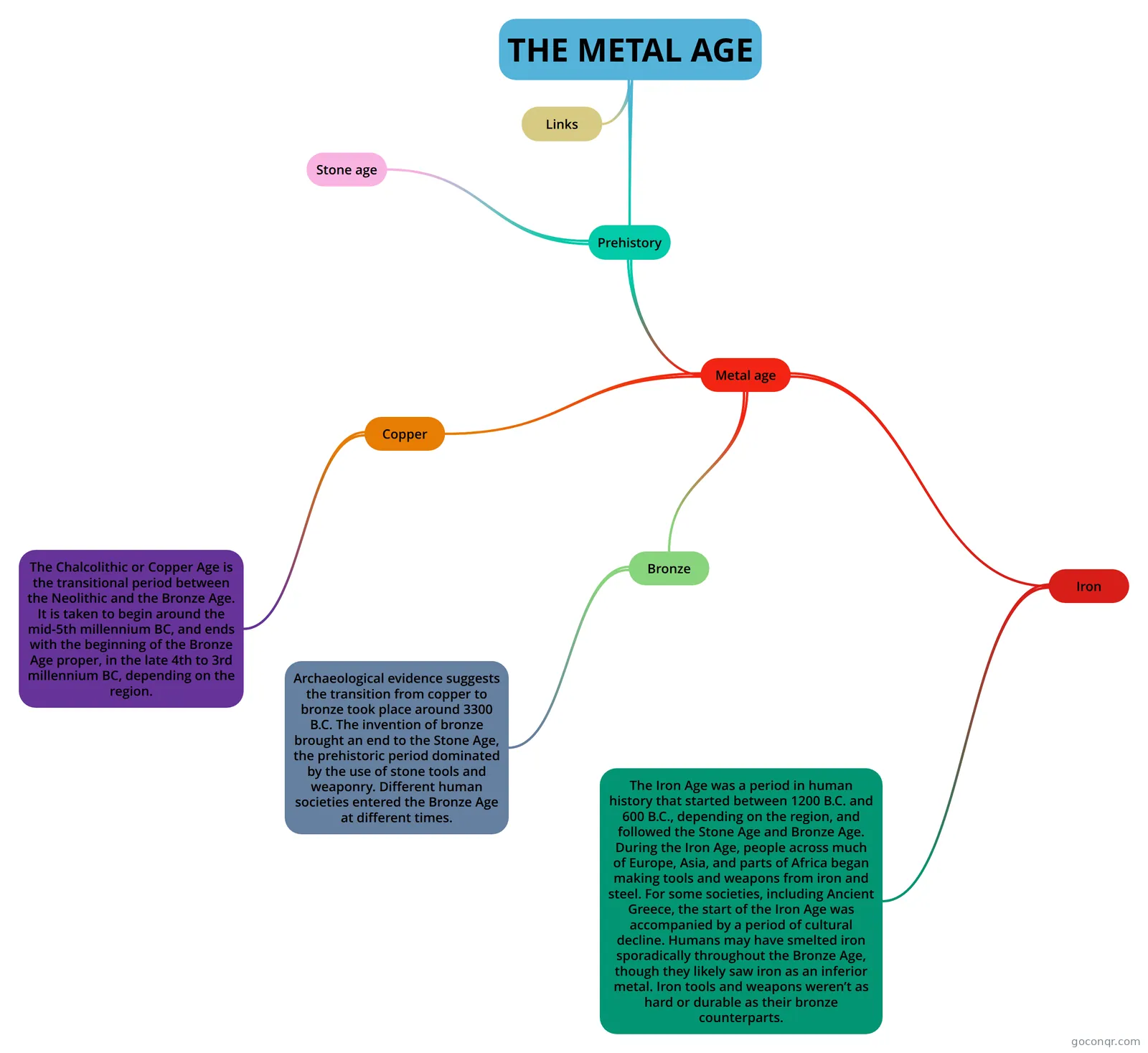 Mind map THE METAL AGE Formative 2
-
Mind map Agricultural Revolution
-
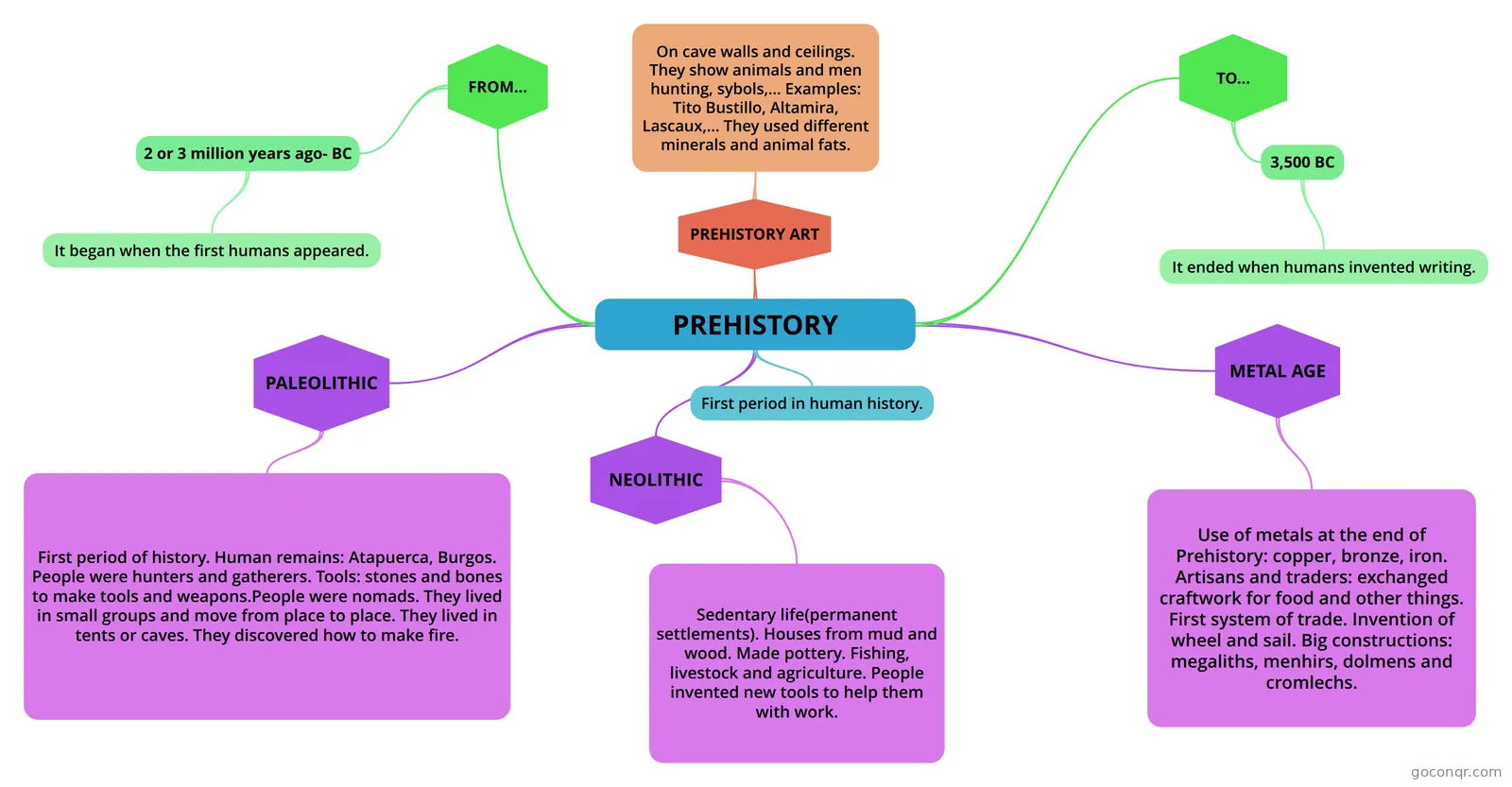 Mind map PREHISTORY Periods and main characteristics.
-
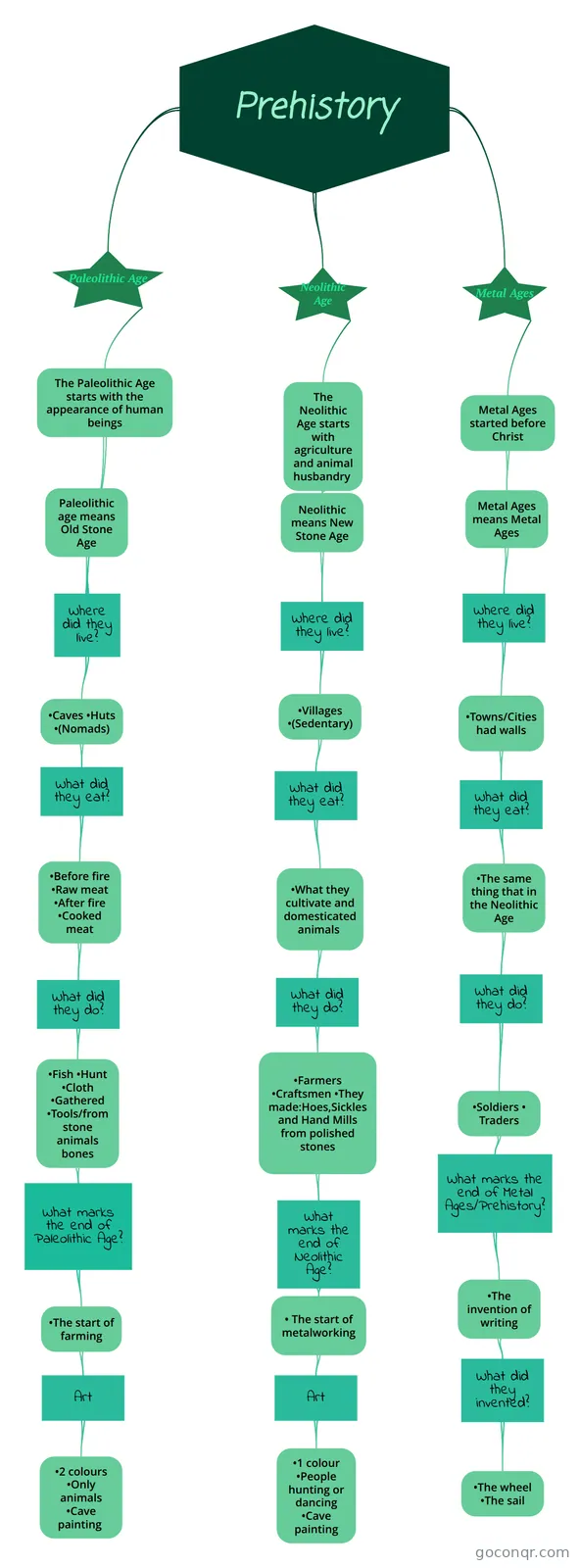 Mind map Prehistory Where did they live? They lived in caves or huts
-
Mind map The Celts in Britain
-
Mind map Early Humans Everything is off the slides
Quizzes
See all 51 quizzes-
20 questionsPrehistory (Uni5 5 4EP Anaya Social Science) Build the timeline of Spanish history
-
100 questionsNeolithic and Paleolithic Ages
-
100 questionsNeolithic and Paleolithic Ages_1
-
7 questionsKey Concept 1.2 The Neolithic Revolution and Early Agricultural Societies Intro: Paleolithic man made one of the most important discoveries that humans have ever made: that every [b...
-
40 questionsHIS118 Test #1 (Chapters 1-4)
-
69 questionsThe Prehistory The term 'Neolithic' means...
-
54 questionsUnit 2 - Revising the Neolithic and the Age of Metals The term 'Neolithic' means...
-
20 questionsUnit 1 Quizzes
Mind maps
See all 836 mind maps-
Life of Early Man Palaeolithic age, Mesolithic age, Neolithic age, stone age, archeologist, excavation, Chalcolithic period
-
THE METAL AGE Formative 2
-
Agricultural Revolution
-
PREHISTORY Periods and main characteristics.
-
Prehistory Where did they live? They lived in caves or huts
-
The Celts in Britain
-
Early Humans Everything is off the slides
-
Prehistory
Flashcards
See all 171 flashcards-
22 cardsPrehistory Paleolithic hominids lived in...
-
3 cardsWorld History Exam Review Characteristics of life in the Paleolithic Age (Old Stone Age)
-
76 cardsPrehistory Exam Images
-
32 cardsMigration and Agriculture Out of Africa Theory
-
29 cardsAgricultural Revolution Flashcards What is agriculture?
-
26 cardsCh. 1 Voc words to Ch. 1
-
28 cardsHistory Where did the mesolithic people usually settle ?
-
28 cardsUntitled
Flowcharts
See all 11 flowchartsNotes
See all 40 notes-
Chapter 1 Outline: Before History For thousands of years, humans lived in tiny communities without a permanent home. Most societies consisted of a few dozen people. They traveled in pursuit of game and edible plants. Humans were set apart from other a...
-
PREHISTORY NOTES Overview Scholars define prehistory as events that occurred before the existence of written records in a given culture or society. History refers to the time period after the invention of written record...
-
Notes - Early Man Did early man live at the same time as dinosaurs? No. Dinosaurs died about 65 million years ago. First human like primates called hominids appeared only 3.6 million years ago. Dinosaurs were dead long before this. Wha...
-
JCH3 Notes Video Link: The Celts https://youtu.be/28soKCP03yE THE REMAINS OF NEOLITHIC IRELAND Neolithic means “New Stone Age”. The first settlers arrived from Scotland about 6.000 B.C. They were Hunter-Gatherers and u...
-
STONEHENGE For centuries, historians and archaeologists have puzzled over the many mysteries of Stonehenge, the prehistoric monument that took Neolithic builders an estimated 1,500 years to erect. Located in southern England, it...
-
Western Civ Essay Questions Question 1: 1. Explain how “culture” is a defining trait of human beings and how it contributes to our multi-characteristic definition of civilization.Culture-The ways of living built up by a group and passed on from ...
-
Prehistory PALAEOLITHIC PERIOD 4.4 million years ago to 10000 BCE. Predators, fishing, hunting and collecting fruit. Nomads, travel looking for food.
-
How We Do History Three Age System Archaeology and Physical AnthropologyStone Age: 2.5 mya - 4,000 BCEBronze Age: 4,000 BCE - 1300 BCEIron Age: 1300 BCE - 400 CEWhat is common in evidence for each?What assumption is about it?Probl...
Slides
Topics in Prehistory
More History topics
About Prehistory
GoConqr OriginalWhat the resources cover
The page follows prehistory from the first humans to the Metal Age. The mind map Early Humans looks at Homo Habilis and Homo Erectus. Life of Early Man splits the Stone Age into the Palaeolithic, Mesolithic and Neolithic. THE METAL AGE covers Copper, Bronze and Iron, including the Chalcolithic as a transition from the Neolithic.
There are also regional maps. The Mesolithic Period describes early arrivals in Ireland by dugout canoe, while The Celts in Britain looks at the Iron Age and ironworking. Maps on Stonehenge and the Agricultural Revolution add further detail.
Where to start
Begin with the mind map PREHISTORY. It explains that prehistory began with the first humans and ended when writing was invented. Next, open Life of Early Man for the three stone ages. Then move on to THE METAL AGE.
- Read an overview map first.
- Choose one period and open its map.
- Try a quiz on that period.
- Use flashcards for vocabulary.
Using quizzes and maps together
Read a map, then close it and take a quiz such as Neolithic and Paleolithic Ages or Early Settlers in Ireland. Note the questions you missed and go back to the matching branch of the map. The quiz Key Concept 1.2 The Neolithic Revolution and Early Agricultural Societies suits learners on AP World History, and the flashcard decks on prehistory vocabulary help with key terms. Teachers can pick notes, slide sets and quizzes to set as classwork. GCSE History and Junior Certificate students will also find relevant material.
Where it fits
This unit sits in the strand Foundations and the Ancient World, within History. It gives the starting point before written records begin.
Choose a map, take a quiz and see which topics need another look.
Frequently asked questions
Which resource should I open first?
Start with the mind map PREHISTORY. It gives a short overview: prehistory began when the first humans appeared and ended when humans invented writing. After that, open Life of Early Man to see the Palaeolithic, Mesolithic and Neolithic ages side by side.
What do the mind maps cover?
They cover early humans such as Homo Habilis and Homo Erectus, the three Stone Age periods, the Metal Age, Stonehenge and the Agricultural Revolution. Some also look at Ireland and Britain, including the Mesolithic Period and the Celts in Britain.
Are the resources free to use?
Yes. Every resource listed here is free to open, study and take, with no account needed. They were made by GoConqr users, not by GoConqr itself, so styles and depth vary. Try a few and keep the ones that suit how you revise.
Which levels and exams do they suit?
Most resources are at secondary level, so they suit school students. Some listed items mention GCSE History, Junior Certificate and AP World History. A few resources are simpler, and teachers can browse the notes, quizzes and slide sets for classroom material.
What if I can't find the topic I need?
Try a nearby term, such as Neolithic, Bronze Age or hominids, since titles differ between creators. If nothing fits, a free account lets you save your quiz scores and make your own mind maps, flashcards, quizzes and notes.
Are there flashcards for vocabulary?
Yes. There are over 100 flashcard decks, many of them chapter vocabulary sets on prehistory. Others cover hominids, the Neolithic Age and the Agricultural Revolution. They work well after you read a mind map, helping you learn key terms.