
Mind map
Restless Earth
Map content
Restless Earth
Earth Structure and Plates
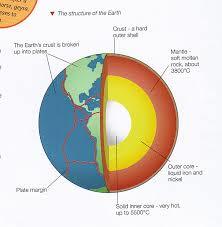
- Earth's Structure
- Plate margins
- Crust
- Mantle
- Outer Core
- Solid Inner Core
- Plates Margins
- Constructive Plate Margins
- This is where new land is being made through two plates are moving apart/separating from each other. This allows the magma from the mantle to rise up to the crust and the magma cools and solidifies making new land. This is happening under the Atlantic Ocean.
- Destructive Plate Margins
- This is where an oceanic plate collides with the continental plate margin and the more dense oceanic plate sinks below the less dense continental plate upon collision (Subduction zone).
- This is how earthquakes are formed and ocean trenches and volcanoes are found on these boundaries.
- Continental Plate
- This is the plate which make up the land/continents which we stand on. This plate is less dense but thicker than the oceanic plate.
- Oceanic Plate
- This plate is the plate which lies under oceans. It is more dense but thinner than the continental plate.
- Conservative Plate Margins
- This is where two plates are moving alongside or past each other. This causes friction between the plates which in turn causes earthquakes which can be very destructive but rare.
- Constructive Plate Margins
- Earth's Structure
Fold Mountains
- Fold mountains are a series of mountains which are formed when two tectonic plates are moving against each other and the high pressure pushes the plates upwards and this is how the fold mountains are formed.
- Ocean Trenches
- These are found at destructive plate margins. For example as the Nazca plate sinks below the South American plate, it creates a deep-sea trench.
- Mountain Ranges
- Himalayas
- Alps
- The Alps were formed around 30 million years ago by the collision between the African and European plates.
- Around 12 million live at the Alps and it's tallest peak is Mont Blanc and is found at the Italian-French border.
- Uses For The Alps
- Farming
- 1) The steep upland areas are used to farm goats which in turn produce milk, cheese and meat. 2) Sunnier slopes have been terraced to plant vineyards.
- Tourism
- 1) 100 million tourists visit the Alps every year, which is a huge contribution to their economy. 2) 70% of the tourists visit at winter for winter sports.
- 3) New villages have been built to cater for high quantities of tourists. 4) Ski runs, ski lifts, cable cars, holiday chalets and restaurants are scattered around the landscape .
- Mining
- Salt, iron, gold, silver and copper were all mined in the Alps but mining has dramatically declined due to other cheaper foreign sources.
- Forestry
- Scots Pine is planted across the Alps because it is more resilient to the munching goats, which kill native tree saplings. The trees are logged and sold to produce things like furniture.
- Hydro-Electric Power
- 1) The narrow valleys are damned to generate HEP, e.g. Switzerland acquires 60% of its power from HEP stations in the Alps.
- 2) The electricity produced is used to power local homes and businesses and some is also exported to towns and cities further away.
- Farming
- Central Europe
- The Alps stretches across Austria, France, Germany, Italy, Liechtenstein, Slovenia and Switzerland.
- Adaptations
- Steep Relief
- Goats are farmed there because they're well adapted to live on steep mountains. Trees and man made defences are used to protect against avalanches and rock slides.
- Poor Soils
- Animals are grazed in most high areas as the area is not good for growing crops.
- Limited Communications
- New roads have been built and to cross the mountains can take long as some roads can sometimes be blocked by snow so tunnels have been made straight through.
- Steep Relief
- Andes
- Uses
- Farming
- Mountain slopes are too steep so they're used to graze animals.
- Lower slopes are used for crops, steep slopes are sometimes used to terrace crops (faster growth)
- Mining
- Mining is very popular at fold mountains as there are generally a huge source of ores.
- It is difficult to access mines at the steep slopes, zig-zag roads have been carved up to combat this.
- Forestry
- Fold mountains are a good environment for a particular type of trees, conifers. They're grown on steep sides of slopes
- The wood from this tree is useful for things such as fuel, building material, paper and furniture.
- Tourism
- Great scenery attracts tourists at winter. Sports like snowboarding and skiing are played.
- In summer, people visit to walk. Tunnels are drilled to make straight roads, improves communication and access to area for both locals and tourists.
- Hydro-Electric Power
- Steep sided mountains and high lakes makes it ideal for generating hydro-electric power.
- Farming
Volcanoes
- Types Of Volcanoes
- Composite Volcanoes
- Made up of lava and ash which had erupted, cooled and hardened into thick layers.
- The lava is usually think and flows slowly. It hardens quickly to form a steep-sided volcano.
- Montserrat
- Shield Volcanoes
- Made up of only lava, the lava is runny and flows quickly so it spreads over a wide area before solidifying which in turn forms a low, flat volcano.
- Dome Volcanoes
- Made up of lava only. The lava is thick and flows slowly. It hardens quickly forming a steep-sided volcano.
- Supervolcanoes
- Composite Volcanoes
- Types Of Volcanoes
Tsunamis
Images and files in the map
Information
- Description
- Mind Map on Restless Earth, created by Nima Nouri on 07/05/2015.
- Created by
- Nima Nouri
- Views
- 0
- Rating