
Mind map
aggression
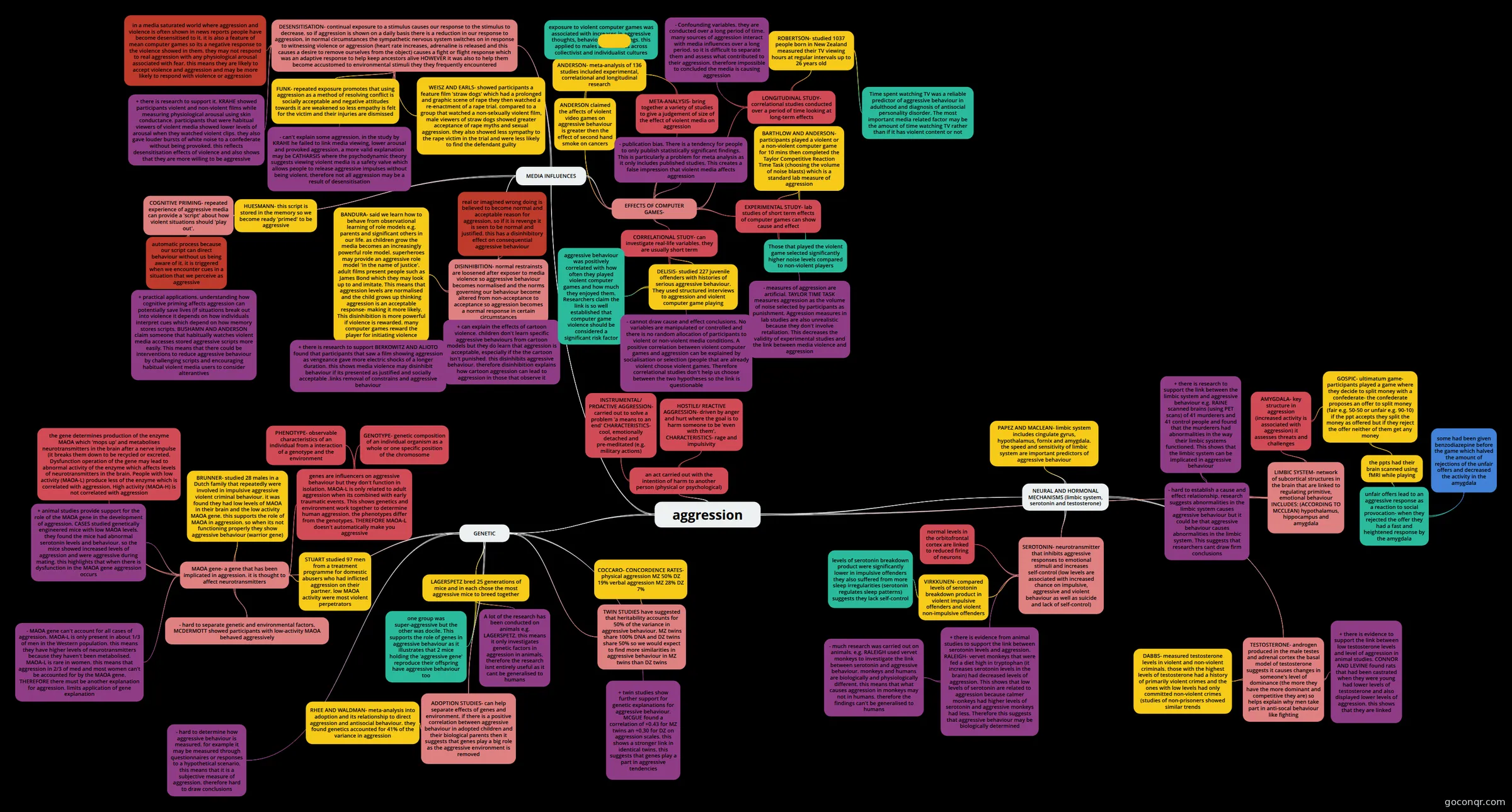
Mind map: aggression
Map content
aggression
an act carried out with the intention of harm to another person (physical or psychological)
- HOSTILE/ REACTIVE AGGRESSION- driven by anger and hurt where the goal is to harm someone to be 'even with them'. CHARACTERISTICS- rage and impulsivity
- INSTRUMENTAL/ PROACTIVE AGGRESSION- carried out to solve a problem 'a means to an end' CHARACTERISTICS- cool, emotionally detached and pre-meditated (e.g. military actions)
LIMBIC SYSTEM- network of subcortical structures in the brain that are linked to regulating primitive, emotional behaviour INCLUDES: (ACCORDING TO MCCLEAN) hypothalamus, hippocampus and amygdala
- AMYGDALA- key structure in aggression (increased activity is associated with aggression) it assesses threats and challenges
- GOSPIC- ultimatum game- participants played a game where they decide to split money with a confederate- the confederate proposes an offer to split money (fair e.g. 50-50 or unfair e.g. 90-10) if the ppt accepts they split the money as offered but if they reject the offer neither of them get any money
- the ppts had their brain scanned using fMRI while playing
- unfair offers lead to an aggressive response as a reaction to social provocation- when they rejected the offer they had a fast and heightened response by the amygdala
- some had been given benzodiazepine before the game which halved the amount of rejections of the unfair offers and decreased the activity in the amygdala
- unfair offers lead to an aggressive response as a reaction to social provocation- when they rejected the offer they had a fast and heightened response by the amygdala
- the ppts had their brain scanned using fMRI while playing
- GOSPIC- ultimatum game- participants played a game where they decide to split money with a confederate- the confederate proposes an offer to split money (fair e.g. 50-50 or unfair e.g. 90-10) if the ppt accepts they split the money as offered but if they reject the offer neither of them get any money
- + there is research to support the link between the limbic system and aggressive behaviour e.g. RAINE scanned brains (using PET scans) of 41 murderers and 41 control people and found that the murderers had abnormalities in the way their limbic systems functioned. This shows that the limbic system can be implicated in aggressive behaviour
- - hard to establish a cause and effect relationship. research suggests abnormalities in the limbic system causes aggressive behaviour but it could be that aggressive behaviour causes abnormalities in the limbic system. This suggests that researchers cant draw firm conclusions
- AMYGDALA- key structure in aggression (increased activity is associated with aggression) it assesses threats and challenges
NEURAL AND HORMONAL MECHANISMS (limbic system, serotonin and testosterone)
- SEROTONIN- neurotransmitter that inhibits aggressive responses to emotional stimuli and increases self-control (low levels are associated with increased chance on impulsive, aggressive and violent behaviour as well as suicide and lack of self-control)
- VIRKKUNEN- compared levels of serotonin breakdown product in violent impulsive offenders and violent non-impulsive offenders
- levels of serotonin breakdown product were significantly lower in impulsive offenders they also suffered from more sleep irregularities (serotonin regulates sleep patterns) suggests they lack self-control
- normal levels in the orbitofrontal cortex are linked to reduced firing of neurons
- + there is evidence from animal studies to support the link between serotonin levels and aggression. RALEIGH- vervet monkeys that were fed a diet high in tryptophan (it increases serotonin levels in the brain) had decreased levels of aggression. This shows that low levels of serotonin are related to aggression because calmer monkeys had higher levels of serotonin and aggressive monkeys had less. Therefore this suggests that aggressive behaviour may be biologically determined
- - much research was carried out on animals. e.g. RALEIGH used vervet monkeys to investigate the link between serotonin and aggressive behaviour. monkeys and humans are biologically and physiologically different. this means that what causes aggression in monkeys may not in humans. therefore the findings can't be generalised to humans
- VIRKKUNEN- compared levels of serotonin breakdown product in violent impulsive offenders and violent non-impulsive offenders
- TESTOSTERONE- androgen produced in the male testes and adrenal cortex the basal model of testosterone suggests it causes changes in someone's level of dominance (the more they have the more dominant and competitive they are) so helps explain why men take part in anti-socal behaviour like fighting
- DABBS- measured testosterone levels in violent and non-violent criminals. those with the highest levels of testosterone had a history of primarily violent crimes and the ones with low levels had only committed non-violent crimes (studies of non-prisoners showed similar trends
- + there is evidence to support the link between low testosterone levels and level of aggression in animal studies. CONNOR AND LEVINE found rats that had been castrated when they were young had lower levels of testosterone and also displayed lower levels of aggression. this shows that they are linked
- PAPEZ AND MACLEAN- limbic system includes cingulate gyrus, hypothalamus, fornix and amygdala. the speed and sensitivity of limbic system are important predictors of aggressive behaviour
- SEROTONIN- neurotransmitter that inhibits aggressive responses to emotional stimuli and increases self-control (low levels are associated with increased chance on impulsive, aggressive and violent behaviour as well as suicide and lack of self-control)
GENETIC
- TWIN STUDIES have suggested that heritability accounts for 50% of the variance in aggressive behaviour. MZ twins share 100% DNA and DZ twins share 50% so we would expect to find more similarities in aggressive behaviour in MZ twins than DZ twins
- COCCARO- CONCORDENCE RATES- physical aggression MZ 50% DZ 19% verbal aggression MZ 28% DZ 7%
- ADOPTION STUDIES- can help separate effects of genes and environment. if there is a positive correlation between aggressive behaviour in adopted children and their biological parents then it suggests that genes play a big role as the aggressive environment is removed
- RHEE AND WALDMAN- meta-analysis into adoption and its relationship to direct aggression and antisocial behaviour. they found genetics accounted for 41% of the variance in aggression
- LAGERSPETZ bred 25 generations of mice and in each chose the most aggressive mice to breed together
- one group was super-aggressive but the other was docile. This supports the role of genes in aggressive behaviour as it illustrates that 2 mice holding the 'aggressive gene' reproduce their offspring have aggressive behaviour too
- A lot of the research has been conducted on animals e.g. LAGERSPETZ. this means it only investigates genetic factors in aggression in animals. therefore the research isnt entirely useful as it cant be generalised to humans
- + twin studies show further support for genetic explanations for aggressive behaviour. MCGUE found a correlation of +0.43 for MZ twins an +0.30 for DZ on aggression scales. this shows a stronger link in identical twins. this suggests that genes play a part in aggressive tendencies
- - hard to determine how aggressive behaviour is measured. for example it may be measured through questionnaires or responses to a hypothetical scenario. this means that it is a subjective measure of aggression. therefore hard to draw conclusions
- MAOA gene- a gene that has been implicated in aggression. it is thought to affect neurotransmitters
- the gene determines production of the enzyme MAOA which 'mops up' and metabolises neurotransmitters in the brain after a nerve impulse (it breaks them down to be recycled or excreted. Dysfunction operation of the gene may lead to abnormal activity of the enzyme which affects levels of neurotransmitters in the brain. People with low activity (MAOA-L) produce less of the enzyme which is correlated with aggression. High activity (MAOA-H) is not correlated with aggression
- BRUNNER- studied 28 males in a Dutch family that repeatedly were involved in impulsive aggressive violent criminal behaviour. it was found they had low levels of MAOA in their brain and the low activity MAOA gene. this supports the role of MAOA in aggression. so when its not functioning properly they show aggressive behaviour (warrior gene)
- genes are influencers on aggressive behaviour but they don't function in isolation. MAOA-L is only related to adult aggression when its combined with early traumatic events. This shows genetics and environment work together to determine human aggression. the phenotypes differ from the genotypes. THEREFORE MAOA-L doesn't automatically make you aggressive
- PHENOTYPE- observable characteristics of an individual from a interaction of a genotype and the environment
- GENOTYPE- genetic composition of an individual organism as a whole or one specific position of the chromosome
- + animal studies provide support for the role of the MAOA gene in the development of aggression. CASES studied genetically engineered mice with low MAOA levels. they found the mice had abnormal serotonin levels and behaviour. so the mice showed increased levels of aggression and were aggressive during mating. this highlights that when there is dysfunction in the MAOA gene aggression occurs
- - MAOA gene can't account for all cases of aggression. MAOA-L is only present in about 1/3 of men in the Western population. this means they have higher levels of neurotransmitters because they haven't been metabolised. MAOA-L is rare in women. this means that aggression in 2/3 of med and most women can't be accounted for by the MAOA gene. THEREFORE there must be another explanation for aggression. limits application of gene explanation
- STUART studied 97 men from a treatment programme for domestic abusers who had inflicted aggression on their partner. low MAOA activity were most violent perpetrators
- - hard to separate genetic and environmental factors. MCDERMOTT showed participants with low-activity MAOA behaved aggressively
- TWIN STUDIES have suggested that heritability accounts for 50% of the variance in aggressive behaviour. MZ twins share 100% DNA and DZ twins share 50% so we would expect to find more similarities in aggressive behaviour in MZ twins than DZ twins
MEDIA INFLUENCES
- DISINHIBITION- normal restrainsts are loosened after exposer to media violence so aggressive behaviour becomes normalised and the norms governing our behaviour become altered from non-acceptance to acceptance so aggression becomes a normal response in certain circumstances
- real or imagined wrong doing is believed to become normal and acceptable reason for aggression. so if it is revenge it is seen to be normal and justified. this has a disinhibitory effect on consequential aggressive behaviour
- BANDURA- said we learn how to behave from observational learning of role models e.g. parents and significant others in our life. as children grow the media becomes an increasingly powerful role model. superheroes may provide an aggressive role model 'in the name of justice'. adult films present people such as James Bond which they may look up to and imitate. This means that aggression levels are normalised and the child grows up thinking aggression is an acceptable response- making it more likely. This disinhibition is more powerful if violence is rewarded. many computer games reward the player for initiating violence
- + there is research to support BERKOWITZ AND ALIOTO found that participants that saw a film showing aggression as vengeance gave more electric shocks of a longer duration. this shows media violence may disinhibit behaviour if its presented as justified and socially acceptable .links removal of constrains and aggressive behaviour
- + can explain the effects of cartoon violence. children don't learn specific aggressive behaviours from cartoon models but they do learn that aggression is acceptable, especially if the the cartoon isn't punished. this disinhibits aggressive behaviour. therefore disinhibition explains how cartoon aggression can lead to aggression in those that observe it
- DESENSITISATION- continual exposure to a stimulus causes our response to the stimulus to decrease. so if aggression is shown on a daily basis there is a reduction in our response to aggression. in normal circumstances the sympathetic nervous system switches on in response to witnessing violence or aggression (heart rate increases, adrenaline is released and this causes a desire to remove ourselves from the object) causes a fight or flight response which was an adaptive response to help keep ancestors alive HOWEVER it was also to help them become accustomed to environmental stimuli they they frequently encountered
- in a media saturated world where aggression and violence is often shown in news reports people have become desensitised to it. it is also a feature of mean computer games so its a negative response to the violence showed in them. they may not respond to real aggression with any physiological arousal associated with fear. this means they are likely to accept violence and aggression and may be more likely to respond with violence or aggression
- FUNK- repeated exposure promotes that using aggression as a method of resolving conflict is socially acceptable and negative attitudes towards it are weakened so less empathy is felt for the victim and their injuries are dismissed
- WEISZ AND EARLS- showed participants a feature film 'straw dogs' which had a prolonged and graphic scene of rape they then watched a re-enactment of a rape trial. compared to a group that watched a non-selxually violent film, male viewers of straw dogs showed greater acceptance of rape myths and sexual aggression. they also showed less sympathy to the rape victim in the trial and were less likely to find the defendant guilty
- + there is research to support it. KRAHE showed participants violent and non-violent films while measuring physiological arousal using skin conductance. participants that were habitual viewers of violent media showed lower levels of arousal when they watched violent clips. they also gave louder bursts of white noise to a confederate without being provoked. this reflects desensitisation effects of violence and also shows that they are more willing to be aggressive
- - can't explain some aggression. in the study by KRAHE he failed to link media viewing, lower arousal and provoked aggression. a more valid explanation may be CATHARSIS where the psychodynamic theory suggests viewing violent media is a safety valve which allows people to release aggressive impulses without being violent. therefore not all aggression may be a result of desensitisation
- EFFECTS OF COMPUTER GAMES-
- EXPERIMENTAL STUDY- lab studies of short term effects of computer games can show cause and effect
- BARTHLOW AND ANDERSON- participants played a violent or a non-violent computer game for 10 mins then completed the Taylor Competitive Reaction Time Task (choosing the volume of noise blasts) which is a standard lab measure of aggression
- Those that played the violent game selected significantly higher noise levels compared to non-violent players
- - measures of aggression are artificial. TAYLOR TIME TASK measures aggression as the volume of noise selected by participants as punishment. Aggression measures in lab studies are also unrealistic because they don't involve retaliation. This decreases the validity of experimental studies and the link between media violence and aggression
- BARTHLOW AND ANDERSON- participants played a violent or a non-violent computer game for 10 mins then completed the Taylor Competitive Reaction Time Task (choosing the volume of noise blasts) which is a standard lab measure of aggression
- CORRELATIONAL STUDY- can investigate real-life variables. they are usually short term
- DELISIS- studied 227 juvenile offenders with histories of serious aggressive behaviour. They used structured interviews to aggression and violent computer game playing
- aggressive behaviour was positively correlated with how often they played violent computer games and how much they enjoyed them. Researchers claim the link is so well established that computer game violence should be considered a significant risk factor
- - cannot draw cause and effect conclusions. No variables are manipulated or controlled and there is no random allocation of participants to violent or non-violent media conditions. A positive correlation between violent computer games and aggression can be explained by socialisation or selection (people that are already violent choose violent games. Therefore correlational studies don't help us choose between the two hypotheses so the link is questionable
- DELISIS- studied 227 juvenile offenders with histories of serious aggressive behaviour. They used structured interviews to aggression and violent computer game playing
- LONGITUDINAL STUDY- correlational studies conducted over a period of time looking at long-term effects
- ROBERTSON- studied 1037 people born in New Zealand measured their TV viewing hours at regular intervals up to 26 years old
- Time spent watching TV was a reliable predictor of aggressive behaviour in adulthood and diagnosis of antisocial personality disorder. The most important media related factor may be the amount of time watching TV rather than if it has violent content or not
- - Confounding variables. they are conducted over a long period of time. many sources of aggression interact with media influences over a long period. so it is difficult to separate them and assess what contributed to their aggression. therefore impossible to concluded the media is causing aggression
- ROBERTSON- studied 1037 people born in New Zealand measured their TV viewing hours at regular intervals up to 26 years old
- META-ANALYSIS- bring together a variety of studies to give a judgement of size of the effect of violent media on aggression
- ANDERSON- meta-analysis of 136 studies included experimental, correlational and longitudinal research
- exposure to violent computer games was associated with increases in aggressive thoughts, behaviours and feelings. this applied to males and females across collectivist and individualist cultures
- ANDERSON- meta-analysis of 136 studies included experimental, correlational and longitudinal research
- ANDERSON claimed the affects of violent video games on aggressive behaviour is greater then the effect of second hand smoke on cancers
- - publication bias. There is a tendency for people to only publish statistically significant findings. This is particularly a problem for meta analysis as it only includes published studies. This creates a false impression that violent media affects aggression
- EXPERIMENTAL STUDY- lab studies of short term effects of computer games can show cause and effect
- COGNITIVE PRIMING- repeated experience of aggressive media can provide a 'script' about how violent situations should 'play out'.
- HUESMANN- this script is stored in the memory so we become ready 'primed' to be aggressive
- automatic process because our script can direct behaviour without us being aware of it. it is triggered when we encounter cues in a situation that we perceive as aggressive
- + practical applications. understanding how cognitive priming affects aggression can potentially save lives (if situations break out into violence it depends on how individuals interpret cues which depend on how memory stores scripts. BUSHAMN AND ANDERSON claim someone that habitually watches violent media accesses stored aggressive scripts more easily. This means that there could be interventions to reduce aggressive behaviour by challenging scripts and encouraging habitual violent media users to consider alterantives
- DISINHIBITION- normal restrainsts are loosened after exposer to media violence so aggressive behaviour becomes normalised and the norms governing our behaviour become altered from non-acceptance to acceptance so aggression becomes a normal response in certain circumstances
Information
- Description
- Mind Map on aggression, created by Tashie Wyton on 28/04/2022.
- Created by
- Tashie Wyton
- Views
- 0
- Rating