
Aromatic Chemistry
142 resources created by 108 users
This Aromatic Chemistry page on GoConqr gathers community-made mind maps, flashcards, quizzes and notes on benzene, from its structure and the Kekulé model to electrophilic substitution and directing groups. It's built for school students revising a topic, university students and professional candidates filling gaps, and teachers after ready-made material. There are over 140 resources here, including more than 9 quizzes and over 40 mind maps, pitched mostly at A-level with some university material. Pick a mind map, then test yourself with a quiz.
Top Aromatic Chemistry resources
-
109 cardsOrganic III Define enthalpy change of hydrogenation
-
Mind map Aromatic Compounds - Mindmap
-
9 questionsBenzene quiz Which option is incorrect about benzene?
-
Mind map benzene
-
 Mind map Reactions of Benzene and Methylbenzene All reactions required to learn for the 2017 A2 chemistry syllabus
-
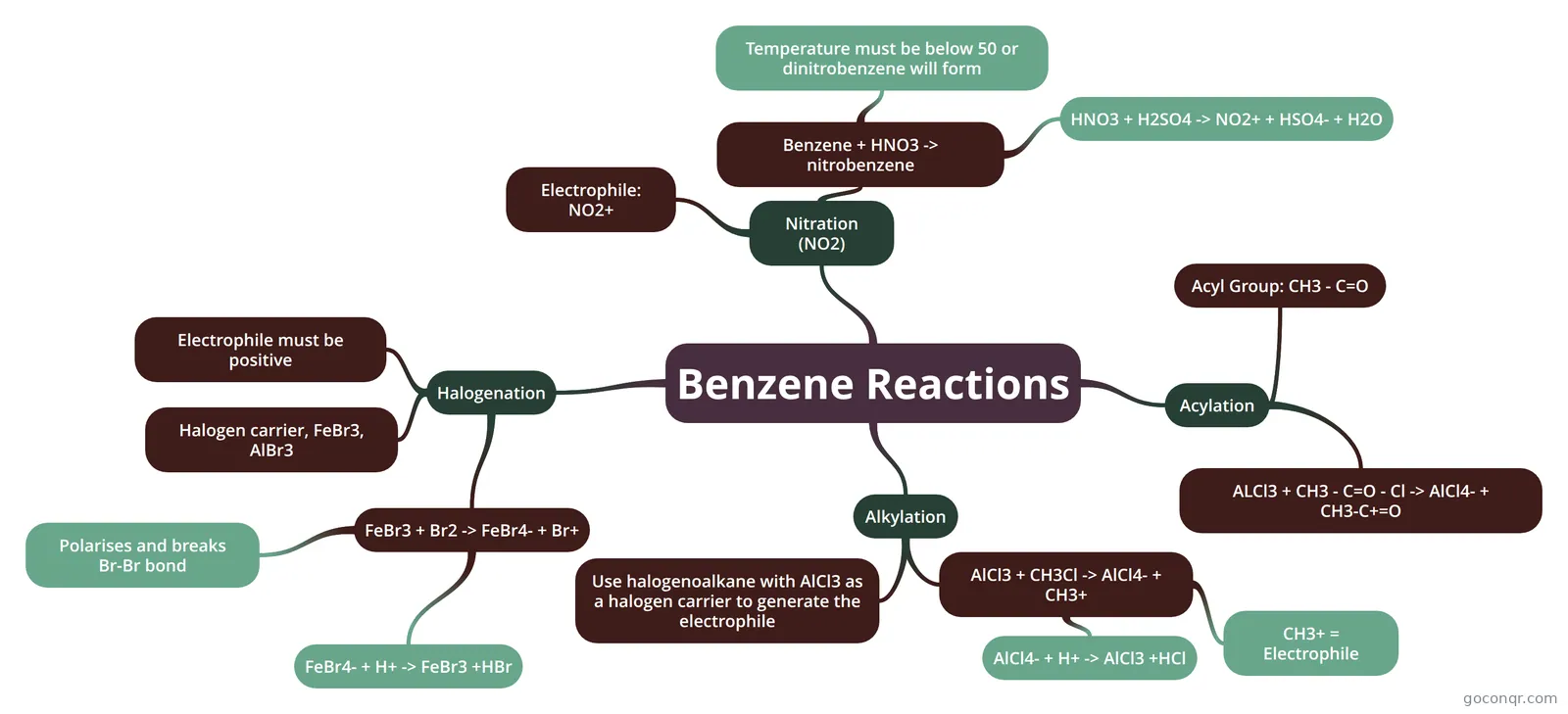 Mind map Benzene Reactions
-
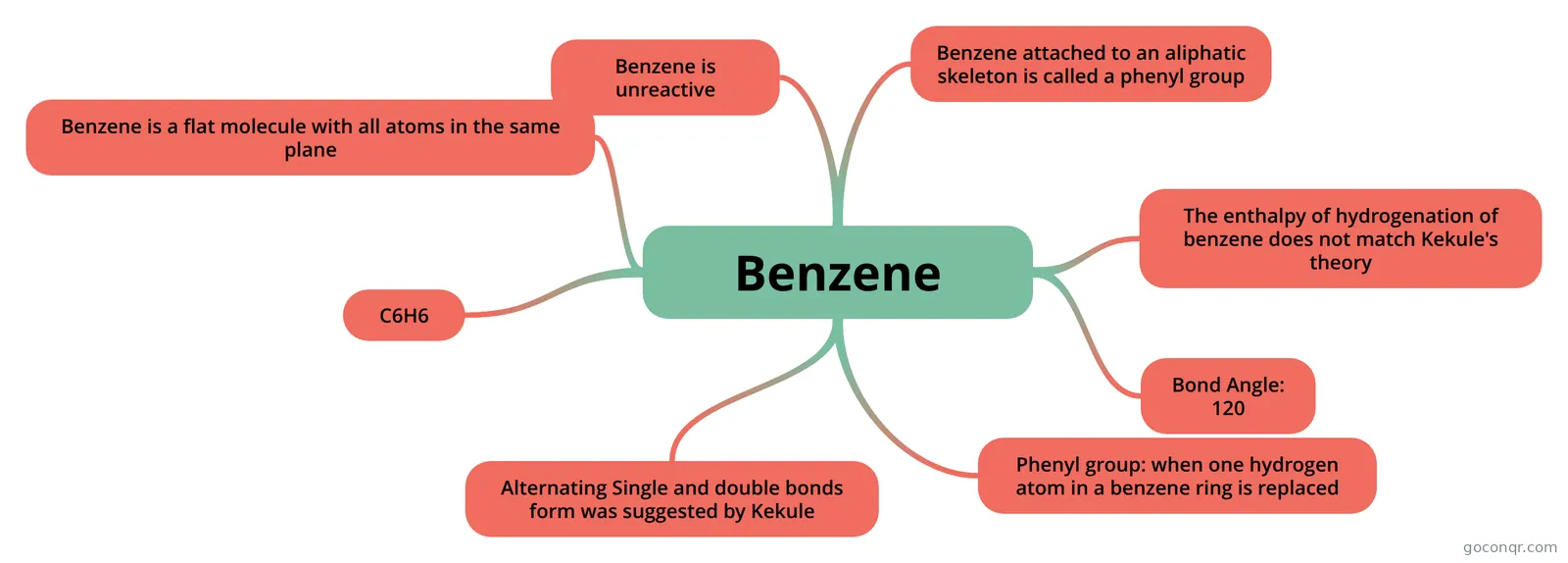 Mind map Benzene
-
44 cardsAromatic compounds Which two scientists came up with ideas about the structure of benzene? Whos was proved to be correct?
Quizzes
-
9 questionsBenzene quiz Which option is incorrect about benzene?
-
16 questionsReaction Conditions Quiz F324 What are the reaction conditions for the bromination (halogenation) of benzene?
-
15 questionsonly related to ring o,p,m primary Amine Group
-
7 questionsBenzene
-
5 questionsReactions of arenes What is the substitution of a NO2 group for one of the hydrogen atoms in an arene ring called?
-
3 questionsReactions of benzene Why can't benzene react with halogens on their own?
-
5 questionsCapitulo 14 Los activantes son directores orto-para
-
5 questionsLesson IV.12-13 Mini-Quiz: EAS on Substituted Benzene These problems are a self-assessment to follow reading the indicated lessons from the “Organic Chemistry 2 ...
Mind maps
See all 47 mind mapsFlashcards
See all 66 flashcards-
109 cardsOrganic III Define enthalpy change of hydrogenation
-
44 cardsAromatic compounds Which two scientists came up with ideas about the structure of benzene? Whos was proved to be correct?
-
85 cardsch 18 what is the major product for the nitration of toluene? draw it
-
56 cards25.2 Electrophilic Substitution reactions of benzene What type of reactions does benzene and its derivatives undergo?
-
24 cardschem 25 physical properties of benzene
-
19 cardsChapter 25 - Benzene What is benzene?
-
23 cards25.4 Directing groups Phenol can undergo an electrophilic substitution reaction with nitric acid to form what two isomers?
-
17 cardsCHEM 342 - Exam 2 - Ch. 16 Inductive effect, resonance effect, reactivity, and directing effect of:
Flowcharts
Notes
See all 14 notes-
Structure of benzene Structure of benzene Kekulé ModelConsists of a ring of carbon atoms containing alternating single and double bonds (3 double bonds and 3 single bonds). Delocalised ModelConsists of the sideways overlap of p-orbitals o...
-
Structure of Benzene
-
Electrophilic substitution of arenes Electrophilic substitution of arenesBecause the benzene ring is so stable is resists addition reactions because breaking the delocalisation would lose its stability.General mechanism of electrophilic substitutionA+ re...
-
Aromatic Compounds - BRIEF NOTES Benzene, naming and its structure LIQUID at room temperature and a key ingredient added to gasoline Molecular formula = C6H6 Natural constituent of crude oil Colourless + flammable liquid Has CARCINOGENIC PROPERTIES U...
-
F324: Module 1 Specification 4.1.1 Arenes Structure of benzene The development and acceptance of models for the structure of benzene. Candidates should be able to: (a) compare the Kekulé and delocalised models for benzene in terms of p-orbital ov...
-
Benzene Reactions Benzene Reactions Addition causes a loss of delocalisation. Substitution can occur as the electron density is spread over a larger area. There are two steps to substitution: 1. Addition, 2. Elimination. Addition: The ...
-
Benzene
-
Benzene Recap Benzene Benzene (C6H6) is an aromatic compound. It was discovered in 1825 by Michael Faraday who found it in an oily residue in street lighting. It is colourless Sweet smelling Highly flammable Component of...
Slides
Topics in Aromatic Chemistry
More Chemistry topics
About Aromatic Chemistry
GoConqr OriginalWhat the page covers
The resources here follow benzene from its structure through to its reactions. Many are mind maps and flashcard decks, with notes, slide sets, flowcharts and quizzes alongside them. Most are pitched at A-level Chemistry, and a smaller share is aimed at university courses.
Where to start
Begin with structure. The mind map benzene sets out the formula C6H6, the Kekulé structure and why benzene is unreactive: it did not react with bromine water and has no C=C bonds. The notes on the structure of benzene compare the Kekulé model with the delocalised model. The flashcard deck Organic III then tests the enthalpy change of hydrogenation, the key evidence against Kekulé's ring.
Moving on to reactions
- Open the mind map Benzene Reactions. It covers nitration, including the NO2+ electrophile made from HNO3 and H2SO4, and the need to keep the temperature below 50 so dinitrobenzene does not form.
- Read Reactions of Benzene and Methylbenzene for chlorination and bromination, which need a reflux and a halogen carrier.
- Use the notes on electrophilic substitution of arenes to see the general mechanism and why the stable ring resists addition.
- Finish with the decks on directing groups and the flowchart on the directing groups of phenol.
Using quizzes and maps together
Read a map first, then take the Benzene quiz. It checks points such as halogen carriers like AlCl3 and FeBr3. If a question catches you out, go back to the matching branch of the map and read it again. The quiz titled Reactions of arenes gives another round on the same ideas.
Where it fits
Aromatic Chemistry sits in the Organic Chemistry strand of Chemistry. It links naturally to the phenol resources listed here, such as the mind map Phenol.
Choose one mind map today, then try a quiz and see what sticks.
Frequently asked questions
Which resource should I open first?
Start with the mind map called benzene, which covers the formula, the Kekulé structure and why benzene is unreactive. Then read the notes on the structure of benzene to compare the Kekulé and delocalised models. After that, move to the Benzene Reactions mind map.
What do the mind maps cover?
They cover benzene's structure, the evidence against Kekulé's model, and electrophilic substitution. Reactions include nitration, halogenation, acylation and alkylation, plus activating and deactivating groups. There are also maps on phenol and aryl halides. Over 40 mind maps are listed, so you can compare how different students laid out the topic.
Are the resources free to use?
Yes. Every resource on this page is free to open, study and take, with no account needed. They were made by GoConqr users, not by GoConqr itself. A free account also saves your quiz scores and lets you build your own quizzes, mind maps, flashcards and notes.
Which levels and exams do these suit?
Most of the resources are at secondary level, and the exam they mention is A-level Chemistry. About a fifth are university material, so university students and professional candidates can use them to fill gaps. Teachers can pick out ready-made maps, decks and quizzes for their classes.
How can I test myself on benzene reactions?
Try the Benzene quiz, the quiz called Reactions of arenes, or the quiz called Reactions of benzene. Over 9 quizzes are listed in total. Some are aimed at university courses, such as those on electrophilic aromatic substitution. Pair each one with a mind map so you can check any answers you miss.
What if the topic I need is missing?
Look at the related resources on phenol, aryl halides and directing groups, which sit close to the main benzene material. If something is still missing, you can make your own mind map, flashcards or notes with a free account and keep them for revision.