
Data Structures and Algorithms
33 resources created by 33 users
This Data Structures and Algorithms page on GoConqr gathers community-made quizzes, mind maps, flashcards and notes, from lists, stacks and dictionaries to graphs and algorithm growth rates. It's built for university students practising how structures work and how algorithms are analysed, and for teachers after ready-made material, with a few resources suited to school students. There are more than 30 resources here, including over 20 mind maps, 3 quizzes and 6 flashcard decks. Try a quiz to find your gaps, then explore the maps.
Top Data Structures and Algorithms resources
Quizzes
Mind maps
See all 23 mind mapsFlashcards
Notes
Topics in Data Structures and Algorithms
More Databases and data science topics
About Data Structures and Algorithms
GoConqr OriginalWhat the resources cover
The page mixes quick checks with visual overviews. The quiz on algorithm growth rates asks what algorithm analysis is concerned with and which of two algorithms is faster. The Graphs quiz tests terms such as the order of a graph and the degree of a node, and it asks about distinct edges that connect the same endpoints.
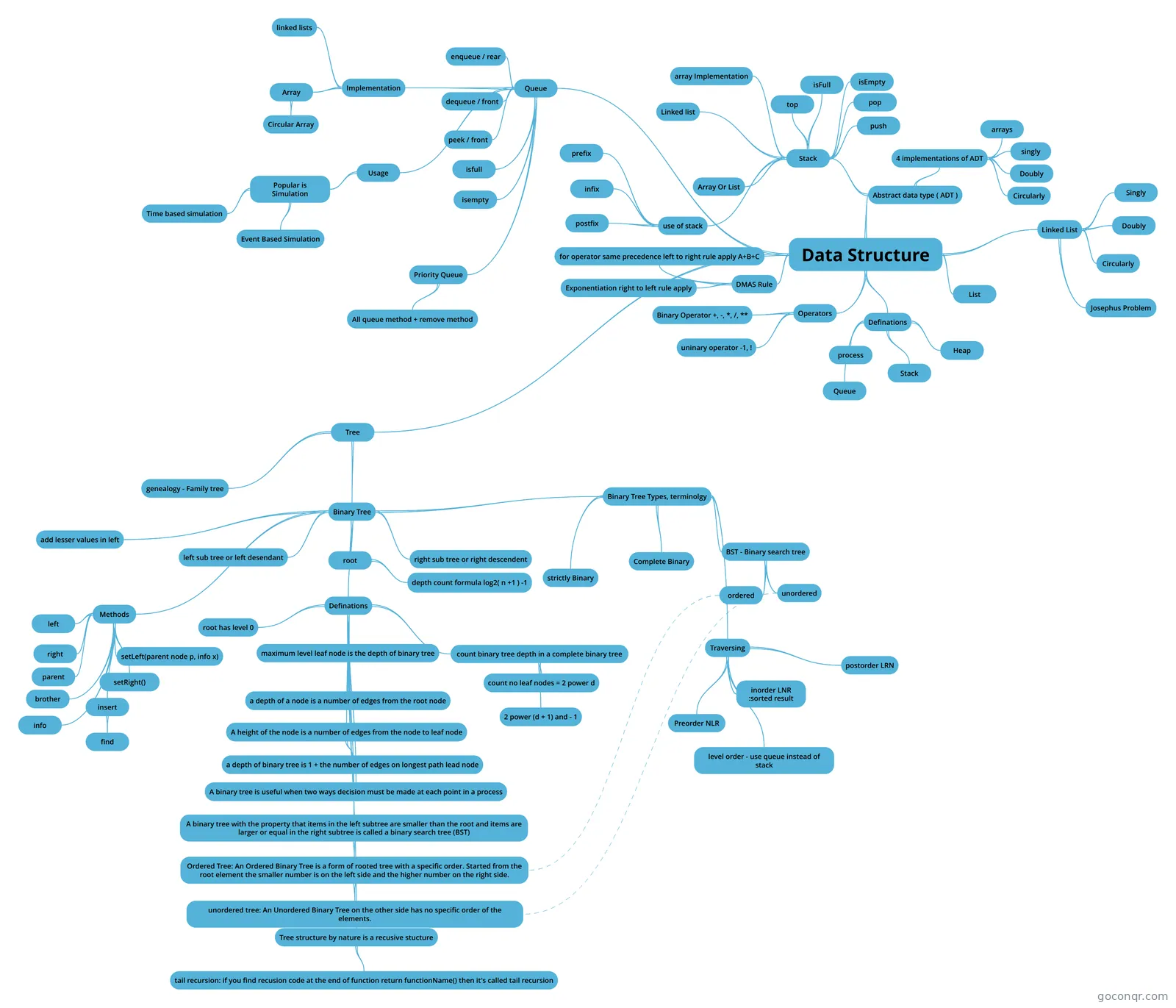
Most of the page is mind maps. Data Structure walks through lists, linked lists (singly, doubly and circularly linked), the Josephus problem, abstract data types, stacks with push and pop, and more. Dictionary Data Structure explains keys and values, and notes that dictionaries are also called associative arrays or maps. Another map compares series, arrays and data frames, and points out that series can hold mixed types while arrays are homogeneous.
Where to start
- Open the notes on data abstraction first. They separate the properties of data from the details of how it is implemented, and they cover the List ADT and array-based lists.
- Move to the Data Structure mind map to see the main structures side by side.
- Read the Dictionary Data Structure map, then the Linear Data Structures map.
- Finish with the Graphs quiz and the quiz on algorithm growth rates.
Using quizzes and maps together
Read a map first, then take the matching quiz without looking. Any term you miss, such as degree or order, tells you which branch of the map to revisit. The flashcard deck on ArrayList sizing is a good example of a small, focused check. It asks why doubling capacity when an array is full is not as wasteful as it sounds.
Where it sits
This unit belongs to the Database Foundations strand of Databases and data science. It links the way data is held in memory with the way it is later stored, queried and exchanged. Some maps look at sparse matrices, JSON APIs and data exchange.
Next step
Pick one map that matches what you are studying today, then test yourself with a quiz. If you want something your own, make a set of flashcards from the terms you missed.
Frequently asked questions
Which resource should I open first?
Start with the notes on data abstraction, which introduce abstract data types, the List ADT and array-based lists. Then open the Data Structure mind map for a wider view of lists, linked lists and stacks. Once the vocabulary feels familiar, try the Graphs quiz.
What do the mind maps cover?
They range across lists, linked lists, stacks, dictionaries, matrices, series, arrays and data frames, trees, graphs and recurrence relations. Some also look at JSON APIs and data exchange. Several are short, so they work well for a quick review before a lab or lecture.
Are the quizzes worth taking?
There are 3 quizzes. One covers algorithm growth rates and what algorithm analysis is concerned with. Another covers graph terms such as order, degree and edges. They are short checks that show which ideas you still need to revisit.
Are these resources free to use?
Yes. Every resource listed here is free to open, study and take, with no account needed. They were made by GoConqr users, not by GoConqr itself. A free account also saves your quiz scores and lets you make your own quizzes, maps, flashcards and notes.
Who is this page for?
Mostly university students, since most resources are at that level, and teachers who want ready-made material to share or adapt. A smaller share suits school students meeting the basics. The content is about data structures and algorithm analysis.
What if I cannot find a topic I need?
Try the other mind maps, since several have broad titles and cover more than their names suggest. If a topic is still missing, you can build your own map or flashcards from your course notes and use them alongside the resources listed here.