
Electrical Fundamentals
113 resources created by 93 users
This Electrical Fundamentals page on GoConqr gathers community-made quizzes, mind maps, flashcards and a slide set, from Ohm's law and SI prefixes to AC and DC theory, batteries, inductors and electrical safety. It's built for university students and professional candidates, school students, and teachers after ready-made material. There are over 100 resources here, including more than 30 quizzes, more than 30 mind maps and more than 30 flashcard decks. Pick a topic, try a quiz to spot your gaps, then make your own revision sets.
Top Electrical Fundamentals resources
-
40 questionsUnit 202 Revision: Electrical Science Question Bank 1 Electric current is described as a flow of
-
53 questionsFundamentals Midterm Written Practice Exam
-
40 questionsUnit 202 Revision: Electrical Science Question Bank 1 Electric current is described as a flow of
-
27 cardsLectures 1 & 2 What is 1 Coulomb equal to?
-
20 questionsUnit 202: Electrical principles and processes for building When carrying out a continuity test would you expect:
-
10 questionsElectrical Level I - Test 1 Electrical Level I - Test 1
-
45 cardsWhat is Electronics? (Introduction) Here we have some of my flashcards/notes from my electronics technician course at Penn Foster. I suggest li...
-
25 questionsF.O.S.A. Practice Test 3 What is OHMS LAW?
Quizzes
See all 39 quizzes-
40 questionsUnit 202 Revision: Electrical Science Question Bank 1 Electric current is described as a flow of
-
53 questionsFundamentals Midterm Written Practice Exam
-
40 questionsUnit 202 Revision: Electrical Science Question Bank 1 Electric current is described as a flow of
-
20 questionsUnit 202: Electrical principles and processes for building When carrying out a continuity test would you expect:
-
10 questionsElectrical Level I - Test 1 Electrical Level I - Test 1
-
25 questionsF.O.S.A. Practice Test 3 What is OHMS LAW?
-
9 questionsSI Unit Quiz The transmission lines may carry anywhere around 11kV-500kV. What does 'V' stand for?
-
30 questionsBSNL TTA ONLINE TEST - 1 Basic Electricity -1 The resistance of a conductor of diameter d and length l is R Ω. If the diameter of the conductor is halved...
Mind maps
See all 40 mind maps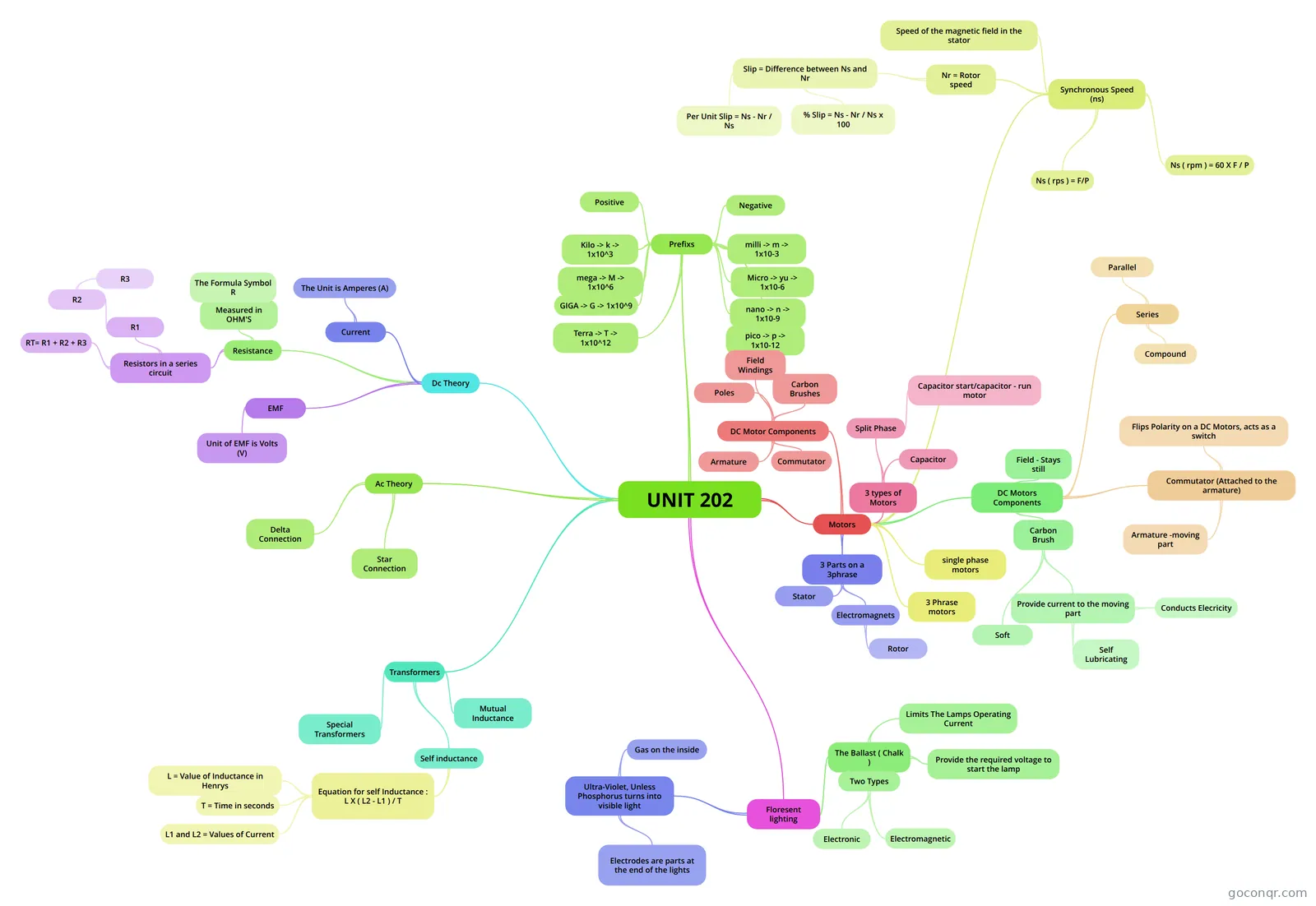
Flashcards
See all 31 flashcards-
27 cardsLectures 1 & 2 What is 1 Coulomb equal to?
-
45 cardsWhat is Electronics? (Introduction) Here we have some of my flashcards/notes from my electronics technician course at Penn Foster. I suggest li...
-
142 cardsB-03a Electrical Fundamentals Flashcards What are the atomic elements located in the nucleus of the atom?
-
26 cardsScience What the difference between c open and closed electrical circuits?
-
31 cardsIntroduction to Switching (Mod.3 Sect.3 Part 1) ):P
-
42 cardsElectrical Engineering Basics Define an Atom
-
26 cardsChapter 14: Electrical Safety These are the note cards for the Electrical Safety Chapter.
-
39 cardsKapitel 7--more Variable Resistor - mehr Variable Widerstandstypen 13.06.2016
Notes
Slides
Topics in Electrical Fundamentals
More Electrical and electronic engineering topics
About Electrical Fundamentals
GoConqr OriginalWhat the resources cover
The quizzes start with the basics. Fundamentals Midterm Written Practice Exam asks about current as a flow through a conductor and the units used to measure it. Electrical Level I - Test 1 covers fuses, circuit breakers, converting amperes to milliamperes and working safely with wet hands. SI Unit Quiz checks units and circuit symbols.
A large share of the page follows Unit 202. Its question bank asks about electromotive force and what happens to a conductor as current rises. A second quiz covers continuity tests, faults and multimeter probes.
Where to start
- Begin with the flashcards named Lectures 1 & 2, which cover coulombs, current, charge and time.
- Move to What is Electronics? (Introduction) for conductors and insulators.
- Try F.O.S.A. Practice Test 3 for Ohm's law, power, resistance and hertz.
- Finish with the Unit 202 question bank once the terms feel familiar.
Using maps and quizzes together
Read a mind map first to see how a topic fits together. The D.C theory and AC Theory maps lay out the branches. The UNIT 202 map also takes in motors, transformers and three-phase parts. Then take a quiz and note which branches you missed. Return to the map and the flashcards for those branches only.
Exams and levels
Most of the page suits professional candidates and university students, with a good share for school students. Some resources mention C&G exams and BSNL TTA, including the BSNL TTA online tests on basic electricity. Others are plain topic checks, such as Electrical Safety and Resistor Color Code Practice for resistor colour codes.
Where it sits
This unit belongs to the strand Electrical Principles and Circuit Theory, in Electrical and electronic engineering. Choose one resource today, then build a map or deck of your own for the parts that stick less.
Frequently asked questions
Which resource should I open first?
Try the flashcards called Lectures 1 & 2 if you are new to the topic. They cover coulombs, current and charge. If you already know the basics, go straight to Electrical Level I - Test 1 or the Unit 202 question bank to see what you remember.
What do the mind maps cover?
The maps cover AC and DC theory, electrical variables, methods of producing EMF, formulas and resistance colour codes. The UNIT 202 map also branches into motors, transformers and three-phase parts. They work well as a quick overview before you take a quiz.
Are these resources free to use?
Yes. Every resource listed here is free to open, study and take, with no account needed. A free account also saves your quiz scores and lets you make your own quizzes, mind maps, flashcards and notes.
Which exams do the resources suit?
Some resources mention C&G exams, and the BSNL TTA online tests on basic electricity are listed too. Others are general topic quizzes. The mix leans towards professional candidates and university students, with a good share for school students.
Who made these resources?
They were made by GoConqr users, not by GoConqr itself. That means styles and depth vary, from short term lists to full question banks. Check the title and the first questions to see whether a resource fits what you need.
What if I cannot find a topic I need?
Look through the other formats first, as a topic may appear as a mind map or flashcard deck rather than a quiz. If it is still missing, you can make your own quiz, map, flashcards or notes and use them for revision.