
Electronic Components and Devices
134 resources created by 118 users
This Electronic Components and Devices page on GoConqr gathers community-made quizzes, mind maps, flashcards and notes, from schematic symbols and resistor codes to diodes, transistors and capacitors. It's built for school students, university students and professional candidates revising or filling gaps, and for teachers after ready-made material. There are over 120 resources here, including more than 10 quizzes, over 70 mind maps and more than 20 flashcard decks. Pick a topic, try a quiz to find your gaps, then build your own sets.
Top Electronic Components and Devices resources
-
6 questionsIPC 610- Class 2 training Are solder projections allowed if they violate other rules?
-
6 cardsSchematic Symbols Basic schematic symbols
-
73 questions208-276+19-24 To limit output voltage of positive limiter to 5V, when a 10V peak input voltage is applied, bias voltage m...
-
62 cardsBipolar Transistors (Mod. 4 Sect. 3 Part 1) ?♀️
-
22 cardsPCB design What is PCB used for? What is it usually made of (two things)?
-
55 cardsUnit Review - Important Soldering Terms (Mod. 3 Sect. 2) (~_~)
-
55 questions4TA UNIDAD
-
25 questionsplandesign 3 What device is described here: The 'It' rating must be equal to or above the normal operating current of th...
Quizzes
See all 18 quizzes-
6 questionsIPC 610- Class 2 training Are solder projections allowed if they violate other rules?
-
73 questions208-276+19-24 To limit output voltage of positive limiter to 5V, when a 10V peak input voltage is applied, bias voltage m...
-
55 questions4TA UNIDAD
-
25 questionsplandesign 3 What device is described here: The 'It' rating must be equal to or above the normal operating current of th...
-
25 questionsTest 1 Study for Final A real voltage source has
-
33 questionsEXAMEN 1 A semiconductor ir fomed by ... bonds.
-
33 questionsTransistores
-
10 questionsElectronics Phase 4 Quiz by Gerard Galligan What device does this symbol represent?
Mind maps
See all 79 mind maps-
Capitulo 2 ( Electronic fundamentals )
-
Types of Diodes.
-
Analogue electronic components
-
Inductors
-
Chapter 3 : Transducers And Signal Conditioning Circuitry Industrial Electronic(Chapter 3 : Transducers and Signal Conditioning Circuitry)
-
SAFETY RULES FOR ELECTRONICS LABORATORIES
-
Electronics
-
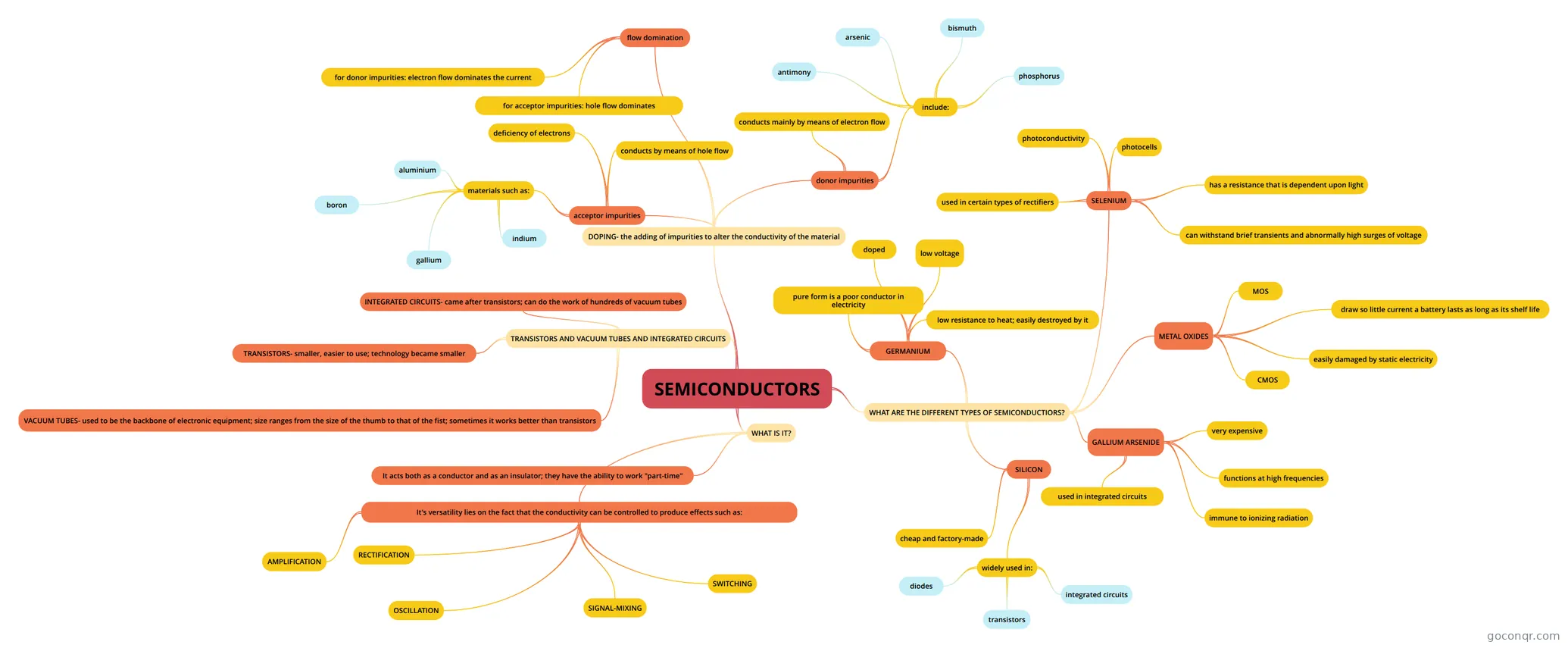 SEMICONDUCTORS
Flashcards
See all 26 flashcards-
6 cardsSchematic Symbols Basic schematic symbols
-
62 cardsBipolar Transistors (Mod. 4 Sect. 3 Part 1) ?♀️
-
22 cardsPCB design What is PCB used for? What is it usually made of (two things)?
-
55 cardsUnit Review - Important Soldering Terms (Mod. 3 Sect. 2) (~_~)
-
23 cards02Handout1
-
28 cardsSchematic Symbols
-
18 cardsThe Use of Light in Technology / Additional Light Sources (Mod.7 Sect.4 Parts 4-5)
-
14 cardsElectronic fundamentals Name this electronic component
Flowcharts
Notes
-
Untitled CONSTRUCTION AND OPERATION OF JFET(with characterstics) JFET consist of the channel of semiconducting material through which a current flows. JFET’s are of two types; one is n-channel JFET and another is p-channel JFE...
-
A Summary of electronics - chp 8,11,12,13,14,16 JEFT - junction Field Effect Transistor N Channel Type Always reversed biasd (all voltages are negative) the N channel is controlled by Vgs ( aka Vgg) Higher Vgg (gate voltage) = smaller Id (drain...
-
Electronic Component Description All electronic circuits require a power supply in order to make them work. Batteries are often the safest and most convenient way to power small, portable or mobile projects. The chemicals inside a battery react and w...
-
Project Ideas - created from Mind Map Variable Power Supply Doorbell Sun-tracker
Slides
Topics in Electronic Components and Devices
More Electrical and electronic engineering topics
About Electronic Components and Devices
GoConqr OriginalWhat the resources cover
This unit sits in the Analogue Electronics strand of Electrical and electronic engineering. The listed resources start with recognition: naming parts and reading symbols. Flashcard decks such as Schematic Symbols, Component Symbols and CIRCUIT SYMBOLS cover items like the rheostat, potentiometer, Zener diode, NPN transistor, thyristor and 555 IC. Name the Switches asks for each switch's name, category and symbol.
Where to start
Begin with the symbol decks, then move on to Identify the Electronic Components, which asks you to name the component and identify its symbol. Once the shapes are familiar, the mind maps give you the structure behind them.
- Capacitors and Inductors for passive parts.
- Semiconductors, Types of Diodes. and Shockley Diode for devices.
- Transistor and SCR CONTROLLED RECTIFIERS for switching and control.
- HNC Electronic Principles for rectifiers, amplifiers, BJT, FET and instruments such as the oscilloscope and multimeter.
Going further
The Memristor map describes a passive element whose resistance depends on the charge that has flowed through it, built from a thin TiO2 film between platinum contacts. Other listed items touch on connectors, PCB design, soldering terms and laboratory safety rules, so you can look at the practical side too. The quiz IPC 610- Class 2 training tests solder and connector acceptance questions.
Using quizzes and maps together
Read a map, then take a quiz on the same topic. Note the questions you missed, return to the matching map or deck, and try again. Flashcards suit short daily sessions, while maps help you see how parts and devices connect.
Make it yours
Choose one topic today, such as diodes or capacitors, and work through its map and quiz. Then gather what you learn into your own flashcards or notes.
Frequently asked questions
Which resource should I open first?
Start with a symbol deck such as Schematic Symbols or Component Symbols. They cover parts like the potentiometer, Zener diode, transformer, NPN transistor and thyristor, and give you the vocabulary the mind maps and quizzes rely on.
What do the mind maps cover?
There are over 70 mind maps. They cover capacitors, inductors, semiconductors, several kinds of diodes, transistors, SCR controlled rectifiers, integrated circuits and sensors. There are also maps on laboratory safety rules and the memristor.
Are the resources free to use?
Yes. Every resource listed here is free to open, study and take, with no account needed. They were made by GoConqr users rather than by GoConqr. A free account also saves your quiz scores and lets you make your own quizzes, maps, flashcards and notes.
Who is this page for?
It suits school students, university students and professional candidates, plus teachers looking for ready-made material. Learners can practise naming components, reading symbols, and checking their understanding of devices with quizzes and maps. The page does not tie its resources to any particular exam.
Is there anything on soldering and connectors?
Yes. The IPC 610- Class 2 training quiz asks about solder balls, bridging and bent connectors. There is also a flashcard deck on important soldering terms and a deck naming connectors with pictures, so you can practise the hands-on side as well.
What if I can't find the topic I need?
Try a nearby map or deck, since several cover the same ideas in different words, such as the capacitor maps. You can also build your own flashcards, maps or notes on the missing topic and keep them for revision.