
Storage, Query Processing and Transactions
77 resources created by 48 users
This Storage, Query Processing and Transactions page on GoConqr gathers community-made flashcards, quizzes, mind maps, notes and slides, from ACID properties and locking to query optimisation, B-trees and hash indexes. It's built for university students practising how databases keep data safe and fast, and for teachers after ready-made material. There are over 70 resources here, including more than 30 mind maps, over 20 flashcard decks and more than 10 quizzes. Pick a topic, try a quiz to find your gaps, then make your own revision aids.
Top Storage, Query Processing and Transactions resources
-
39 cardsDatabases Topic 7 What is a transaction?
-
55 questionsCHAPTER 10: TRANSACTION MANAGEMENT AND CONCURRENCY CONTROL 1. Most real-world database transactions are formed by only one database request.
-
48 questionsC192 Transaction Management C192 Practice Test
-
20 questionsTransactions Transactions
-
35 cardsCONCURRENCY CONTROL What is concurrency control?
-
37 cardsQUERY PROCESSING AND OPTIMISATION Why query processing problem is much more difficult in distributed environments than in centralized ones?
-
55 cardsSCC 201 - Concurrency and Transactions Define a multi-user database?
-
45 cardsSCC 201 - Concurrency Locking What are concurrency control techniques used for?
Quizzes
See all 10 quizzes-
55 questionsCHAPTER 10: TRANSACTION MANAGEMENT AND CONCURRENCY CONTROL 1. Most real-world database transactions are formed by only one database request.
-
48 questionsC192 Transaction Management C192 Practice Test
-
20 questionsTransactions Transactions
-
17 questionsData Concurrency and Locking Which of the following describes the disadvantage of executing a set of DML statements outside a transaction?
-
20 questionsChapter 10 (T/F) 1. Most real-world database transactions are formed by only one database request.
-
18 questionsC192 StrongArm
-
10 questionsC192 Query Processing
-
10 questionsC192 Thuggery
Mind maps
See all 37 mind maps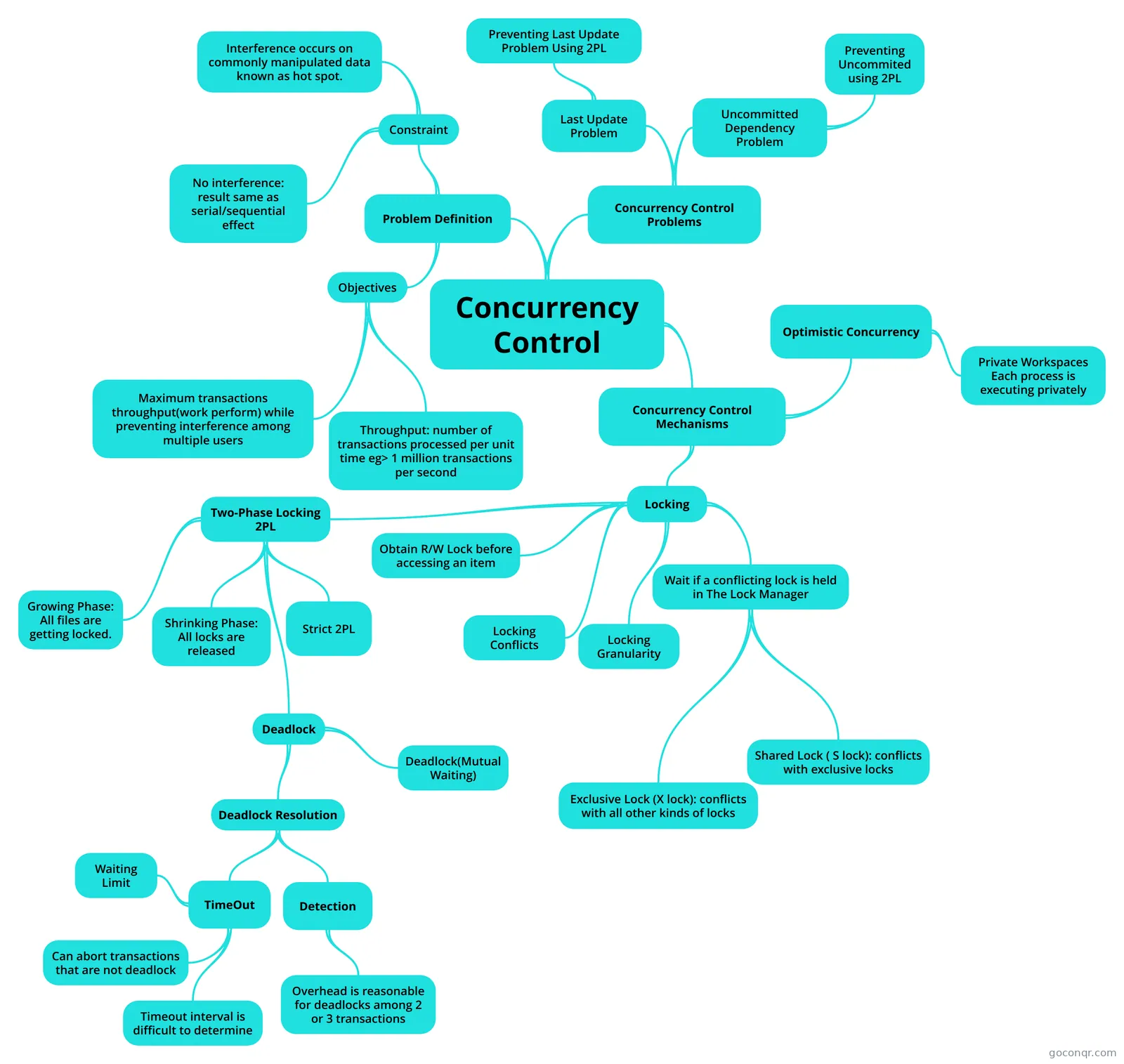
Flashcards
See all 23 flashcards-
39 cardsDatabases Topic 7 What is a transaction?
-
35 cardsCONCURRENCY CONTROL What is concurrency control?
-
37 cardsQUERY PROCESSING AND OPTIMISATION Why query processing problem is much more difficult in distributed environments than in centralized ones?
-
55 cardsSCC 201 - Concurrency and Transactions Define a multi-user database?
-
45 cardsSCC 201 - Concurrency Locking What are concurrency control techniques used for?
-
45 cardsUntitled Two Views of the System
-
32 cardsSCC 201 - Secondary Files access What are fields used used to create an index in an auxiliary access structure called and how can they be cr...
-
26 cardsSCC 201 - Access Routines Describe the linear search (brute force) access routine?
Notes
-
Untitled Intro Each node in a Logical Query Plan may be executed in several ways there is no single implementation that is always better than the others so we need to compare alternatives based on their c...
-
Untitled transaction and concurrency control Transaction In the context of DBMS, a transaction is an execution of a program that accesses a database in the context pf transactional file server,a transaction is an execution of ...
-
Column Stores What are the cost-sensitive major factors in query processing? – Size of database – Index or not – Join Current hardware configuration – Cheap storage – allow distributed redundant data store – Fast CPUs – compression...
-
Untitled Recoverability Recoverable Schedules: Schedules in which transactions commit only after all transactions whose changes they read commit are called recoverable schedules. In other words, if some transaction Tj is ...
-
Untitled User A and User B try to read X. Say they are doing ATM updates. A wants to add five dollars, x = x+ 5. This requires an update. B wants to add ten dollars, x = x+10. This requires an update. Look up Lost ...
Slides
Topics in Storage, Query Processing and Transactions
More Databases and data science topics
About Storage, Query Processing and Transactions
GoConqr OriginalWhat this unit covers
The page sits in the Database Internals and Administration strand of Databases and data science. Most of the material is about transactions and concurrency control. A smaller group looks at storage and query work: files and indices, tree indexing, hashing, query processing and optimisation, and parallelism.
Where to start
Begin with the flashcard deck Databases Topic 7. It runs from the question of what a transaction is through transaction properties, transaction support and three parts on concurrency control. Then open the slide set ACID properties and the deck Transactions & ACID. They explain atomic, consistent, isolated and durable behaviour: all or nothing, starting and ending in a consistent state, and not affecting other transactions.
Using quizzes and mind maps together
Mind maps give you the shape of a topic. The Concurrency Control maps cover why it is needed (lost updates, uncommitted data, inconsistent retrievals) and the pessimistic and optimistic techniques. Another map states the aim: maximise throughput while preventing interference among users. The Transactions map adds the database architecture, with the transaction manager, scheduler, recovery manager and buffer manager.
Read a map first, then test yourself. These quizzes are a good fit:
- Transactions, which asks about transaction properties and lock types.
- Data Concurrency and Locking, for locks in more depth.
- Chapter 10 (T/F), for quick true or false checks.
Wrong answers show you which map to reopen.
Moving on to storage and queries
Once transactions feel secure, try the SCC 201 decks on search and B-trees, access routines, secondary file access, and query processing and optimisation. The maps on intraoperation and interoperation parallelism, and on validation techniques and snapshot isolation, suit later revision.
Make it your own
Teachers can set a deck or quiz as ready-made practice. Students can pick one topic from the list, work through it, and then build their own cards or maps to fill any gap.
Frequently asked questions
Which resource should I open first?
Start with the flashcard deck Databases Topic 7. It moves from what a transaction is, through transaction properties and support, to three parts on concurrency control. After that, the ACID properties slide set and the Transactions mind map make good follow-ups.
What do the mind maps on this page cover?
They cover concurrency control problems such as lost updates and uncommitted data, pessimistic and optimistic techniques, ACID, recovery control and database architecture. Others look at query work, intraoperation and interoperation parallelism, and validation techniques with snapshot isolation.
Are there quizzes for locking?
Yes. Data Concurrency and Locking is a dedicated quiz, and the Transactions quiz asks about lock types and transaction properties. The Chapter 10 quizzes also check transaction management and concurrency control, including a true or false set.
Does the page include storage and indexing topics?
Yes. There are flashcard decks on Files and Indices, Tree Indexing, Hash Indexes and Hashing, plus SCC 201 decks on search and B-trees and on secondary file access. A note on Column Stores is also listed.
Who made these resources, and are they free?
The resources were made by GoConqr users, not by GoConqr itself. Every one listed here is free to open, study and take, with no account needed. A free account also saves your quiz scores and lets you make your own materials.
What if the topic I need is missing?
Try the neighbouring decks and maps first, since transaction and query topics overlap. If a gap remains, make your own flashcards, mind map or notes on it. Teachers can do the same for a class.