
Sustainability and the Environment
19 resources created by 18 users
This Sustainability and the Environment page on GoConqr gathers community-made mind maps, flashcards, slides and notes, from the 4Rs, 6Rs and the circular economy to upcycling, eco design and life cycle assessment. It's built for school students revising a topic and for teachers after ready-made material, with a few university students filling gaps too. There are over 170 resources here, including more than 140 mind maps and over 10 flashcard decks, mostly at GCSE and A-level. Pick a map, test yourself with a deck, then build your own.
Top Sustainability and the Environment resources
-
25 cardsLife Cycle Assessment and Cleaner design and technology Through what stages should product impacts be assessed?
-
10 cardsRecycling Materials Materials for recycling
-
Mind map 4R's Reuse, Recycle, Reduce, Recover
-
Mind map circular economy
-
Mind map working towards a sustainable future NEA
-
Mind map UPCYCLING HISTORY
-
14 cardsSustainability and environmental concerns Manufacturere and retailers are becoming increasingly concerned with the impact that the products they make...
-
Mind map Sustainability work
Mind maps
See all 14 mind maps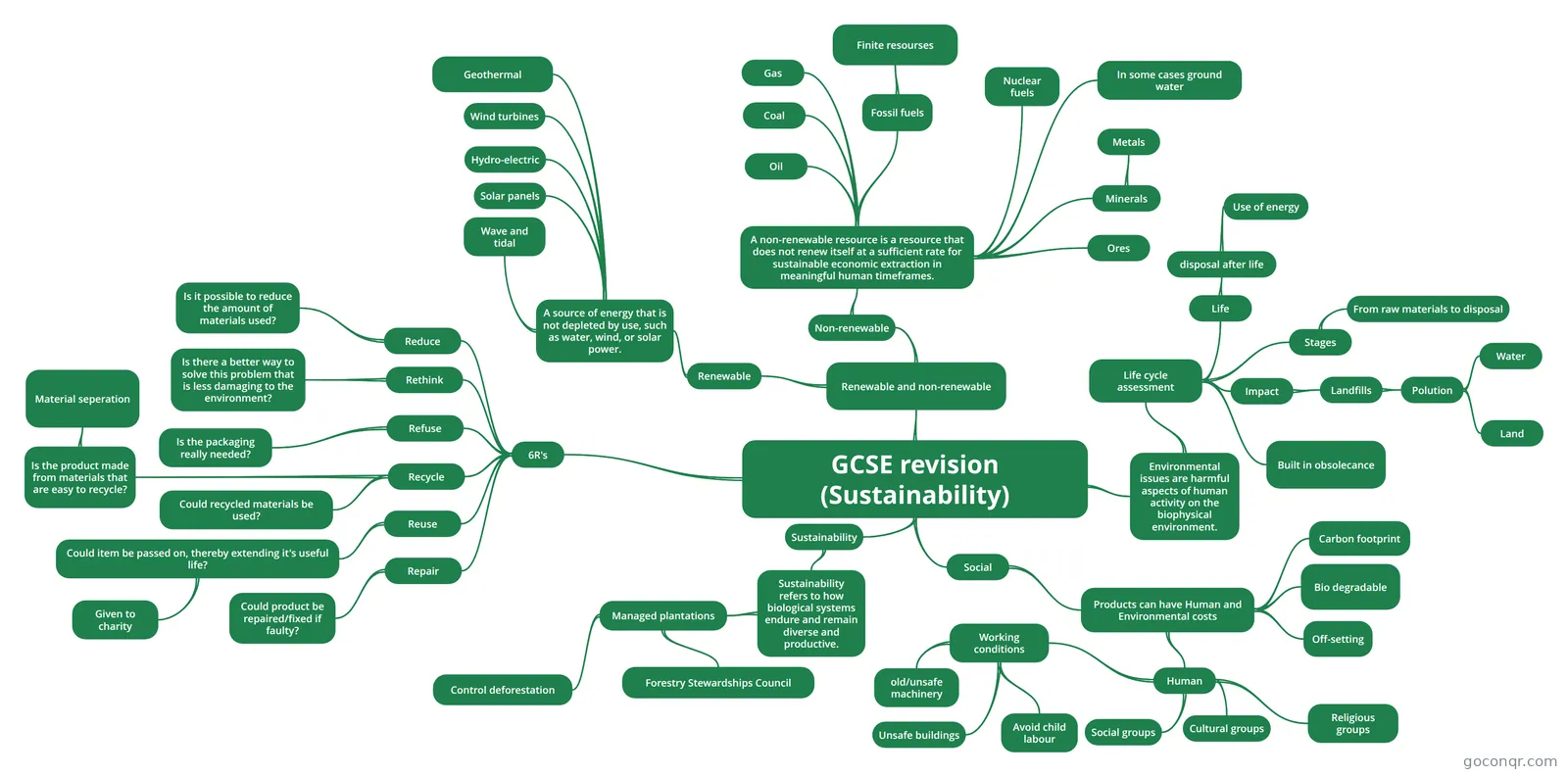
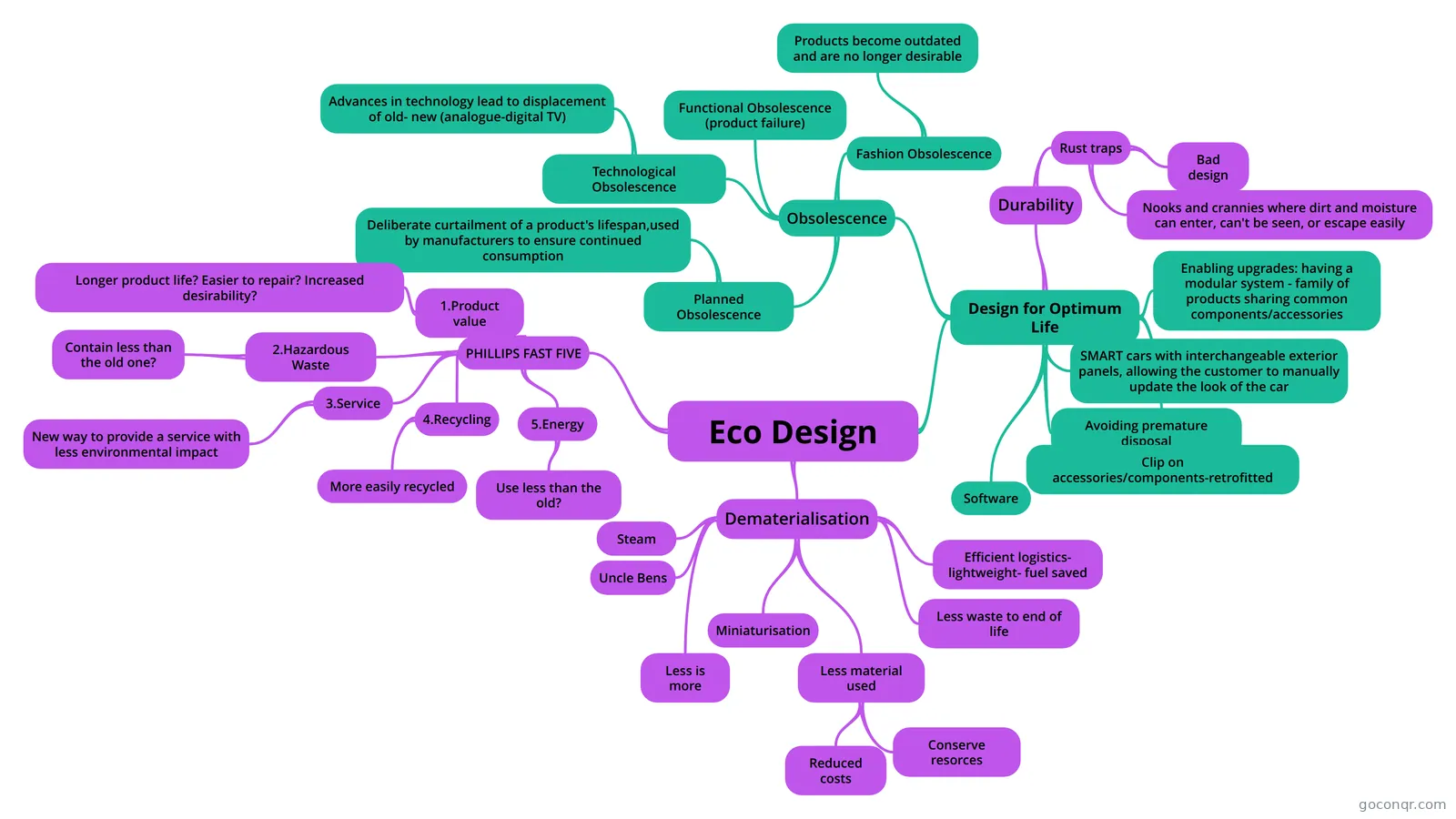
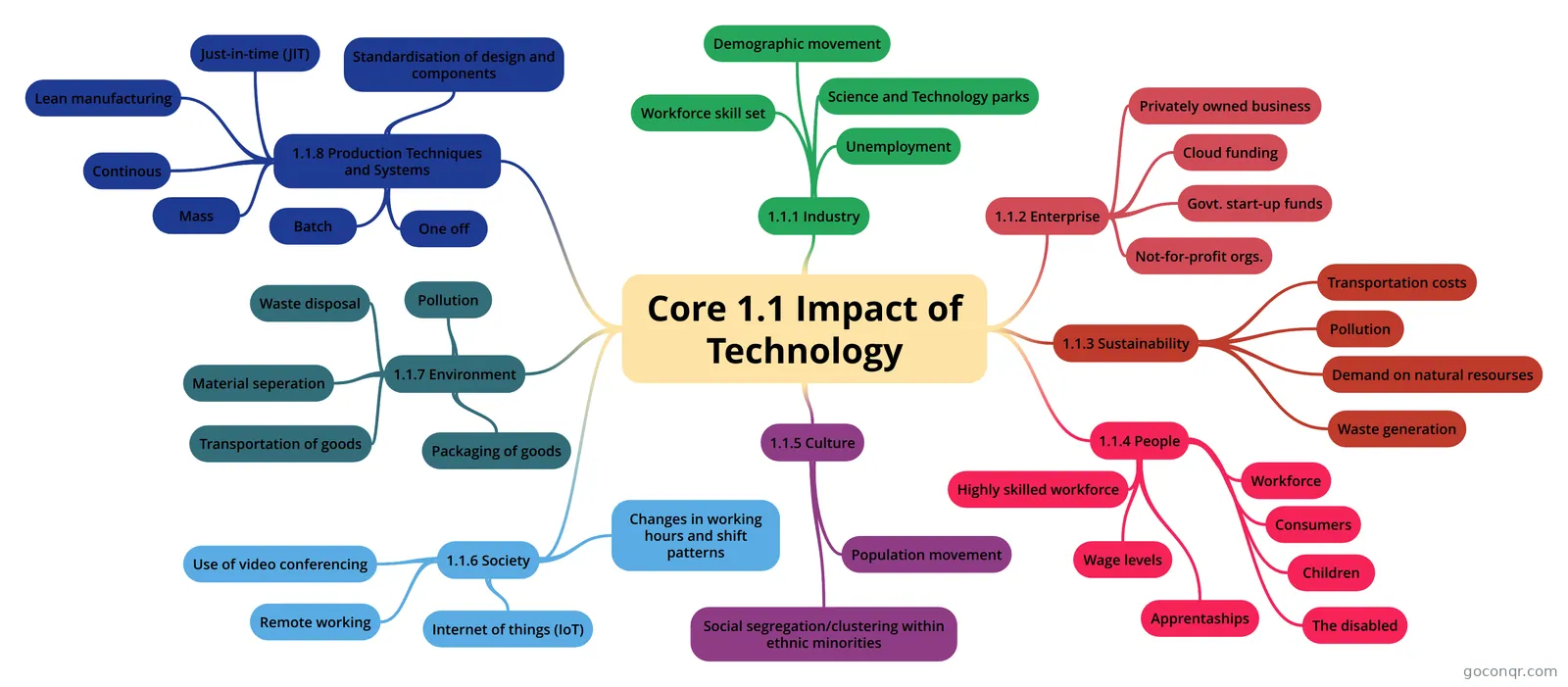
Flashcards
-
25 cardsLife Cycle Assessment and Cleaner design and technology Through what stages should product impacts be assessed?
-
10 cardsRecycling Materials Materials for recycling
-
14 cardsSustainability and environmental concerns Manufacturere and retailers are becoming increasingly concerned with the impact that the products they make...
-
6 cardsThe 6Rs
Flowcharts
More Design and technology topics
About Sustainability and the Environment
GoConqr OriginalWhat this unit covers
This unit sits in the Design Principles and Context strand of Design and technology. Its resources look at how products affect the environment and how designers can reduce that harm. Most are mind maps, with flashcard decks, a few slide sets and some notes alongside them.
Start with the Rs
The Rs are the easiest way in. The mind map 4R's covers reuse, recycle, recover and reduce, and explains just in time production: making only the amount of product that matches demand, so nothing is left over. Move on to The 6 R's and The Six R's for Sustainability, which ask practical questions such as whether a product can be reused many times, or whether the packaging can be reduced. The circular economy map then shows the bigger idea: keeping products and materials in use and cutting waste.
Go deeper
- Recycling Materials is a flashcard deck on glass, aluminium, plastic, paper, textiles, batteries, oil and steel.
- Product Design - Design Issues asks about renewable and non-renewable materials and the common recycling symbols.
- Life Cycle Assessment and Cleaner design and technology covers the stages of assessment and life-cycle inventory.
- The two upcycling maps, UPCYCLING RESEARCH and UPCYCLING HISTORY, define upcycling and trace where it came from.
Using maps and flashcards together
- Read a map to see how the ideas connect.
- Cover the map and try the matching flashcard deck from memory.
- Note what you missed and go back to that branch.
The GCSE revision maps on sustainability are handy for a quick check before an exam, and several resources mention GCSE and A-level Design and Technology. Teachers can use the slide sets such as 6Rs in lessons.
Make it your own
Once you have found the gaps, try writing a map of your own for a product you are designing, and turn its key terms into a deck.
Frequently asked questions
Which resource should I open first?
Start with the mind map 4R's, which sets out reuse, recycle, recover and reduce in a few branches. Then open The 6 R's and the circular economy map to see how the ideas widen. Once those feel familiar, the Recycling Materials flashcards give you facts to test yourself on.
What do the mind maps on this page cover?
Most of the resources here are mind maps. They cover the 4Rs and 6Rs, the circular economy, upcycling, eco design, sustainable product design, timber sustainability and ideas for making a food product more sustainable. Some are written as GCSE revision summaries, so they are quick to scan.
Which exams do these resources suit?
Most of the resources are at secondary level, and the listed ones mention GCSE Design and Technology and A-level Design and Technology. A smaller share suits university students. Check the title and contents of a resource first, since the community wrote them for different courses.
Are the resources free to use?
Yes. Every resource on this page is free to open, study and take, and you don't need an account. They were made by GoConqr users rather than by GoConqr itself. A free account also saves your quiz scores and lets you create your own maps, flashcards, quizzes and notes.
What can I do if a topic I need is missing?
Look through the related maps and decks first, as topics like life cycle assessment, energy efficient design and minimising waste in engineering are covered in separate resources. If you still can't find it, you can build your own mind map or flashcard deck on the topic.