
Rheumatology and Connective Tissue Disease
427 resources created by 280 users
This Rheumatology and Connective Tissue Disease page on GoConqr gathers community-made quizzes, mind maps, flashcards, flowcharts and notes, from rheumatoid arthritis, gout and lupus to vasculitis and scleroderma. It's built for university students and professional candidates practising recall and clinical vignettes, and for teachers after ready-made material. There are over 400 resources here, including more than 30 quizzes and over 200 mind maps. Open a mind map to get your bearings, then test yourself with a quiz.
Select topic
- Arthritis Types and Diagnosis45
- Rheumatology Examination and Investigations9
- Rheumatoid Arthritis75
- Spondyloarthritis36
- Gout and Pseudogout63
- Osteoarthritis23
- Systemic Lupus Erythematosus40
- Systemic Sclerosis and Mixed Connective Tissue Disease10
- Inflammatory Myopathies6
- Vasculitis18
- Polymyalgia Rheumatica9
- Musculoskeletal Pain5
Top Rheumatology and Connective Tissue Disease resources
-
6 questionsRheumatology_2013 Which is the best clinical feature to differentiate ankylosing spondylitis from mechanical back pain?
-
200 cardsMDEMO 2 epidemiology of sjogrens syndrome
-
32 questionsRheumatology Questions Scenario: (If a clinical vignette, then keep scenarios realistic and language naturalistic rather than tech...
-
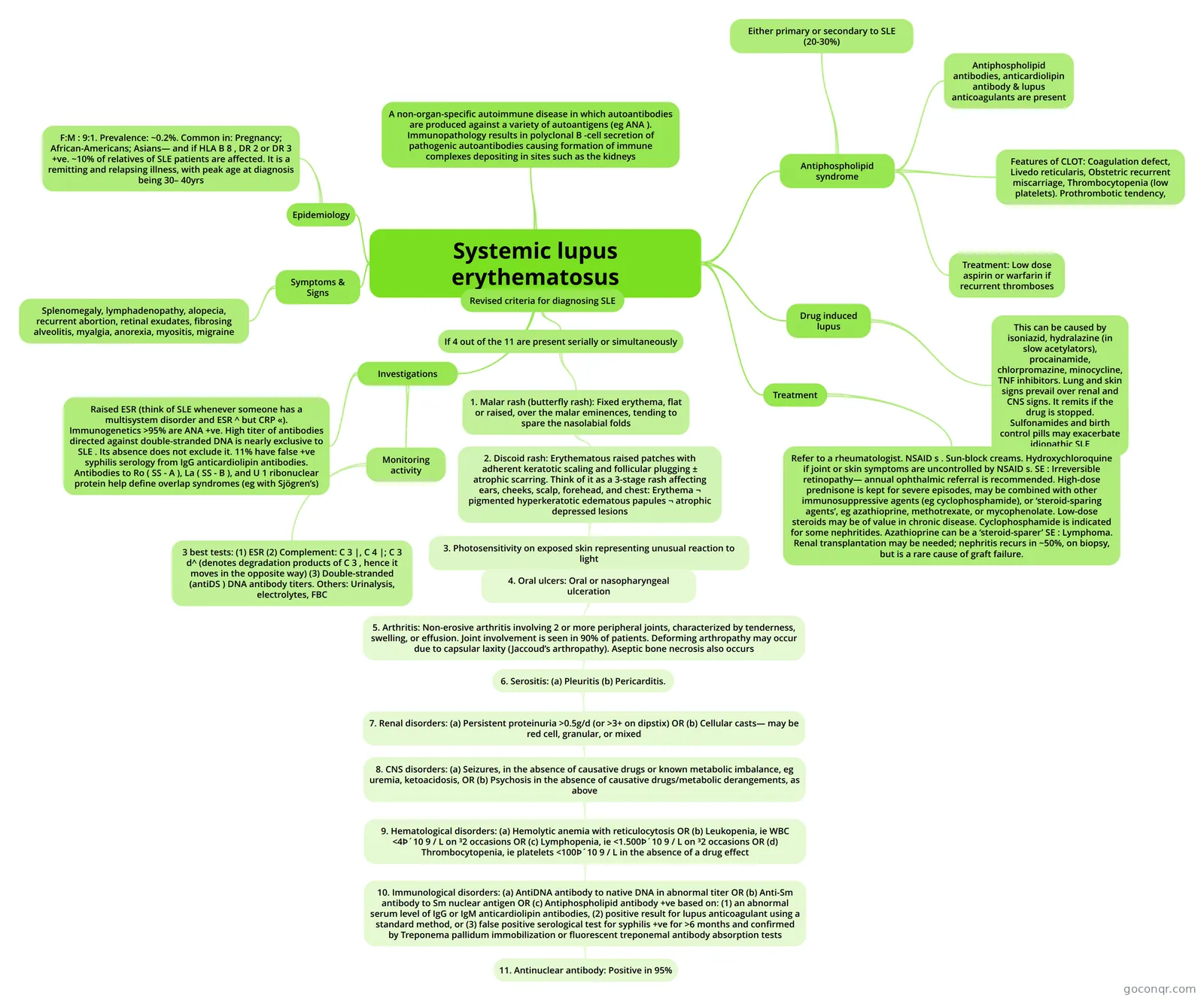
Mind map SLE Systemic Lupus Erythematosus First stab at mind mapping. A work in progress.
-
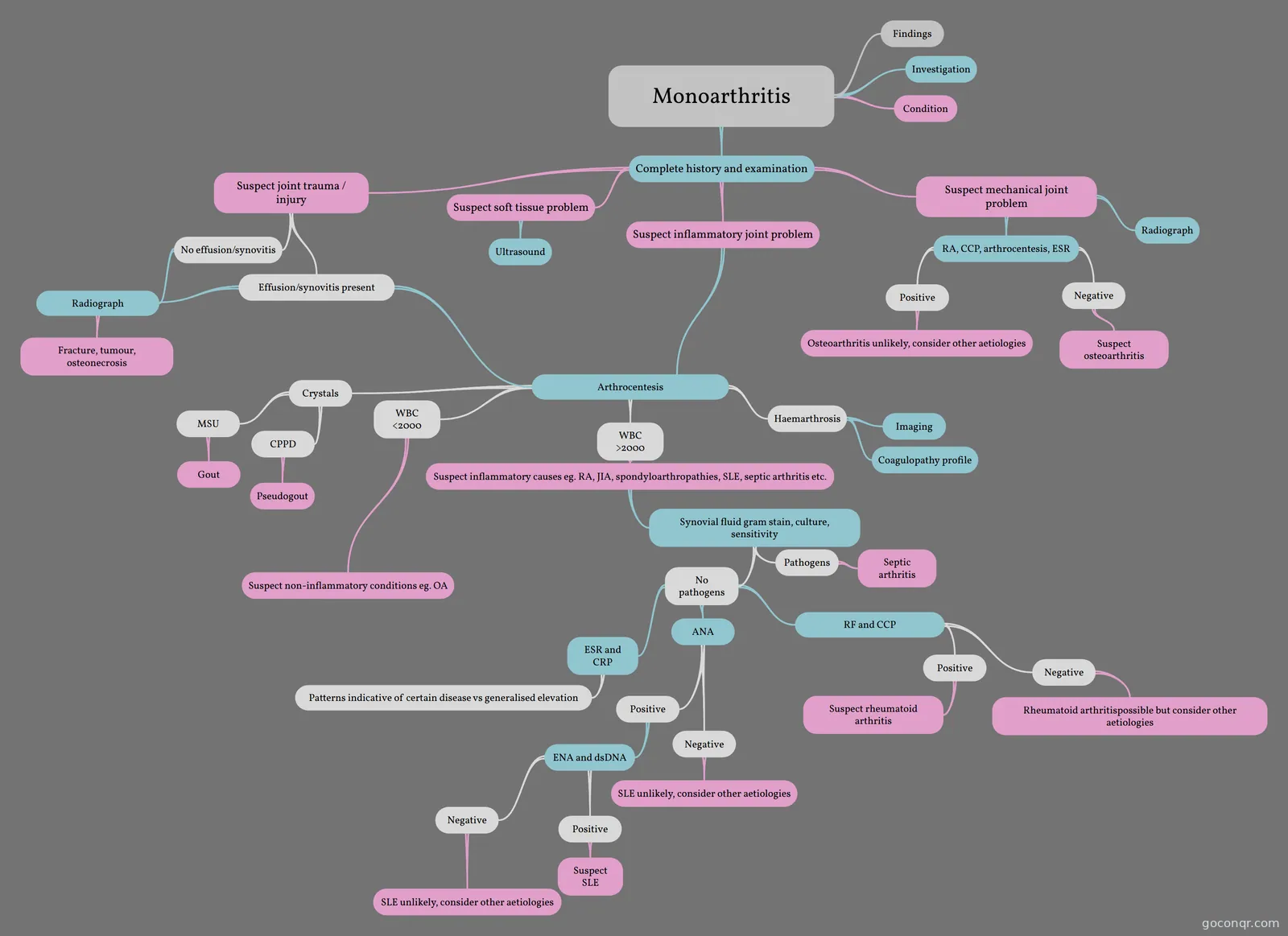 Mind map Monoarthritis Algorithm for the investigation of monoarthritis
-
Mind map gout
-
39 cardsArthritides What is osteoarthritis?
-
23 cardsRheumatoid Arthritis Usual age of onset for RA
Quizzes
See all 41 quizzes-
6 questionsRheumatology_2013 Which is the best clinical feature to differentiate ankylosing spondylitis from mechanical back pain?
-
32 questionsRheumatology Questions Scenario: (If a clinical vignette, then keep scenarios realistic and language naturalistic rather than tech...
-
13 questionsRheumatology_2009 Which of the following activities is most likely to cause pain in osteoarthritis of the patello‐femoral joint?
-
11 questionsExemplar 13.5: Osteoarthritis You have a patient that has been newly diagnosed with osteoarthritis. You are educating her about her affli...
-
9 questionsMusculoskeletal Extended Matching Questions A 26-year-old man presents with a migratory arthritis. He has red eyes. On examination you also note defect...
-
2 questionsRheumatology Which of the following is true about Polymyalgia Rheumatica?
Mind maps
See all 240 mind maps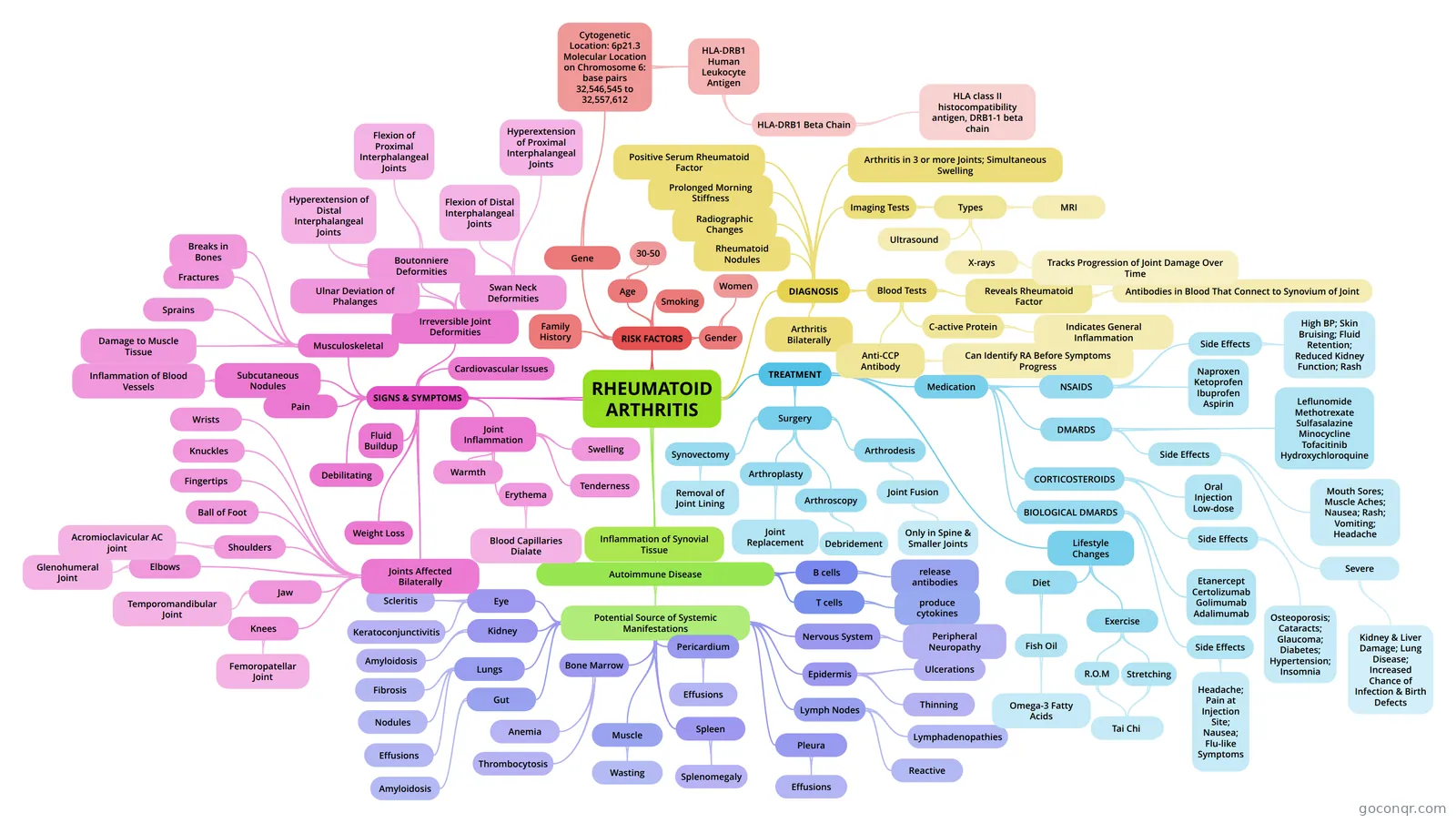

Flashcards
See all 127 flashcards-
200 cardsMDEMO 2 epidemiology of sjogrens syndrome
-
39 cardsArthritides What is osteoarthritis?
-
23 cardsRheumatoid Arthritis Usual age of onset for RA
-
47 cardsRHEUMATOID ARTHRITiS Rheumatoid Arthritis what is it How is it characterized Which Joints Age
-
28 cardsGout 1. Which of the following is the most common cause of gout? a. Intake of purine-rich foods b. Decreased tub...
-
28 cardsTests What are the indications for synovial fluid analysis?
-
36 cardsVasculitis What is vasculitis?
-
11 cardsOxidative stress in rheumatoid arthritis What is rheumatoid arthritis?
Flowcharts
See all 15 flowcharts
Topics in Rheumatology and Connective Tissue Disease
More Internal medicine, pathology and clinical semiology topics
About Rheumatology and Connective Tissue Disease
GoConqr OriginalWhat this unit covers
The page brings together material on the main inflammatory and autoimmune conditions of joints and connective tissue. Rheumatoid arthritis, osteoarthritis, gout, psoriatic arthritis, reactive arthritis, polymyalgia rheumatica, scleroderma and Henoch-Schonlein purpura all have their own mind maps. Lupus and vasculitis appear across maps, flashcards, flowcharts and quizzes.
Where to start
Begin with the mind maps, which give you the shape of a topic quickly. The SLE Systemic Lupus Erythematosus map branches into fatigue, fever, photosensitivity, pericarditis and lupus nephritis. The Monoarthritis map walks through a complete history and examination, then asks whether you suspect trauma, a soft tissue problem, a mechanical problem or an inflammatory one. The Rheumatoid Arthritis map covers epidemiology, risk factors such as HLA DR4 and DR1, and extra-articular features.
Then test yourself
Once a map feels familiar, move to a quiz. The quiz called Rheumatology Questions uses a realistic clinical vignette, such as a woman with joint pain and a known rheumatoid arthritis diagnosis. The 2013 rheumatology quiz asks how to tell ankylosing spondylitis from mechanical back pain. Some listed resources mention USMLE, so the flashcard deck Step 3- Rheumatology may suit those preparing for it.
- Read a mind map on one condition.
- Run through a flashcard deck on the same condition, such as Antiphospholipid Syndrome or Giant Cell Arteritis.
- Take a quiz and note what you missed.
- Go back to the map and the flowchart for that gap.
Where it sits
This unit belongs to the strand Musculoskeletal, Skin and Special Senses, within Internal medicine, pathology and clinical semiology. Teachers can borrow maps and flashcard decks for sessions, or use the quizzes as ready-made questions.
Pick one condition today, open its map, and then make your own flashcards to fill any gaps.
Frequently asked questions
Which resource should I open first?
Start with a mind map, since it shows how a topic fits together. The SLE Systemic Lupus Erythematosus map and the Rheumatoid Arthritis map are good first choices. When you feel comfortable, try a quiz on the same condition to see what you remember.
What do the mind maps cover?
They cover rheumatoid arthritis, gout, lupus, monoarthritis, psoriatic arthritis, reactive arthritis, scleroderma, polymyalgia rheumatica and Henoch-Schonlein purpura. Some are built around cases, such as the one titled My hands are aching, which can help you practise working from symptoms to a diagnosis.
Are the resources free to use?
Yes. Every resource listed here is free to open, study and take, with no account needed. They were made by GoConqr users, not by GoConqr itself. A free account also saves your quiz scores and lets you make your own quizzes, mind maps, flashcards and notes.
Is there anything for USMLE preparation?
Some listed resources mention USMLE. The flashcard deck Step 3- Rheumatology is one place to look, with prompts on how rheumatoid arthritis is diagnosed and what Felty's syndrome is. Check each deck against your own syllabus.
Who is this page for?
It suits university students and professional candidates who want to revise rheumatology and connective tissue disease, and teachers who want ready-made quizzes, maps and flashcards to share. Almost all the resources are at university level.
What if I can't find the topic I need?
Try a nearby resource first. Vasculitis, for example, appears in flashcards, flowcharts and quizzes under several titles. If a topic is still missing, you can build your own mind map, flashcards or quiz and keep it for revision.