
Flashcards
1 - Diabetes
Cards in this deck (187)
- 1how does diabetes affect life expectancy?decrease by 20years if T1DM
decrease by 10years if T2DM - 2why is diabetes on the increase?people are living longer and are diagnosed younger
- 3what is the aetiology of T1DMautoimmune destruction of pancreatic beta cells
- 4what causes maturity onset diabetes of the young? (MODY)different to T1 and T2 diabetes
caused by a mutation in a gene - 5what is the aetiology of T2DM?abnormal insulin secretion or effect (resistant or reduced insulin receptors)
- 6describe the 4 stages of T2DM1 - normal insulin and blood glucose levels
2 - hyperinsulinaemia: body compensates for insulin resistance by increasing insulin secretion from beta cells in pancreas
3 - hyperglycaemia: as resistance to insulin increases and beta cells fail to compensate fully, glucose levels rise
4 - T2DM: escalating beta cell failure and increasing loss of glycaemic control = progression from oral treatment to insulin - 7what % of diabetic patients are T2?90%
- 8what ethnicity is diabetes more common in?asian and afro-carribbean descent
- 9which type of diabetes has a strong genetic link?T2DM
- 10what are the signs and symptoms of diabetes?thirst, polyuria, lethargy, visual disturbances, weight loss, urinogenital infections, foot ulcers, retinopathy and impotence
- 11what does diabetes increase the risk of?MI / stroke
- 12what are the glucose levels of a diabetic?fasting = >7
2hr post glucose = >11 - 13what are the glucose levels of impaired glucose tolerance?fasting = <7
2hr post glucose = >7.8 - 14what are the glucose levels of impaired fasting glycaemia?fasting = 6.1-7
2hr post glucose = <7.8 - 15what does HbA1c mean? whats the target?how much glycosylated glucose being attached to haemoglobin = gives an idea of 3-4 months = long term control
target = <48 - 16what regular screening for diabetics is needed?eyes, BP, feet and lipids
- 17what can glucose control prevent?- deaths from CVD
- stroke
- blindness and foot amputation
- renal failure - 18why do T1DM get more hypos?longer you have diabetes = more hypos you get and your body will stop TELLING you you're hypo = smaller window of opportunity to treat it = can go unconscious with no warning
- 19what can tight blood glucose and BP prevent?microvascular complications
- 20what does a prescription for a diabetic normally look like? (6 things)- insulin
- oral hypoglycaemic drugs
-antihypertensives
-lipid lowering agents
- CV agents
- anti platelets - 21whats the best treatment for T1DM?try to treat with diet first
then try basal bolus insulin - 22why use basal bolus?long acting OD then short acting when they eat = replicates natural insulin levels
- 23what is the ideal fasting glucose levels?4-7mmol/L
- 24what is the ideal blood glucose level 2hrs post glucose?< 8.5
- 25what are the 3 possible types of insulin- bovine
- porcine
- human - 26how is human insulin made?enzymatic modification of porcine insulin OR use Ecoli/yeast
- 27how long do intermediate insulins act?about 8hours and have a more pronounced peak activity
- 28how long do long acting act for?13-18hours
- 29what is OD basal insulin?one injection of long acting insulin (usually used alongside oral agents)
- 30whats the advantage of basal modern insulin (compared to basal human insulin)?modern insulin lasts about 24hrs and doesn't have a peak = no night time hypos
- 31why does basal insulin cause night time hypos?peak is highest at night = hypo
- 32what is degludec?long acting analogue
- 33whats the advantage of degludec over normal basal insulins?slow absorption = flat and stable profile = decreased risk of hypos
long duration = pt can adjust the time of injection when needed - 34how does degludec work?as its injected, it breaks down into soluble hexamers, from which monomers separate and absorb into the blood stream = flat profile
- 35why is degludec only given to certain pts?very expensive
- 36how long does the long acting insulin zinc suspension last for?peak = 6-14hrs
lasts 24-48hrs - 37whats the appearance difference between long acting and isophane insulin?long acting is clear, isophane is cloudy
- 38name 3 examples of long acting insulinglargine (Lantus)
detemir (Levemir)
degludec (Tresiba) - 39whats the problem with isophane insulin?risk of nocturnal hypos
- 40describe the basal bolus regimelong acting analogue + 3x rapid acting analogue doses
- 41what should you do if you skip a meal with basal bolus?don't use rapid insulin
- 42should you inject if you have a snack?no - covered by basal insulin
- 43what is carb counting?educating patients on how much rapid to use
e.g. 1 unit of rapid acting = 10g carb - 44what works quicker - fast acting or soluble insulin?fast acting works in 5-10mins
soluble works in 30-60mins - 45if using fast acting insulin in basal bolus, when should it be injected?just before/after food
- 46if using soluble insulin in basal bolus, when should it be injected?30mins before food - hard to do
- 47give an example of fast acting and soluble insulinsfast acting = novorapid
soluble = actrapid - 48what is premixed insulin? how often is it injected?basal and short acting insulins together - given once, twice or three times daily
- 49who is premixed insulin good for?older patients or those who don't like injecting
- 50describe the 3 possible regimens with premixed insulin- OD with largest daily meal
- BD with dinner and breakfast
- TDS with each meal - 51biphasic analogues: give the onset, peak duration and an exampleonset = 5-10mins
peak = 1-2hrs and 6-12hrs
duration = 12-24hrs
e.g. Novomix 30 - 52biphasic insulin: give the onset, peak duration and an exampleonset = 30-60mins
peak = 1-12hrs
duration = 14-24hrs
e.g. Humulin M3 - 53what regime is best?depends on the patient!
- 54what are the most commonly used regimens?- biphasic analogue mix
- basal bolus - 55describe an OD insulin regimenlong actin insulin e.g. Levemir - given at same time daily
- 56describe a BD insulin regimene.g. Novomix 30
short acting controls blood glucose levels after breakfast and evening meal
long acting component maintains glycaemic control from lunch to early evening, then until the next morning - 57why is it common to have snacks when on BD regimens?to avoid hypos between meals
- 58what the advantage of basal bolus?greater flexibility - adjust short acting according to blood glucosee reading/exercise/carbs eaten
- 59in basal bolus, when is long acting normally taken?at night (but can be taken anytime as long as its the same time everyday)
- 60how is insulin dose normally started?start low, increase by 2 units every 2-3 days
- 61how is dose adjusted once patients total daily dose is >40units?increase by 10%
- 62what needles should be used?4 or 5mm needles irrespective of body - skin is never more than 2mm so 4mm will go into fat
- 63which injection site absorbs more readily?abdomen
- 64what happens to insulin requirements as you lose weight?requirements decrease
- 65what happens to insulin requirements if you're ill?insulin needs increase
- 66what usually happens to insulin requirements on holiday?hotter climate = more energy to keep cool = use more insulin
- 67what insulin vials need to be rolled?human insulins - roll 20 cycles to re-suspend
- 68what is lipodystrophy?fatty deposits at site of constant injecting
- 69whats the problem with lipodystrophy?anaesthetises spot = don't absorb insulin properly (when you move to another injection site you'll need half the dose)
- 70Would you expect someone to use different injection sites at different times of day, or to rotate within one site?depends on the speed of absorption and also ease of accessibility...
Use same site for each time of day administration and rotate within this site - 71where are fast acting insulins normally injected?areas where there is quicker absorption e.g. arms, abdomen
- 72where are slow acting insulins normally injected?into thigh or buttock (buttock not often used and arm can be harder to get to if in public)
- 73what are the 2 most common injection sites?abdomen and thigh
- 74list the 4 different sites depending on rate of absorptionFASTEST abdomen
– arms
– legs
- buttocks SLOWEST - 75who is offered an insulin pump?people that can be trained and are motivated
previously tried multiple treatments - 76whats the problem with pancreas transplants?swapping one life for another - need to take anti-rejection meds!!
- 77does T1 or T2 get more complications?T2
- 78what are symptoms of a hypo?adrenergic e.g. sweating and adrenaline
- 79what are BM sticks for?test blood and compare it to colour scale (precise but not accurate)
- 80why does blood sugar increase at night?as cortisol peaks at night
- 81which carbs are best in diabetes?complex ones e.g. pasta and rice
NOT sticky toffee pudding - 82when might you need a correction dose of insulin?after testing blood glucose if its high = give correction dose to bring it back down
- 83what is Insuject?needle free! but expensive
- 84how do you calculate a correction dose?take daily insulin units and divide by 500 (down by 1mmol/L e.g. need 1.3 units)
- 85whats the advantage of carb counting?can decrease the dose of short acting insulin by 50%
- 86how do you educate pts on carb counting?6 week course - 3 hrs a week
- 87what is one of the first signs of illness in a diabetic?blood sugars >15
- 88what should you test for when ill? why?ketones - because if you cant get energy from glucose you metabolise fats = ketoacidosis
- 89what are the danger levels of ketones?>1.5 = seek help
- 90what blood glucose level indicates ketones should be tested?blood glucose over 14
- 91how often should you test blood glucose when ill?every 2hrs
- 92what should diabetics do if they vomit more than 3 times?seek instant help - risk of dehydration
- 93what should you recommend insulin patients do with their dosing on holiday?if the time difference is over 4hrs then make adjustment to doses
try to keep to UK time
OR survive on short term insulin until you reach destination, then adjust it there - 94whats the risk of very low blood sugar?risk of heart attack / stroke
- 95whats the risk of very high blood sugar?vascular complications
- 96what makes eye conditions worse?swinging from high blood glucose to low
- 97what is abdominal fat implicated in?development of insulin resistance and T2DM
- 98who usually gets T1DM?young people - although can happen at any age
- 99can stress cause diabetes?it can be the final push in killing beta cells = diabetes
- 100what would happen if T1DM was left untreated?diabetic ketoacidosis, which can lead to coma and death
- 101what are the blood markers for diabetic ketoacidosis?blood glucose > 14
ketones > 2 - 102what should you do if you think you have diabetic ketoacidosis?seek medical help ASAP
- 103should you take oral hypoglycaemics and long acting insulin even if not eating much?yes
- 104what should you do if BG is >14 for 2 or more readings, and ketones are present?increase all future doses of insulin by 1/5, then continue to test glucose and ketones every 2 hours
- 105what should you do if BG is > 20 and ketones are present?STAT - need 8 extra units of fast acting or 1/5 of usual BD insulin, then continue to test glucose and ketones every 2hours
- 106what should you do if you're vomiting/diarrhoea for more than 6 hours/ unable to eat or drink for 4hrs / illness hasn't improved after 2 dayscontact GP or diabetic nurse
- 107what is the problem of diabetics in surgerystress of surgery can increase blood sugars = unstable BG peri-op
- 108what is the risk of pre-op fasting?risk of hypos
- 109what should BG be before surgery?well controlled, 5-8
- 110when should diabetic pts operations be?in the morning if possible
- 111what should be omitted on the morning of surgery?breakfast and morning dose of insulin/oral drug
- 112what do T1DM pts need during surgery?glucose, K+ and insulin IV infusion to maintain metabolic control
- 113what do T2DM diet controlled need?observation only
- 114why do you need more glucose in illness?increased energy need to fight infection = need more insulin
- 115what happens in fever when the liver stores release lots of glucose?cant be used so will be passed out in the urine = take fluid with it
- 116when diabetic pts are ill, where do they get energy from?fat and muscle are broken down into ketones = acidosis ontop of dehydration = medical emergency
- 117what should diabetic pts be drinking when illlots of water
replace energy by sipping something sugary - 118what should happen if diabetic pts are vomiting when illgive antiemetic
- 119what should you do if BG is 9-11 with ketones?give 2 extra units of rapid insulin
- 120what should you do if BG is 11-17?give 4 extra units of rapid insulin
- 121what should you do if BG is 17+give 6 extra units of rapid acting
- 122what if the total daily dose of insulin is <30 units?halve all of these extra doses
- 123what should you do if BG remains above 17 after a second dose?give an extra 10 units of rapid acting
- 124what should you do if BG remains above 17 with ketones, vomiting or drowsy/sob?MEDICAL ATTENTION IMMEDIATELY
- 125what should be given for fever?paracetamol and fluids
- 126what is equivalent to 10g carbs?1 scoop of ice-cream
100mls coke
200mls milk - 127what are the 2 main errors when giving insulin in hospital- using non-insulin syringes, which are marked in mls not units
- the use of abbreviations e.g. U - 128what is diabetic ketoacidosis?pt has no insulin and severe hyperglycaemia and their body uses muscle fat for energy rather than glucose ketones = acidic
- 129what are symptoms of DKA?thirst, polyuria, confusion, fatigue and nausea
- 130when is DKA most likely to occur- first diagnosed with T1DM
- ill
- during growth spurt/puberty
- missed insulin doses - 131what do ketones in the blood smell like?pear drops!
- 132how do you treat DKA? - 4 things- soluble insulin IV
- fluids to rehydrate
- potassium replaced
- LMWH - 133what is a dehydrated pt at risk of?AKI, hypotension, cerebral dysfunction e.g. confusion and DVT
- 134can you put potassium in an insulin infusion bag?NO - put it with the fluids
- 135how is insulin initiated in a cute situations e.g. hospital?VRIII - soluble insulin with the dose varied according to the blood glucose level
- 136can you use the sliding scale guidelines in DKA?no - as BG levels are too high = not on that scale!
- 137how is a VRIII prepared?50units of act rapid insulin added to 0.9% NaCl to a total volume of 50ml (1ml = 1 unit of insulin)
- 138on a sliding scale, how often is BG tested?capillary BG taken every hour
- 139what BG do you want the pt to stay within while on sliding scale?5-10
- 140what should a pt do whilst in surgery/NBM if they normally take long acting insuline.g. levemir / lantus = continue as normal
- 141whats the most common side effect of insulin infusions?hypos
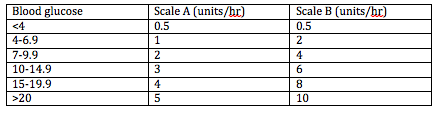
- 142when should BG be treated as a hypo on VRIII? what should you do?<4 = hypo
reduce rate to 0.5units/hr - 143give the infusion rates for each possible BG level
- 144when should you use scale A/B?use scale A initially, if BG isn't settling after 3hrs at max infusion rate then change to scale B
- 145when should the VRIII be stopped?until the pt is eating and drinking and back on their usual diabetes meds
- 146when should oral diabetes meds be started again?when the pt can eat and drink
(metformin only if eGFR is over 50) - 147when should VRIII be stopped and SC insulin started again?when pt is eating and drinking normally
stop VRIII and start SC when next meal-related SC dose is due is breakfast/lunch/dinner - 148what should you do for pts on basal bolus coming off of VRIII?overlap VRIII and 1st dose of fast acting insulin
fast acting given with meal and VRIII stopped 30-60mins later
(if the pt was on long acting levemir this should have been continued anyway) - 149how should premixed insulin be reintroduced after VRIII?insulin reintroduced either before breakfast or before evening meal
VRIII continued for 30-60mins after SC given - 150how should an insulin pump be restarted after VRIII?start at normal basal rate, VRIII continued until next meal bolus has been given
- 151how is DKA differentiated from a hypo coma?DKA symptoms will be before the coma e.g. shaking and vomiting
if the coma is just due to a hypo then it can happen suddenly - 152why do hypos cause coma?because the brain doesn't have any energy
- 153whats the treatment for a hypo?jelly babies / dextrose gel
- 154if a pt is unconscious and you don't know if theyre hyper or hypo - what should you do?always give sugar to treat hypo rather than insulin!!
- 155what type of insulin is given IVsoluble insulins
- 156what are analogue insulins?type of human insulin made in the lab - modified to affect speed of action
- 157how long does rapid acting take to work?about 15 mins
- 158how often is lantus/levemir given?lantus = OD
levemir = BD - 159whats the disadvantage of premixed insulin?less flexibility in tailoring doses
- 160why is glucose found in urine?when BG gets above a certain level, the kidneys cant reabsorb it all = some spills into urine
- 161what should you do if urine contains glucose?do a blood glucose test to confirm (some peoples kidneys can be leaky even when not hyperglycaemic)
- 162when are urine tests best done?before breakfast
bladder emptied when first wake, then take a sample 30mins later - 163whats the disadvantage of testing urine for glucose?less accurate as the urine tested may have been made hours previously
urine tests don't show when BG is too low - 164what BG level from a random test indicates diabetes?random level over 11.1
- 165how is a fasting blood glucose test done?fast 8-10hrs before
a level > 7 = diabetes - 166how do you do the oral glucose tolerance test?fast overnight, in the morning given a drink containing 75g glucose, then blood level taken 2hrs after
>11.1 = diabetes - 167how can you pick up someone in the community with diabetes?recurrent thrush
- 16813yr old newly diagnosed with diabetes - what regime would you expect him to start? (on 30 units in hospital)combination insulin BD e.g. novomix 30
15 units before breakfast
15 units before dinner - 169where is best to inject?thigh or abdomen
- 170should you inject into the same site if using 2 insulins?yes e.g. both into thigh
- 171how do you teach kids to switch injection sites?grid transfer on thigh
- 172whats the disadvantage of biphasic insulin?less controlled hba1c
less flexible dosing
night time and lunch time hypos - 173what are the advantages of biphasic insulin?less injections
wouldn't need to inject at school - 174what monitoring would you do for this pt?hba1c
lipodystrophy
eyes every 6 months
renal function - eGFR and ACR
feet
CV risks e.g. cholesterol/bmi/diet - 175what is the ideal ACR?<3.5 women
<2.5 men - 176what advice would you give to a pt who becomes ill and is not eating?- blood glucose testing at least every 4hrs
- test urine for ketones if possible
- never stop taking insulin
drink plenty of water
- replace energy by sipping something sugary
- replace fluids lost through dehydration with water / SF drinks
-vomiting needs to be stopped with anti emetics - 177what should pts on basal bolus do when ill?take long acting as normal - adjust short acting as needed
- 178what should pts on biphasic do when ill?take as normal but keep checking BG - may need correction dose with fast acting insulin
- 179what plan must all diabetic pts have?sick day plan
- 180what the target BP in diabetes?130/80
- 181what statin should be started if cholesterol is high?atorvostatin 20mg OD
- 182what is target cholesterol?<4 or 20% reduction depending on cv risk
- 183if a diabetics Q2 risk is 52%, what drug might you start him on?aspirin
- 184whats the problem with beta blockers?mask hypos
- 185what drug is 1st line for hypertension in diabetes?ACEI - protects kidneys
- 186what is duloxetine used for?neuropathic pain in diabetes - check its working - change it after 2 months!
- 187why would we give amoxicillin in diabetic patients?we expect its an anaerobe in diabetes = give broad spectrum
Information
- Description
- Masters Clinical Flashcards on 1 - Diabetes, created by lw409 on 24/04/2015.
- Created by
- lw409
- Views
- 6
- Rating