
Business Ownership and Types of Organisation
199 resources created by 169 users
This Business Ownership and Types of Organisation page on GoConqr gathers community-made mind maps, quizzes, flashcards and notes, from sole traders, partnerships and franchising to private and public limited companies and organisational structures. It's built for school students, university students and professional candidates revising a topic, plus teachers after ready-made material. There are over 2,300 resources here, including more than 80 quizzes, more than 1,700 mind maps and over 400 flashcards. Pick a topic, try a quiz to find your gaps, then make your own revision sets.
Top Business Ownership and Types of Organisation resources
-
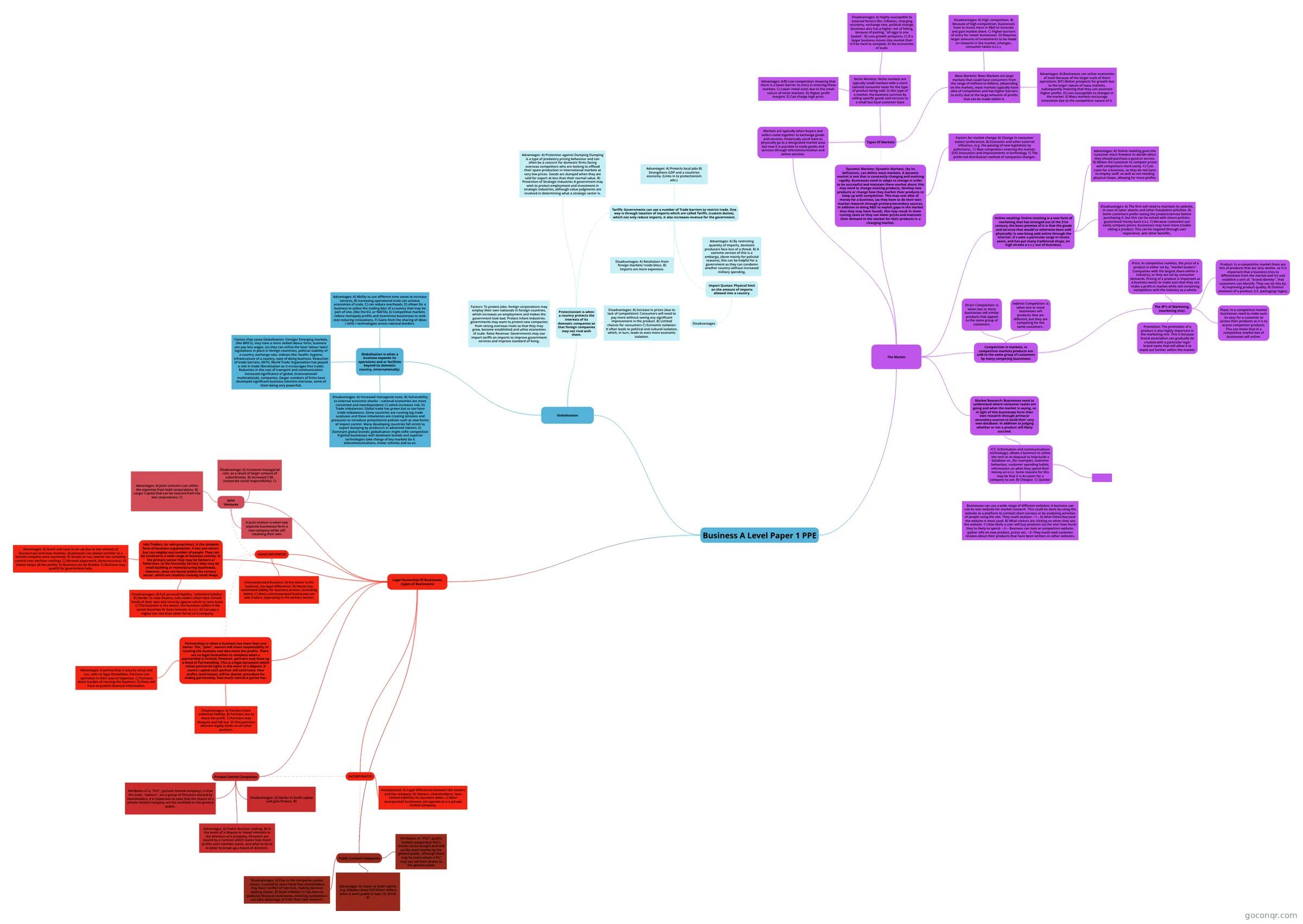 Mind map Business A Level Paper 1 PPE
-
49 questionsIntro to Business Unit 3 What is one advantage of a small business that a corporation or larger business does not have?
-
10 questionsIGCSE Business - Types of Business What type of liability does a business partnership have?
-
10 questionsIGCSE Business - Organisational Structures Quiz An organisational structure is how a business organises its staff to represent the different layers of mana...
-
10 questionsIGCSE Business Franchises What do the logos to the left all have in common?
-
Mind map 4.1 - Organisational structures
-
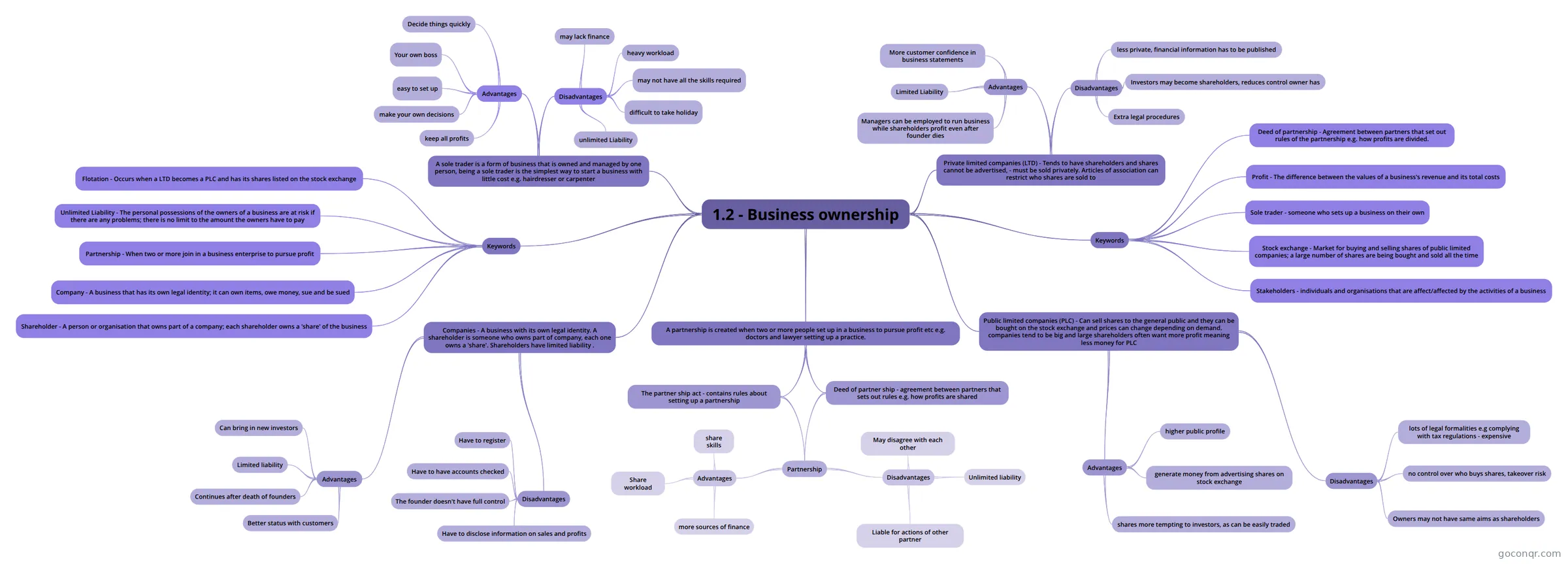 Mind map 1.2 - Business ownership
-
20 questionsForms of Business Ownership Quiz What are the advantages of a Sole Trader.
Quizzes
See all 22 quizzes-
49 questionsIntro to Business Unit 3 What is one advantage of a small business that a corporation or larger business does not have?
-
10 questionsIGCSE Business - Types of Business What type of liability does a business partnership have?
-
10 questionsIGCSE Business - Organisational Structures Quiz An organisational structure is how a business organises its staff to represent the different layers of mana...
-
10 questionsIGCSE Business Franchises What do the logos to the left all have in common?
-
20 questionsForms of Business Ownership Quiz What are the advantages of a Sole Trader.
-
10 questions11 Business 1.2 Types of Business What would be an advantage of a business being registered as a sole trader?
-
20 questionsForms of Business Ownership What are the advantages of a Sole Trader.
-
10 questionsInternal Organization Environment The planning process involves ALL of the following EXCEPT
Mind maps
See all 111 mind maps-
Business A Level Paper 1 PPE
-
4.1 - Organisational structures
-
1.2 - Business ownership
-
 1.2 Types of Business Organization Business and Management IB Program 1.2 Types of Business Organizations
-
 Business Administration and Job Roles
-
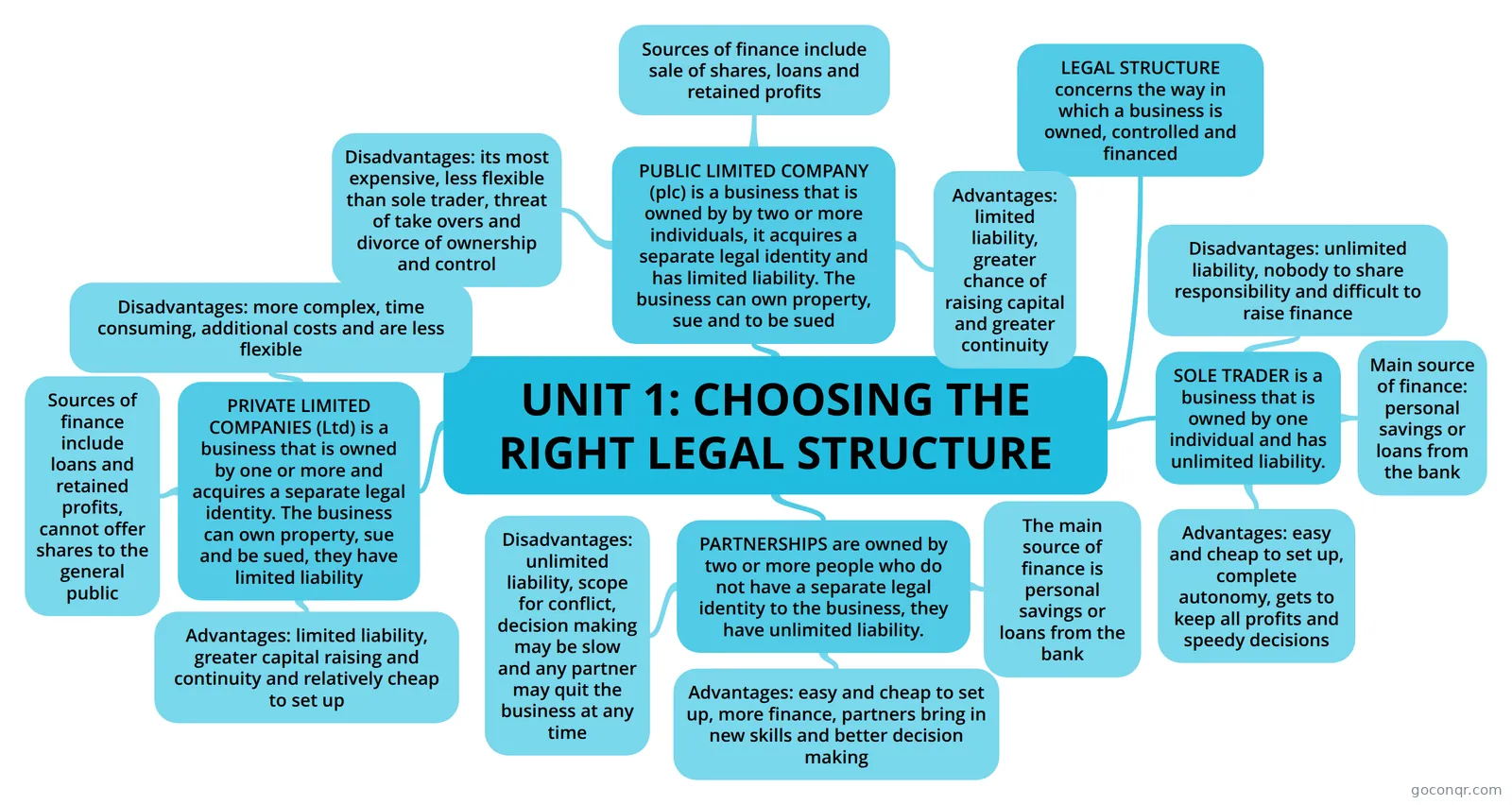 UNIT 1: CHOOSING THE RIGHT LEGAL STRUCTURE
-
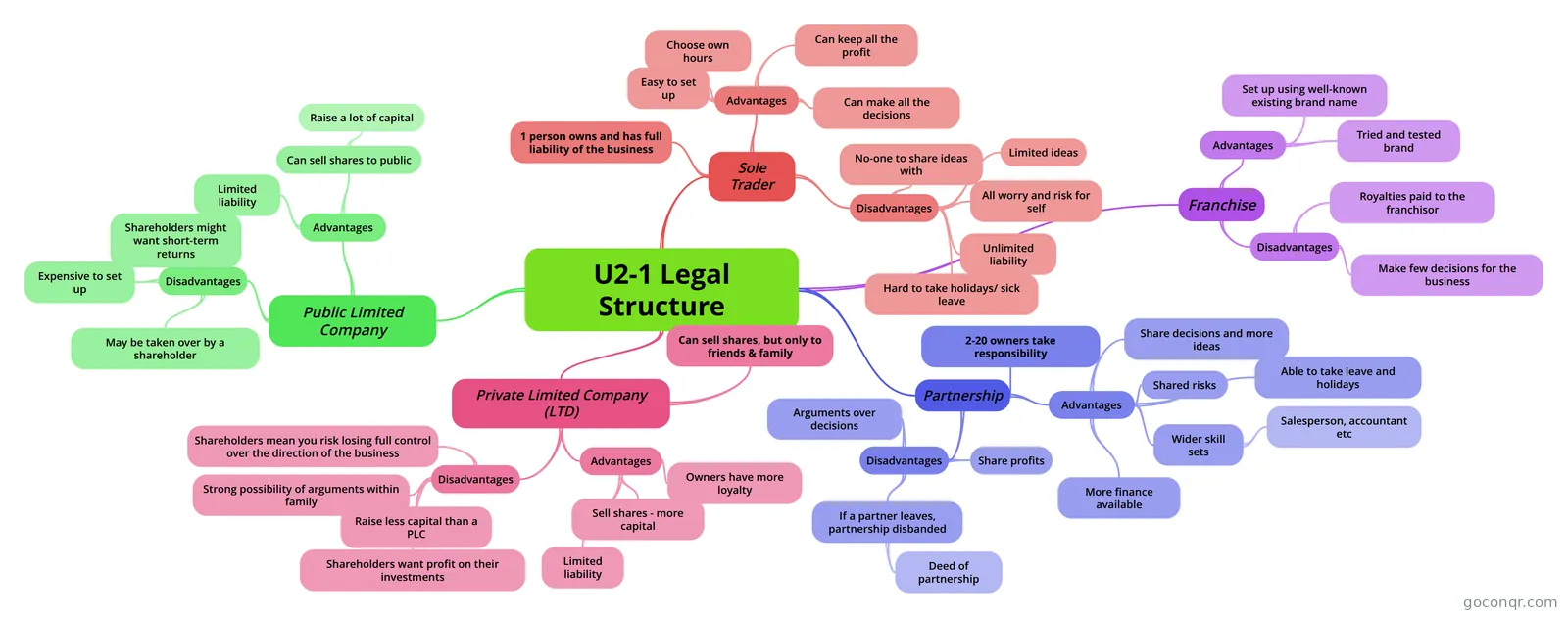 U2-1 Legal Structure
-
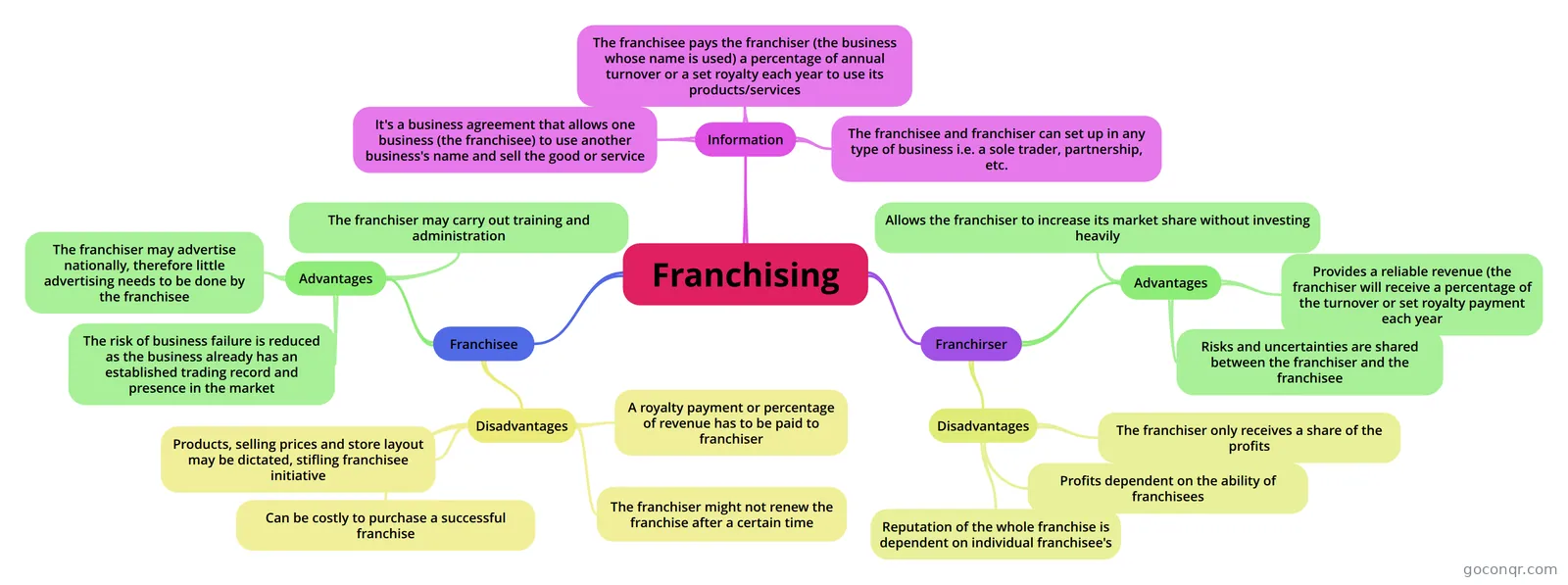 Franchising Describing what a franchise is and the advantages and disadvantages for both the franchisee and the franchiser
Flashcards
See all 57 flashcards-
19 cardsIB Business Management 1.1 What is a business?
-
16 cardsBusiness Studies Junior Cert - Forms of Business What is a sole trader?
-
6 cardsChapter 3 What are the Main Functions of the business and their purpose?
-
11 cards3. Enterprise, business growth and size
-
63 cardsBusiness 2 key terms Business Test 2 KEY TERMS
-
23 cardsBusiness Studies - Possible Exam Questions What is a sole trader?
-
43 cardsBusiness S - Teamwork Chapter 1 Problem causes in teams
-
38 cards3.4 Keywords - Effective People Management All of the keywords and definitions from 3.4 Effective People Management
Notes
-
CHAPTER 11 NOTES The private sector is the part of the economy directly owned and controlled by private individuals The 6 types of businesses Sole proprietorships Partnerships Joint Stock Companies: Private (Ltd) and Public (Plc) limi...
-
Business and Mangement A business is any organisation that uses resources to meet the needs of customers by providing a product or service they demand.They identify the needs of consumers or other firms. Inputs of the business in order to p...
-
CHAPTER 13 NOTES Firms and businesses owned by the state and controlled by the government are part of the public sector The main concern of most public enterprises is to provide a service affordable to all the community They are owned...
-
Types of businesses Types of businessesSole proprietorship: A business run by only one person. Things to remember: unlimited liability, and all work is done by one person. Almost impossible to take holidays. Private data except from HM R...
-
Forms of a Business What is a SOLE TRADER? A Sole Trader is a person who owns,manages and provides the capital for a business. What is a Privately owned company? It is a business owned by shareholders usually 1-99 who finance the busines...
-
Business Legal Structures - created from Mind Map SOLE TRADER minimum 1 owner keep all the profits invest their own capital unlimited liability RETAIL CO-OPERATIVE group of people supplies customers with lower prices lacks loyalty from m...
-
Chapter 2 Businesses with unlimited liabilityUnlimited liability- finances of the business are treated as inseparable from the finance of the business owners(s)Sole Traders- individual who owns and operates his or her own busin...
Slides
More Business administration and management (incl. project management) topics
About Business Ownership and Types of Organisation
GoConqr OriginalWhat this unit covers
The page is about who owns a business and how it is organised. The most common starting point is the Sole Trader mind map, which explains that a sole trader is a one-owner business and sets out the advantages, such as keeping all profits and having complete control, against the disadvantages. The Sole Proprietorship map covers the same ground, with limited capital, unlimited liability and lack of continuity.
Where to start
Begin with the basic forms of ownership, then move on to companies and franchises.
- Read the mind map on types of ownership for the GCSE Business Studies course, which lists sole trader advantages and disadvantages.
- Move to Legal Structures and Public Limited Company (plc) to see how limited liability and a separate legal identity change things.
- Look at Franchising, which explains how a franchisee uses another business's name and pays the franchiser.
- Finish with organisational structures, including the mind map on organisational charts and keywords.
Using quizzes and maps together
Read a map first, then test yourself. The IGCSE Business Franchises quiz uses fill-in-the-blank questions, and there are further quizzes on types of business and organisational structures. Check what you got wrong, go back to the matching map, and try again.
Flashcards are useful for definitions. The deck on forms of business starts with questions such as what a sole trader is and what unlimited liability means, so it suits quick recall.
Exams and wider context
The resources mention GCSE Business, IGCSE Business, A-level Business, IB Business Management and OCR Applied Business. A flow diagram for CIMA BA1 on the features of organisations is there for professional candidates. This unit sits in the Business Foundations strand of Business administration and management (incl. project management).
Next step
Choose one form of ownership, work through its map and quiz, and then try making your own flashcards to compare them.
Frequently asked questions
Where should I start on this page?
Start with the Sole Trader mind map, because it sets out the advantages and disadvantages of the simplest form of ownership. Then move on to Legal Structures and the Public Limited Company (plc) map. Once those feel familiar, try a quiz on types of business to see what you remember.
Are the resources free to use?
Yes. Every resource listed here is free to open, study and take, with no account needed. They were made by GoConqr users, not by GoConqr itself, so it is worth checking anything that looks unclear against your own course materials.
Which exams do these resources suit?
The listed resources mention GCSE Business, IGCSE Business, A-level Business, IB Business Management, OCR Applied Business and CIMA BA1, among others. Most are aimed at school students, with some for university students and a few for professional candidates. Check the title of each resource to match it to your course.
What do the mind maps cover?
They cover sole traders, sole proprietorships, partnerships, private and public limited companies, franchising and legal structures. Others look at organisational structures, business sectors and the functional areas of a company. Many include advantages and disadvantages, which makes them handy for comparing forms of ownership.
Can I use this page for flashcards as well as quizzes?
Yes. There are over 400 flashcards, including a deck on forms of business that asks what a sole trader is and what unlimited liability means. Use them for definitions, then try a quiz to see whether you can apply the terms. A free account also lets you save your scores and make your own sets.
What if the topic I need is missing?
Look at the related resources with different wording, since users title things in many ways, such as business structure, legal structure or forms of business. If you still cannot find it, you can make your own mind map or flashcards with a free account.