
Teaching Reading
692 resources created by 561 users
This Teaching Reading page on GoConqr gathers community-made mind maps, flashcards, quizzes and notes, from reading strategies and balanced reading programmes to Chall's stages and phonics. It's built for university students and professional candidates preparing for teaching exams, and for teachers after ready-made material, with a few resources suited to school students. There are over 600 resources here, including more than 500 mind maps and more than 20 quizzes. Try a quiz to find your gaps, then open a map to fill them.
Select topic
- Reading Skills and Components29
- The Reading Process and Models of Reading13
- Reading Development21
- Phonemic Awareness, Phonics and Decoding21
- Reading Fluency8
- Vocabulary Development10
- Reading Instruction Approaches32
- Guided, Shared and Collaborative Reading19
- Reading Texts and Extensive Reading14
- Reading Comprehension Strategies156
- Active, Close and Critical Reading12
- Second Language Reading15
- Reading Assessment16
Top Teaching Reading resources
-
191 cardsRLA Flashcards
-
Mind map TEACHING READING MIND MAP ABOUT CHAPTER 07: TEACHING READING, BY LINO ANDRÉS DUQUE MOYA.
-
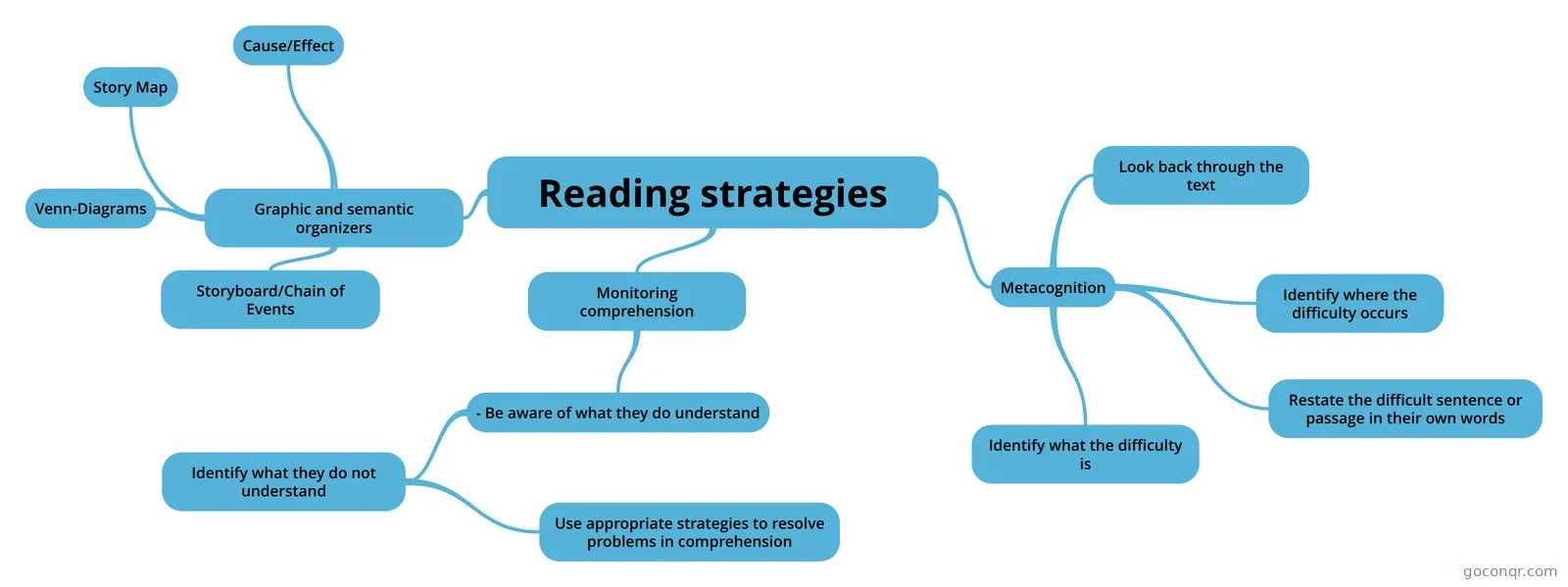 Mind map Reading strategies reading
-
Mind map Recognizing an Author's Purpose DL5013 - Engaging Diverse Learners In Diverse Environments
-
60 questionsRICA Website Practice Test A sixth grader who is advanced in most areas of reading has difficulty completing assigned reading selectio...
-
78 cardsRICA Study Guide The smallest unit of speech
-
40 questionsSubset 1 Which of the following teacher practices in a kindergarten class is likely to be most effective in reinforc...
-
61 questionsSubtest 1 Reading research conducted using scientific-based research methods has identified which of the following ar...
Quizzes
See all 28 quizzes-
60 questionsRICA Website Practice Test A sixth grader who is advanced in most areas of reading has difficulty completing assigned reading selectio...
-
40 questionsSubset 1 Which of the following teacher practices in a kindergarten class is likely to be most effective in reinforc...
-
61 questionsSubtest 1 Reading research conducted using scientific-based research methods has identified which of the following ar...
-
104 questionsRICA Domain III: Developing Reading Comprehension and Promoting Independent Reading A student who moves his/her lips while reading may have a problem with:
-
69 questionsRICA Practice Domain 1 As Jack is reading a text sample, he reads "The dog ran to the horse" rather than what the text actually st...
-
15 questionsRICA TEST PREP 46 - 60 A sixth-grade teacher reads his students the nonsense poem "Jabberwocky" by Lewis Carroll. The first four l...
-
15 questionsRICA TEST PREP 31 - 45 A fourth-grade student who reads grade level narrative texts with fluency and excellent comprehension is st...
-
10 questionsFoundations of Reading - Pearson website Which of the following statements best explains the difference between phonemic awareness and phonics skills?
Mind maps
See all 566 mind maps-
TEACHING READING MIND MAP ABOUT CHAPTER 07: TEACHING READING, BY LINO ANDRÉS DUQUE MOYA.
-
Reading strategies reading
-
Recognizing an Author's Purpose DL5013 - Engaging Diverse Learners In Diverse Environments
-
Beginning Reading
-
How to teach reading?
-
Balanced Reading Program
-
How to teach Reading
-
Vocabulary - What are research-based and evidence-based instructional strategies that early primary teachers can use in Tier 1 instruction?
Flashcards
See all 51 flashcards-
191 cardsRLA Flashcards
-
78 cardsRICA Study Guide The smallest unit of speech
-
117 cardsLiteracy & ELA Review Learning to Read
-
67 cardsRICA Flash Cards RICA STUDY QUESTIONS Domains 1-5 Competencies 1-15
-
67 cardsRICA Flash Cards RICA STUDY QUESTIONS Competencies 1-15
-
45 cardsTeaching reading
-
24 cardsReading Theorists Jeanne Chall (1983)
-
25 cardsReading key terms
Flowcharts
See all 23 flowchartsNotes
See all 19 notes-
Struggling Decoders Phonological Awareness Importance of phonological awareness for struggling decoders Phonological Core Variable Difference Model provides evidence that the core phonological processing at the phoneme level (Stanovich, ...
-
Sub Area II. Reading Instruction and Assessments Competency 6.0 - Understand Phonological and Phonemic AwarenessPhonological Awareness - ability of the reader to recognize the phonemes (or sounds) of spoken language. Includes how the sounds are blended togethe...
-
Reading Extensive and intensive reading Teacher encourage students to choose what they read for themself It is designed to enable students to develop specific skills as reading for gist: reading for specific information, read...
-
Scanning Reading Comprehension Skills - Scanning ESL Lesson Plan By Kenneth Beare One of the most common mistakes students make in reading is to try to understand each and every word they read. The switch to readin...
-
Balanced Reading Program
-
Reading Stages - Jeanne Chall Jeanne Chall's 6 Stages of Reading DevelopmentStage: 0Description: pre-reading Age: 0-6Characteristics: pretend reading and some letter memory Stage: 1Description: initial reading and decodingAge: 6-7Characteristics: ...
-
TEACHING READING COMPREHENSION - created from Mind Map COMPREHENSION FACTORS VOCAB SKILLS FLUENCY TEXT BACKGROUND KNOWLEDGE MOTIVATION READER understand what they read automatically use details to decode reading cognitivly able to read fluenty GENRES TEXT STRUCTURES TEXT ...
-
Reading - Erstellt aus einer Mindmap_1 extensive reading main goal: reading for pleasure or general language improvement students choose what they want to read longer tets reading consistently over time on a regular bassi graded readers 6 types of knowledg...
Slides
Topics in Teaching Reading
More Education and pedagogy (incl. teaching methods, curriculum, educational psychology) topics
About Teaching Reading
GoConqr OriginalWhat this page covers
The page brings together over 600 resources on how reading is taught, made by GoConqr users. Most are mind maps, with flashcards, quizzes, notes, slide sets and flowcharts alongside them. The topics run from word-level skills to comprehension and assessment.
Where to start
Begin with the big-picture maps. The mind map TEACHING READING lays out reasons for reading, kinds of reading, reading levels, skills, principles and sequences. Reading strategies then looks at monitoring comprehension: noticing what you understand, spotting what you do not, and choosing a strategy to fix the problem.
Next, pick the approach that matches your question:
- Learning to read compares the phonics approach, the look and say approach and the psycholinguistics approach.
- Balanced Reading Program covers independent, read aloud, shared and guided reading.
- Shared Reading lists the positives of reading together, such as community spirit and growing confidence.
- Recognizing an Author's Purpose shows ways to practise the skill with task cards, worksheets and Boom Cards.
Preparing for RICA
Several resources mention RICA. The RICA Study Guide flashcards define terms such as phonemes and morphemes. The notes on Sub Area II, Reading Instruction and Assessments, work through Competency 6.0 and phonological and phonemic awareness. The RICA Website Practice Test presents classroom scenarios, and there are four practice sets that split the questions into blocks of fifteen.
Using maps and quizzes together
Read a map first, then take a quiz without looking. Note the questions you missed, go back to the matching map or flashcards, and try again later. Flashcard decks such as Reading Theorists and Jeanne Chall's Stages of Reading Development are handy for quick recall of names and stages. Notes created from mind maps give the same content in a more linear form if you prefer reading to branching diagrams.
Where it fits
This unit sits in the Teaching Language Skills and Literacy strand of Education and pedagogy. It suits university students, professional candidates and teachers who want to compare approaches and check their knowledge.
Choose one map that matches what you are studying today, then take a quiz on it and see what is still unclear.
Frequently asked questions
Which resource should I open first?
Start with the mind map TEACHING READING for an overview of reasons for reading, reading levels, skills, principles and sequences. Then open Reading strategies to see how readers monitor comprehension. After those two, choose a more specific map, such as Balanced Reading Program or Learning to read.
Are there resources for RICA?
Yes. The page lists the RICA Study Guide flashcards, the RICA Website Practice Test, four RICA test prep quizzes and a Domain III quiz on reading comprehension. There are also notes on Reading Instruction and Assessments. They are made by GoConqr users, so use them alongside your official course materials.
What do the mind maps cover?
They cover reading strategies, comprehension, approaches to teaching reading, balanced reading, shared reading, reading assessment, making inferences and the interactive reading process model. Some are linked to courses, and others focus on topics like literature circles or learning to read in ESL. Pick the one closest to your question.
Who is this page for?
It is mainly for university students and professional candidates studying how reading is taught, and for teachers looking for ready-made material. A few resources also suit school students. You can use quizzes to check knowledge and flashcards for key terms and theorists.
Do I need an account to use these resources?
No. Every resource listed here is free to open, study and take without an account. If you want to save your quiz scores or make your own quizzes, mind maps, flashcards and notes, you can add a free account.
What if I can't find the topic I need?
Try a nearby resource first. Reading Assessment, Reading Process and Teaching Reading Comprehension may cover part of it. Because the resources were made by GoConqr users, you can also build your own map or flashcards on the missing topic.