
The Scientific Method
540 resources created by 487 users
This The Scientific Method page on GoConqr gathers community-made notes, mind maps, flashcards, quizzes, slides and flowcharts, from observation and hypothesis to variables, lab reports and the limits of the method. It's built for school students revising a topic, university students and professional candidates filling gaps, and teachers after ready-made material. There are over 500 resources here, including more than 20 quizzes, over 300 mind maps and over 100 flashcard sets, mostly at secondary level with a good share at university level. Pick a resource, try a quiz, then make your own.
Top The Scientific Method resources
-
21 cardsUnit 1.2 Secondary Sources Some reasons you can't always run your own experiments or take your own observations and data.
-
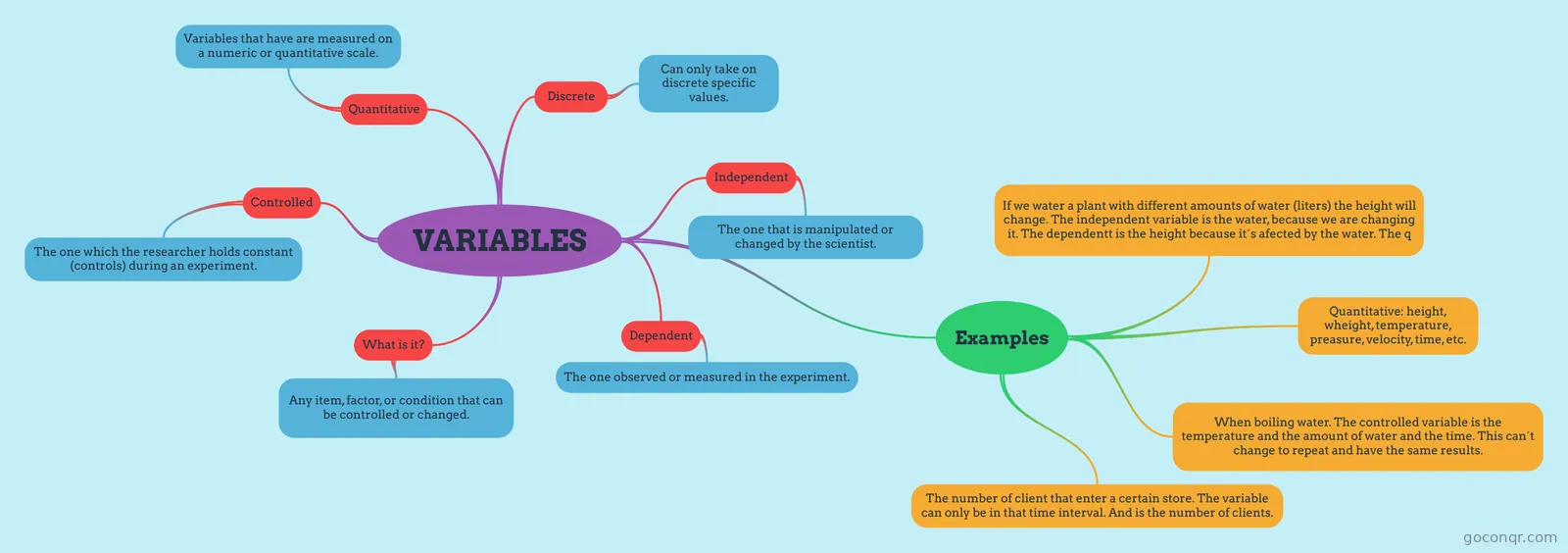 Mind map VARIABLES Types of variables
-
9 cardsChapter 2 - Scientific Inquiry What is a hypothesis?
-
4 cardsScientific Methods Variables Here are some flashcards with terms that need to be included in my experimental design
-
4 cardsScientific Method Variables Here are flashcards to with tems that need to be included in the experimental design of my science project.
-
20 questions2. Types of Variables and levels of measurement. What is a continuous variable?
-
22 cardsChapter 1 Introduction to Research
-
17 cardsAn Introduction to Science What is Science?
Quizzes
See all 36 quizzes-
20 questions2. Types of Variables and levels of measurement. What is a continuous variable?
-
18 questionsWEEK 2 Hypothesis Handout, Synonyms Handout, L1: Theories, Modeling, & Hypothesis, PPT(3): More on the Scientific ...
-
5 questionsIdentifying Independent Variables Do tomatoes grow fastest under fluorescent, incandescent, or natural light?
-
14 questionsExam - Term 1 - Study Quiz What is the independent Variable?
-
10 questionsIntroduction to the scientific method Which are examples of objective observations?
-
8 questionsunderstanding the Scientific Method What is the Scientific Method? The way in which scientists study the world and propose explanations based [...
-
3 questionsIdentifying Hypothesis In the conversation, Jerry states that he believes that if they make peanut butter cupcakes, then they will...
-
3 questionsThe Scientific Method Hypothesis and prediction are both the same.
Mind maps
See all 315 mind maps-
VARIABLES Types of variables
-
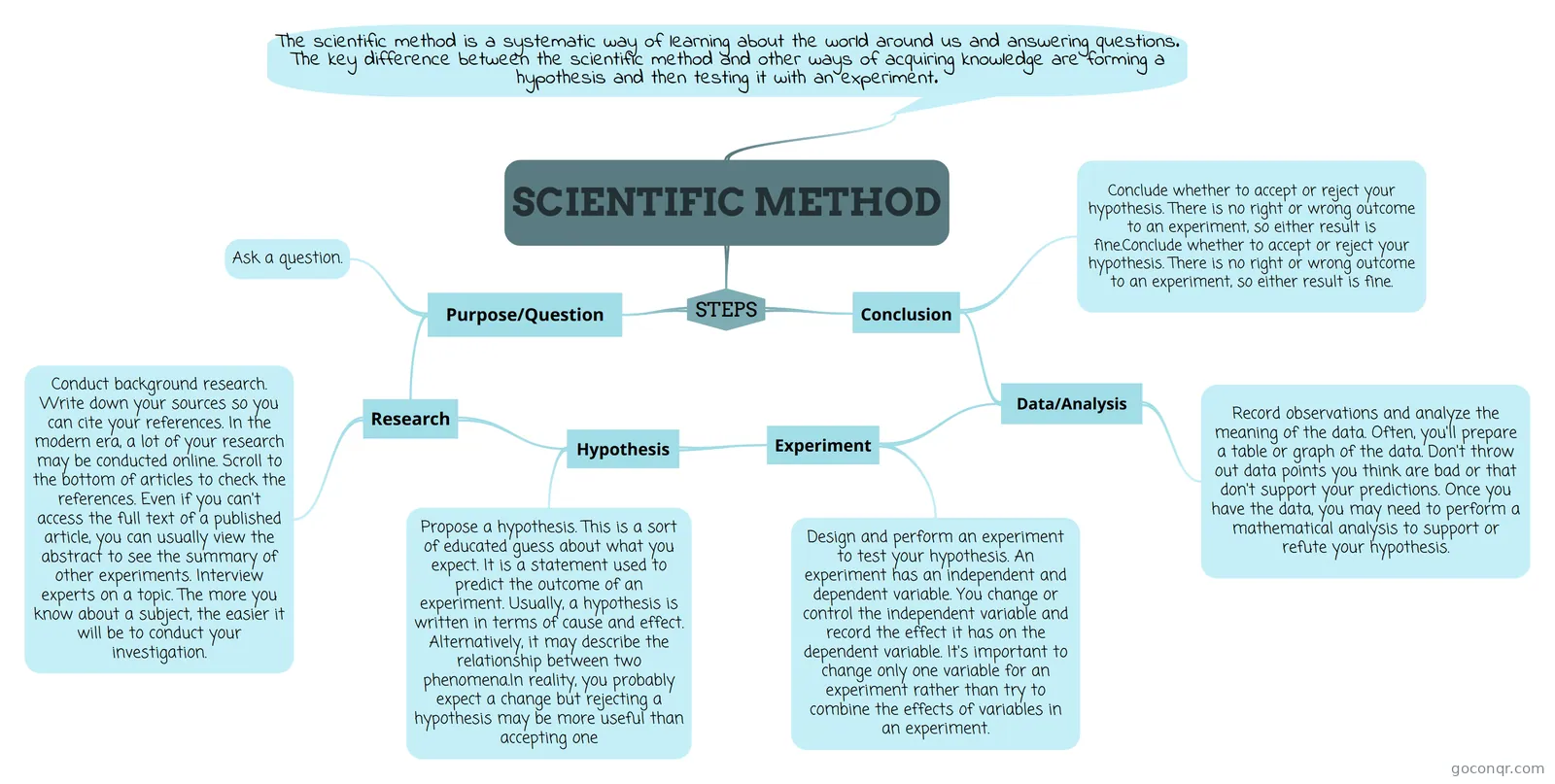 SCIENTIFIC METHOD Definition and steps of the scientific method
-
KNOWLEDGE KNOWLEDGE scientific method
-
AQA GCSE ISA SECTION 1 GUIDE
-
ISA- section 2
-
Scientific Method This mind map shows the steps of the scientific methof and the description of each.
-
The Scientific Method The mind map shows the steps of the scientific method and the description of each.
-
Scientific Method This mind map shows the steps of the scientific method and a description of each.
Flashcards
See all 134 flashcards-
21 cardsUnit 1.2 Secondary Sources Some reasons you can't always run your own experiments or take your own observations and data.
-
9 cardsChapter 2 - Scientific Inquiry What is a hypothesis?
-
4 cardsScientific Methods Variables Here are some flashcards with terms that need to be included in my experimental design
-
4 cardsScientific Method Variables Here are flashcards to with tems that need to be included in the experimental design of my science project.
-
22 cardsChapter 1 Introduction to Research
-
17 cardsAn Introduction to Science What is Science?
-
12 cardsUnit 1 How do you do science? What are Methods of Investigation
-
17 cards1.3 Conducting Investigations 1.3 - Conducting investigations
Flowcharts
See all 25 flowcharts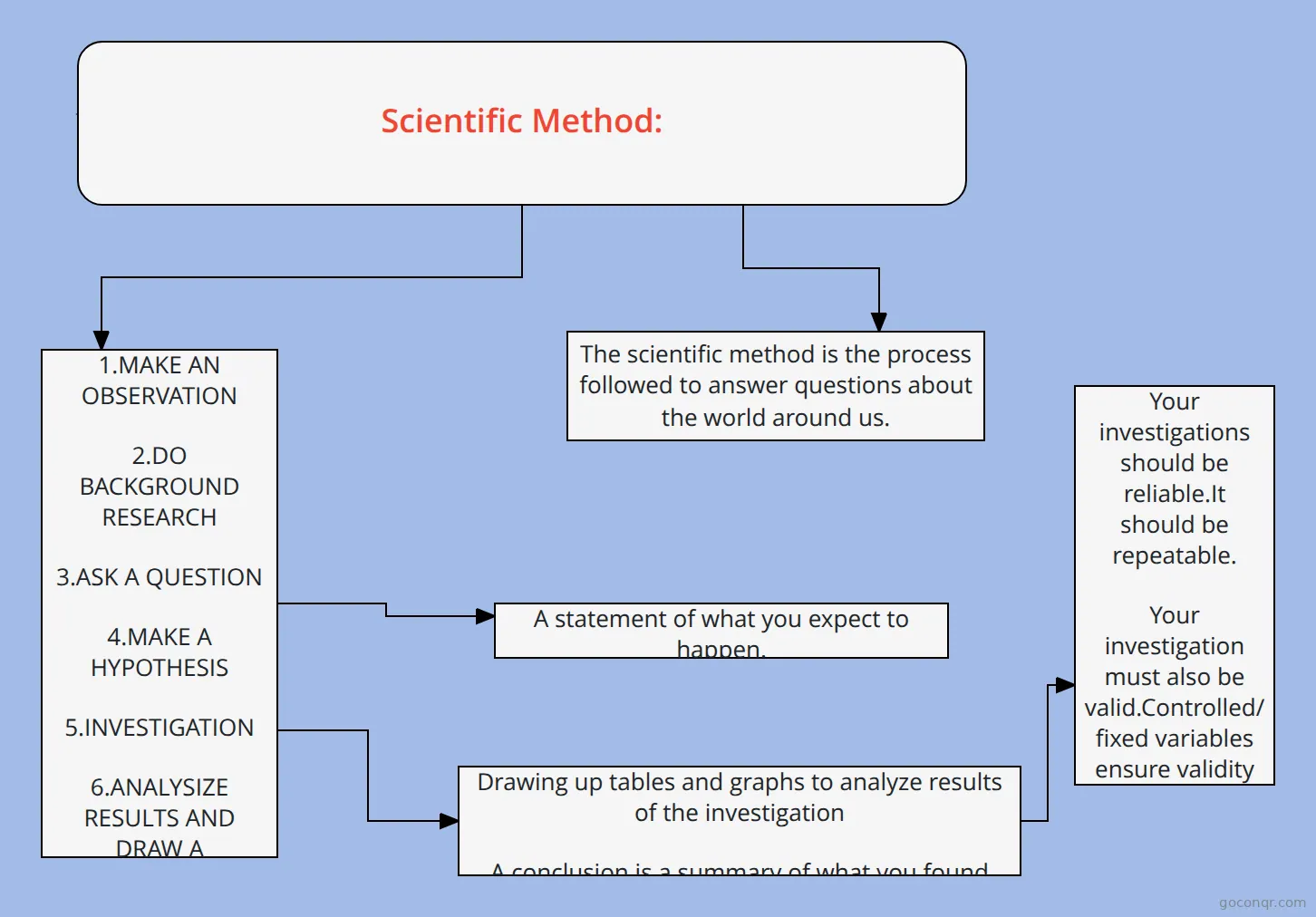
Notes
See all 24 notes-
Scientific Method The Scientific Method is an organised way for scientists (or anyone!) to answer questions and develop solutions. There are usually six parts to it. • Purpose/Question – What do you want to learn? An example would be, ...
-
Limitations of the Scientific Method Insufficient Knowledge - leads to incorrect hypothesis Method of Investigation - inadequate observations or design of experiment can give misleading or incorrect results Misinterpretation of results Human Error - usin...
-
Scientific Method Step 4- Performing an Experiment When a hypothesis has been established and predictions made, a controlled experiment is designed and carried out. There are many principles which must be followed when performing a scientific experiment. The experimen...
-
Scientific Method step 2-hypothesis The second step of the scientific method is to from a hypothesis based on our observations made in step 1. A hypothesis is a clear principle which will predict a certain outcome or effect and can be used to explain a ...
-
Scientific Method step 1-observation The scientific method is a clearly defined protocol to follow when carrying out a scientific study at any level or discipline. The first step of the scientific method is to make observations based on verifiable events...
-
The Scientific Method Step 3-Predictions The prediction step of the scientific method is a continuation of the hypothesis. It is the step where the inductive reasoning which brought about the hypothesis is transformed into a practical thought process where a...
-
The Scientific Method steps 5+6-Analysis and Conclusion When an experiment has been designed and performed, the next step is to analyse the results and deduce a conclusion or conclusions. The simplest analysis is whether the experiment lives up to the prediction and whethe...
-
How to Win a Noble Prize - Peter Doherty What does science involve? To be a good research scientist means understanding that it involves discovery and lots of effort towards pushing society to become more advanced. You can't just say you're going to dis...
Slides
Topics in The Scientific Method
More Research methods and academic skills topics
About The Scientific Method
GoConqr OriginalWhat this unit covers
The core note, Scientific Method, explains that the method is an organised way to answer questions and develop solutions, usually in six parts, starting with the purpose or question. Other notes take the steps one at a time: observation, hypothesis, predictions, performing an experiment, and analysis and conclusion. A further note looks at the limits of the method, such as insufficient knowledge, weak experimental design and misinterpretation of results.
Where to start
Begin with the Scientific Method note, then look at the slide set called The Scientific Method for a quick walk through the process and its definitions. Flowcharts such as Scientific Method Overview show the order of the steps at a glance, which helps if you like to see a process laid out.
Variables and experiments
Variables trip up many students, so give them time. The VARIABLES mind map sets out what a variable is and separates independent from dependent. The flashcard deck Scientific Method Variables adds controlled variables and the control group. After that, the quiz Identifying Independent Variables lets you check your understanding. The Chapter 2 deck on scientific inquiry adds hypotheses, predictions, data and ethics.
Using quizzes and maps together
Read a mind map first to get the shape of a topic. Then take a quiz without looking, and note what you missed. Go back to the map or the matching flashcards for those points only, and try the quiz again later. Some resources lean towards writing up work, such as the Step-by-Step Lab Report mind map and the one on scientific reporting. One mind map goes further, with causal mechanism, correlation, confounding variables and operationalisation, which suits university students. The AQA GCSE ISA SECTION 1 GUIDE mind map is there for GCSE Science.
Where it fits
This unit sits in the Foundations of Research strand of Research methods and academic skills. Teachers can pull in ready-made maps, decks and quizzes for lessons or homework. Choose one resource that matches what you need today, and build your own maps and flashcards from it.
Frequently asked questions
Which resource should I open first?
Start with the note called Scientific Method. It explains the six usual parts of the method in plain language, beginning with the purpose or question. After that, the slide set The Scientific Method and the flowchart Scientific Method Overview give you the same sequence in a shorter, more visual form.
What do the mind maps cover?
The mind maps cover the steps of the method, variables, hypotheses, experimental procedures, data tables, lab reports and scientific reporting. Some go further into correlation, confounding variables and operationalisation. Others look at science as a process, good theories, bad science and the history of the scientific method.
Are the resources free to use?
Yes. Every resource on this page is free to open, study and take, with no account needed. They were made by GoConqr users rather than by GoConqr itself, so styles and depth vary. A free account saves your quiz scores and lets you make your own quizzes, maps, flashcards and notes.
Which levels and exams do these suit?
Most resources are at secondary level, with a good share at university level. Exam wise, the listed resources mention GCSE Science, including an AQA GCSE ISA guide mind map. University students and professional candidates can use the maps on correlation, confounding variables and research methods chapters.
How can I practise variables?
Use the VARIABLES mind map and the Scientific Method Variables flashcards to learn the terms. Then try the quiz Identifying Independent Variables, plus the quiz on types of variables and levels of measurement. Mark what you got wrong and return to the cards for those terms.
What if I can't find what I need?
Try a different format for the same idea, because notes, maps, flashcards and flowcharts cover the steps in different ways. If something is still missing, you can make your own notes, mind maps, flashcards or quizzes with a free account and keep them alongside the community ones.