
Statistics and Quantitative Data Analysis
123 resources created by 108 users
This Statistics and Quantitative Data Analysis page on GoConqr gathers community-made quizzes, mind maps, flashcards and a slide set, from factorial ANOVA and multiple regression to factor analysis and the steps of a statistical investigation. It's built for university students and professional candidates practising analysis and interpretation, and for teachers after ready-made material. There are over 120 resources here, including more than 10 quizzes, over 60 mind maps and more than 30 flashcard decks. Try a quiz to find your gaps, then make your own revision sets.
Select topic
- Stages of Statistical Research15
- Data Collection, Preparation and Questionnaire Analysis10
- Descriptive Statistics and Data Presentation12
- Qualitative Data Analysis12
- Statistical Inference and Hypothesis Testing22
- Analysis of Variance (ANOVA)6
- Correlation and Regression6
- Factor Analysis and Structural Equation Modeling8
- Causal Inference Methods5
Top Statistics and Quantitative Data Analysis resources
-
96 questionsResearch Methods II potential MCQ's Steven scores 55% on a Mathematics exam, and 74% on an Economics exam. Which is Steven's better subject in ...
-
10 questionsResearch Methods IV - Week 7 Factorial ANOVA I I'm doing a three way ANOVA with a 3x3x2 design, what does this tell you?
-
4 questionsResearch Methods: Multiple Regression Fill in the Blank: Multiple Regression is a logical extension of linear regression that allows us to ... an...
-
88 cardsWEEKS 5-7: RMD Why Use SEM?
-
58 questions3. The principles of statistics, the assumptions on which statistical tests are based, sampling, and the preparation of data for analysis Complete the following sentence. All else being equal, it is more likely results will be statistically sign...
-
38 questionsRDA1 Ordinal level data are characterised by:
-
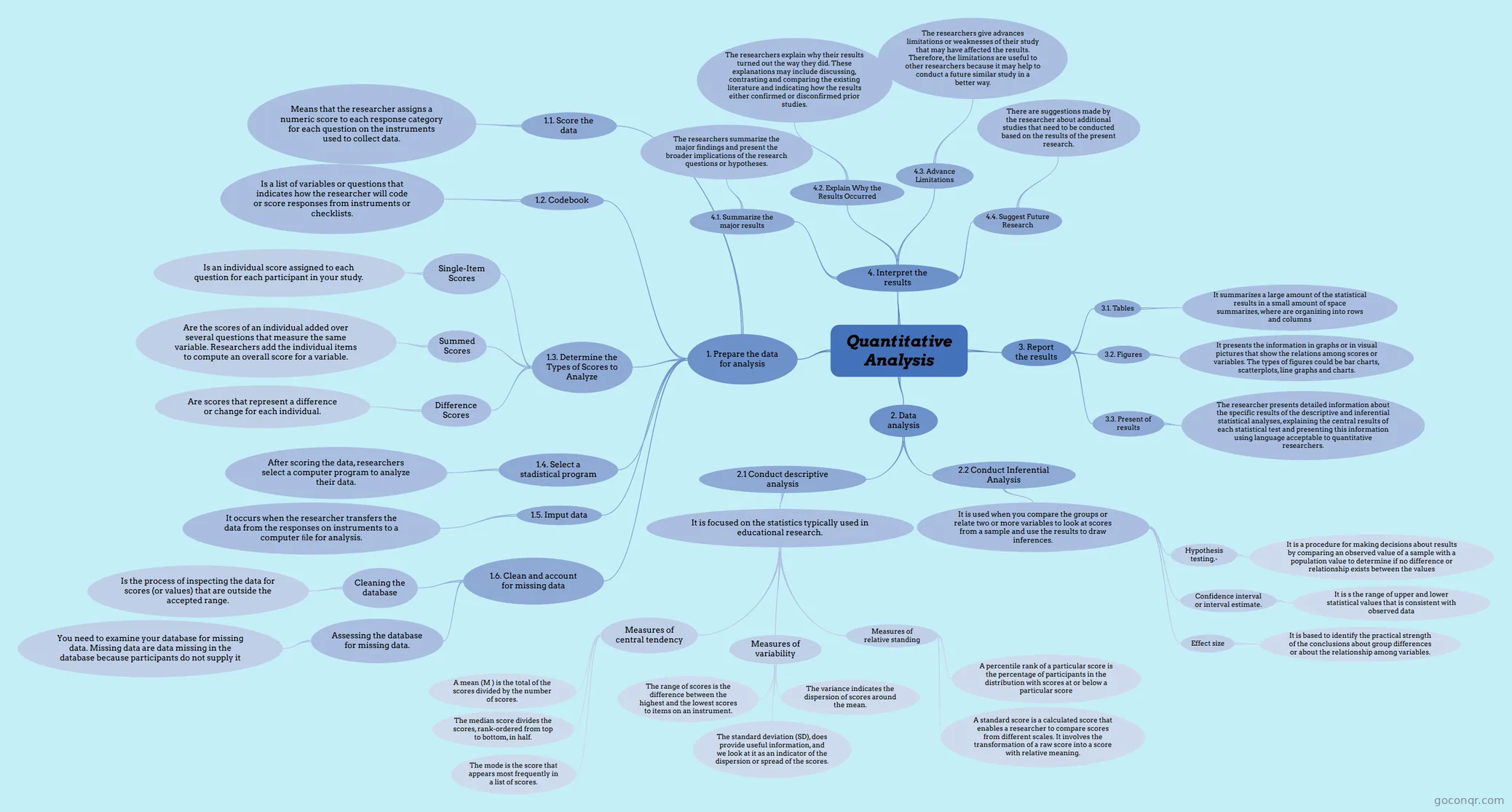 Mind map Quantitative Analysis Relizado por: Karal Vélez Quiñónez y Josselyn Jiménez Jiménez Referencias: Creswell, J. W. (2002). Educatio...
-
18 cardsWEEK 2: Mediation and Moderation What is Mediation?
Quizzes
See all 11 quizzes-
96 questionsResearch Methods II potential MCQ's Steven scores 55% on a Mathematics exam, and 74% on an Economics exam. Which is Steven's better subject in ...
-
10 questionsResearch Methods IV - Week 7 Factorial ANOVA I I'm doing a three way ANOVA with a 3x3x2 design, what does this tell you?
-
4 questionsResearch Methods: Multiple Regression Fill in the Blank: Multiple Regression is a logical extension of linear regression that allows us to ... an...
-
58 questions3. The principles of statistics, the assumptions on which statistical tests are based, sampling, and the preparation of data for analysis Complete the following sentence. All else being equal, it is more likely results will be statistically sign...
-
38 questionsRDA1 Ordinal level data are characterised by:
-
10 questionsResearch Methods IV - Week 4 Within-Subjects ANOVA In a repeated measures ANOVA, the within-participant variability is divided into two components, what are t...
Mind maps
See all 69 mind maps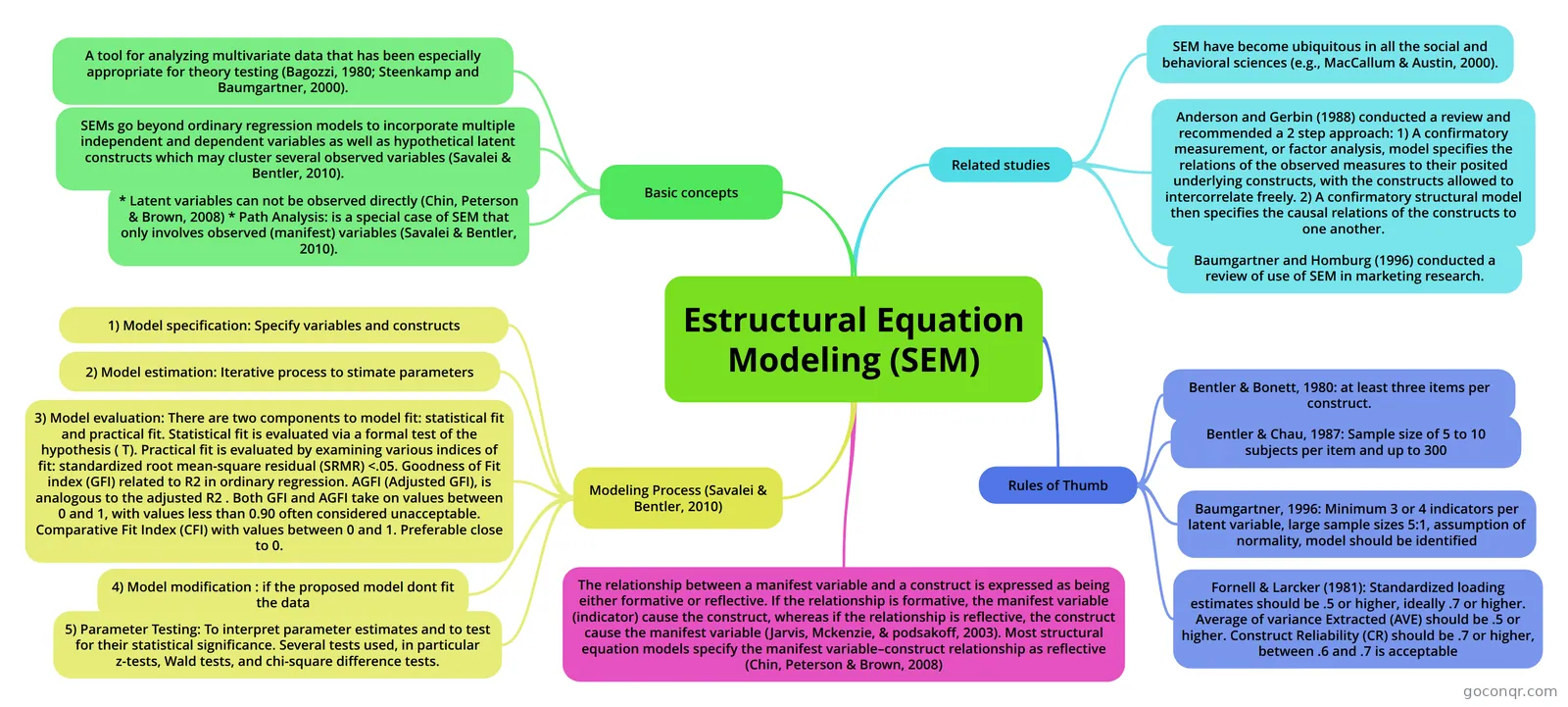
Flashcards
See all 37 flashcards-
88 cardsWEEKS 5-7: RMD Why Use SEM?
-
18 cardsWEEK 2: Mediation and Moderation What is Mediation?
-
18 cardsRDA2- Recap What are the measures of Descriptive Statistics?
-
20 cardsresearch skills L11 bigger sample size makes it BLANK to detecct difference between two populations
-
4 cardsCasual Mechanism 11 MBE, phases, process tracing
-
11 cardsResearch Methods Week Two Variance and Averages
-
33 cardsCH. 8 where is the qualitative data analysis and results
-
32 cardsresearch skills handout4 t or f: catagorical data can be norally ditributed
Topics in Statistics and Quantitative Data Analysis
More Research methods and academic skills topics
About Statistics and Quantitative Data Analysis
GoConqr OriginalWhat the page covers
This unit sits in the Data Collection and Analysis strand of Research methods and academic skills. Most of it is quantitative: tests, models and how to read their output. Some qualitative analysis maps are included too, so you can compare the two approaches.
Tests and models
The quizzes take on the harder material. Research Methods IV - Week 7 Factorial ANOVA I asks what a three way ANOVA with a 3x3x2 design tells you, and how the variability explained by the model can be split further. A companion quiz covers Week 4 Within-Subjects ANOVA. Research Methods: Multiple Regression treats regression as an extension of linear regression and asks when extra variables help. The Research Methods flashcard deck sets out standard, hierarchical and step wise multiple regression.
For factor analysis, the deck RM - Lecture 4 - Factor Analysis asks what Charles Spearman did and what factor analysis is good for. There is also a Factor Analysis slide set, and the Week 3 mind map on the same topic. Moderation and mediation have their own decks.
Foundations and process
If you need the basics first, open the mind map Data analysis and presentation. It covers nominal, ordinal and interval scales, then bar charts and histograms. The quiz Research Methods II potential MCQ's includes a question comparing exam scores against group means and standard deviations. Several maps set out the steps of a statistical investigation, from collecting data to interpreting it.
A sensible order
- Skim a foundations map to settle scales and descriptive statistics.
- Work through the flashcards on regression or factor analysis.
- Take the matching quiz without notes.
- Return to the map for anything you missed.
Maps show how ideas connect, while quizzes show what you can actually recall. Using both gives a clearer picture than either alone.
Pick one test you find hardest, open its quiz, and see where you stand.
Frequently asked questions
Which quiz should I start with?
If you want something concrete, try Research Methods: Multiple Regression, which builds on linear regression. For harder design questions, the Week 7 Factorial ANOVA quiz asks about a 3x3x2 three way design. For a gentler start, Research Methods II potential MCQ's mixes in standard score comparisons.
What do the mind maps cover?
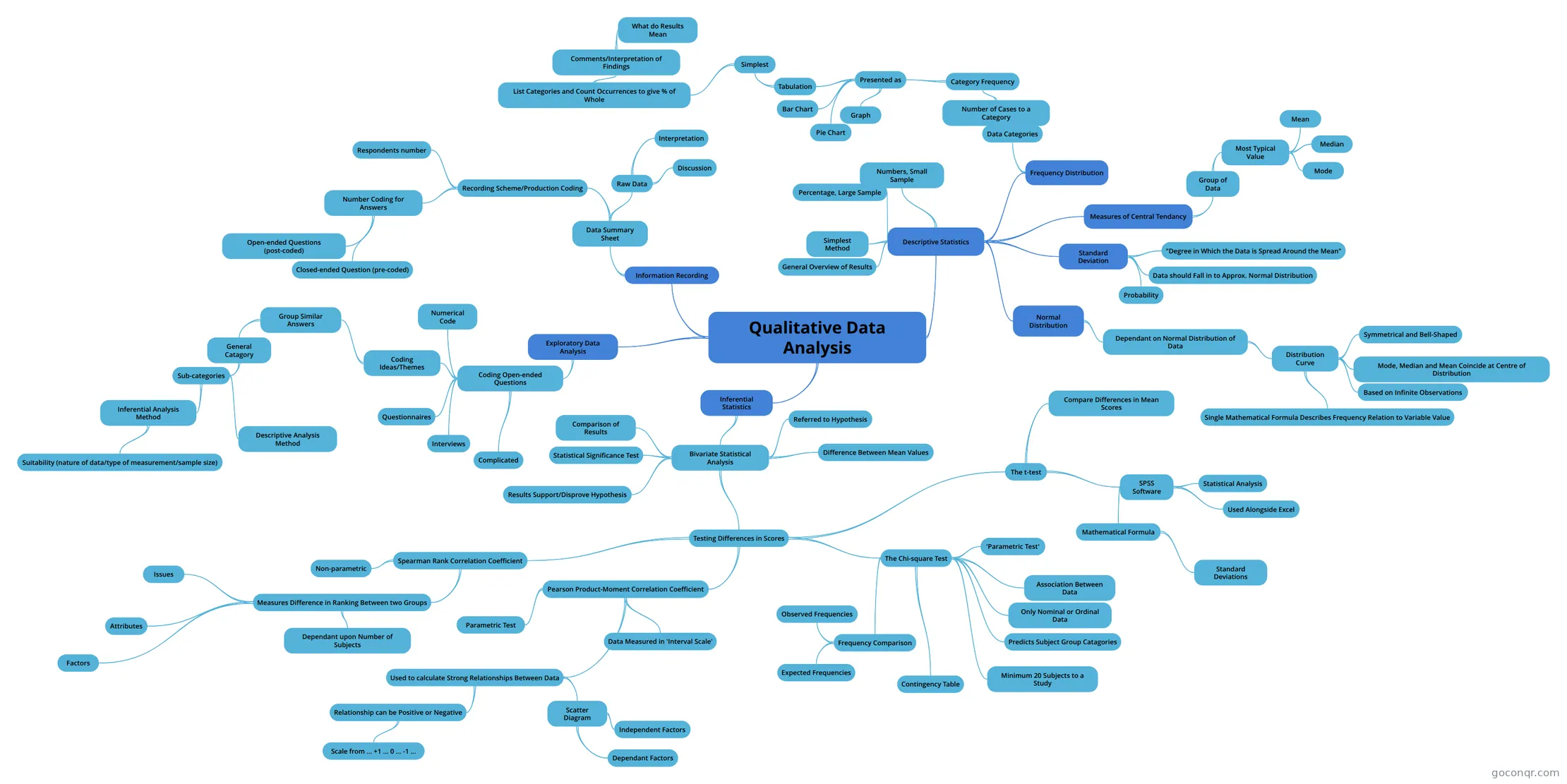
They range from scales of measurement, charts and descriptive statistics to the steps of a statistical investigation, factor analysis, tests of correlation and structural equation modelling. A few cover qualitative content analysis, so you can see how coding differs from numerical analysis.
Are the resources free to use?
Yes. Every resource listed here is free to open, study and take, with no account needed. They were made by GoConqr users, not by GoConqr itself, so it is worth checking anything against your own course notes.
Who are these resources for?
Mostly university students and professional candidates learning to run and interpret statistical tests. Teachers can use the quizzes, decks and maps as ready-made material. A small share suits school-level study, though most of the page is university work.
Can I make my own versions?
Yes. A free account saves your quiz scores and lets you build your own quizzes, mind maps, flashcards and notes. Many people copy the structure of a listed map, such as the factor analysis one, and add their own examples.
What if my topic is missing?
Look at the neighbouring topics first, since regression, ANOVA and factor analysis often share ideas. If nothing fits, make your own flashcards or mind map for the gap and keep it with your revision.