
Introduction and History of Psychology
246 resources created by 210 users
This Introduction and History of Psychology page on GoConqr gathers community-made quizzes, mind maps, flashcards and notes, from Wilhelm Wundt and structuralism to Freud, Gestalt psychology and today's approaches. It's built for university students and professional candidates, school students, and teachers after ready-made material. There are over 1,700 resources here, including more than 260 quizzes and over 700 mind maps, with A-level, AP and GCSE Psychology material alongside university course chapters. Pick a mind map to get the big picture, then test yourself with a quiz.
Top Introduction and History of Psychology resources
-
Mind map THE EVOLUTION OF PSYCHOLOGY My concept map for chapter one.
-
120 questionsPSY 1011 Psychology is best defined as the
-
105 questionsChapter 1 Comprehensive Review Psychology is defined as the scientific study of
-
63 questionsGeneral Psychology Final Exam Study Quiz Which of these is the modern, formal definition of psychology? (Chapter 1, Exam 1)
-
82 questionsPSYC3700 Exam 1 PSYC3700 Exam 1
-
60 questionsPSY Test 1 A series of dots arranged in the shape of a face will be perceived as a face, not a series of dots. A psych...
-
103 cardsPsychology Exam review What school of psychology stated that the task of psychology is to analyze conscious experience into its ba...
-
49 questionsPsyc1022 Multiple Choice The notion that unconscious motivations can influence our overt behaviour is MOST consistent with the views of
Quizzes
See all 52 quizzes-
120 questionsPSY 1011 Psychology is best defined as the
-
105 questionsChapter 1 Comprehensive Review Psychology is defined as the scientific study of
-
63 questionsGeneral Psychology Final Exam Study Quiz Which of these is the modern, formal definition of psychology? (Chapter 1, Exam 1)
-
82 questionsPSYC3700 Exam 1 PSYC3700 Exam 1
-
60 questionsPSY Test 1 A series of dots arranged in the shape of a face will be perceived as a face, not a series of dots. A psych...
-
49 questionsPsyc1022 Multiple Choice The notion that unconscious motivations can influence our overt behaviour is MOST consistent with the views of
-
94 questionsIntroduction to Psychology Mid-Term Aristotle suggested that a meal makes us sleepy by causing heat to collect around the
-
61 questionsPsychology 1001 Exam 1
Mind maps
See all 81 mind maps-
THE EVOLUTION OF PSYCHOLOGY My concept map for chapter one.
-
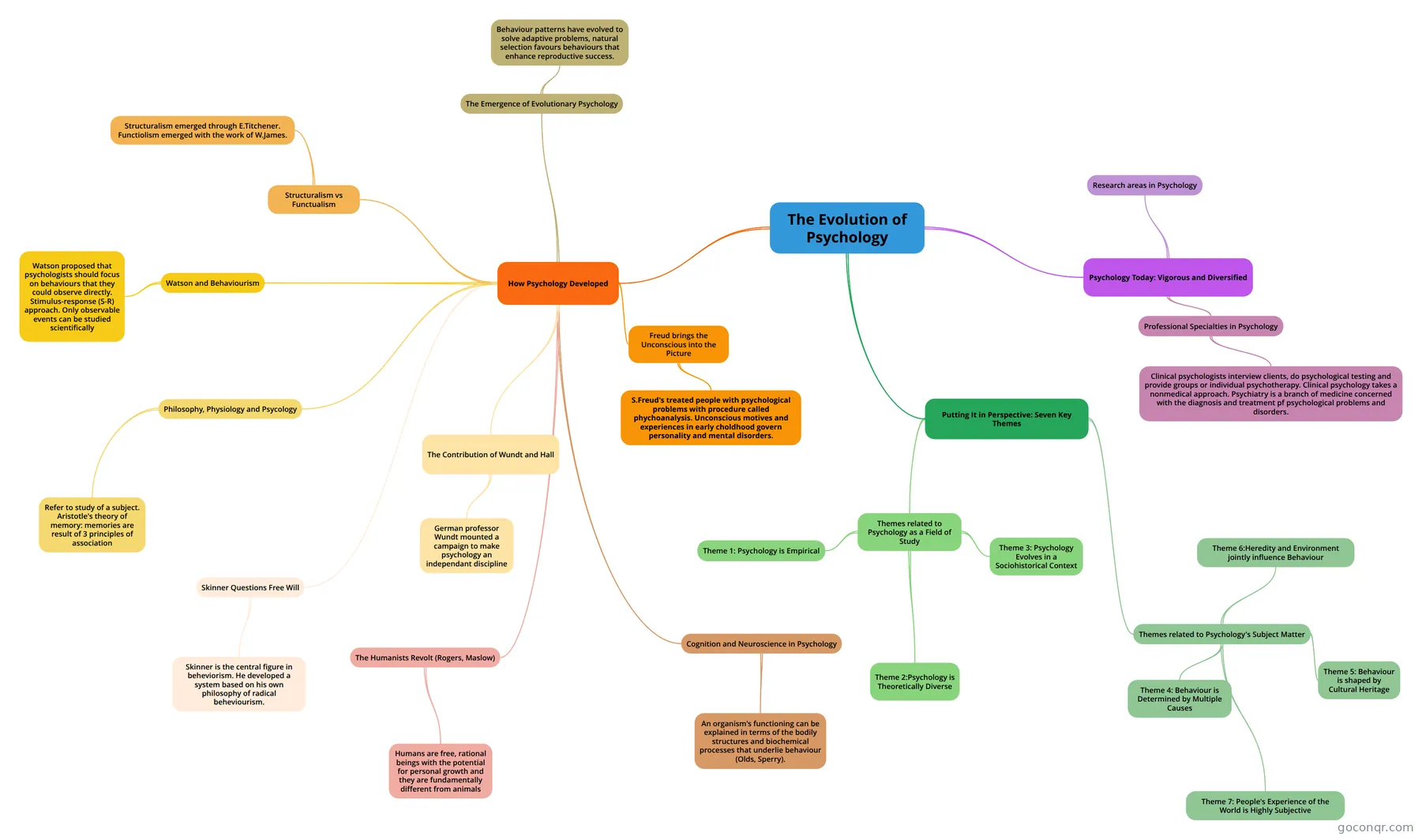 The Evolution of Psychology Chapter one
-
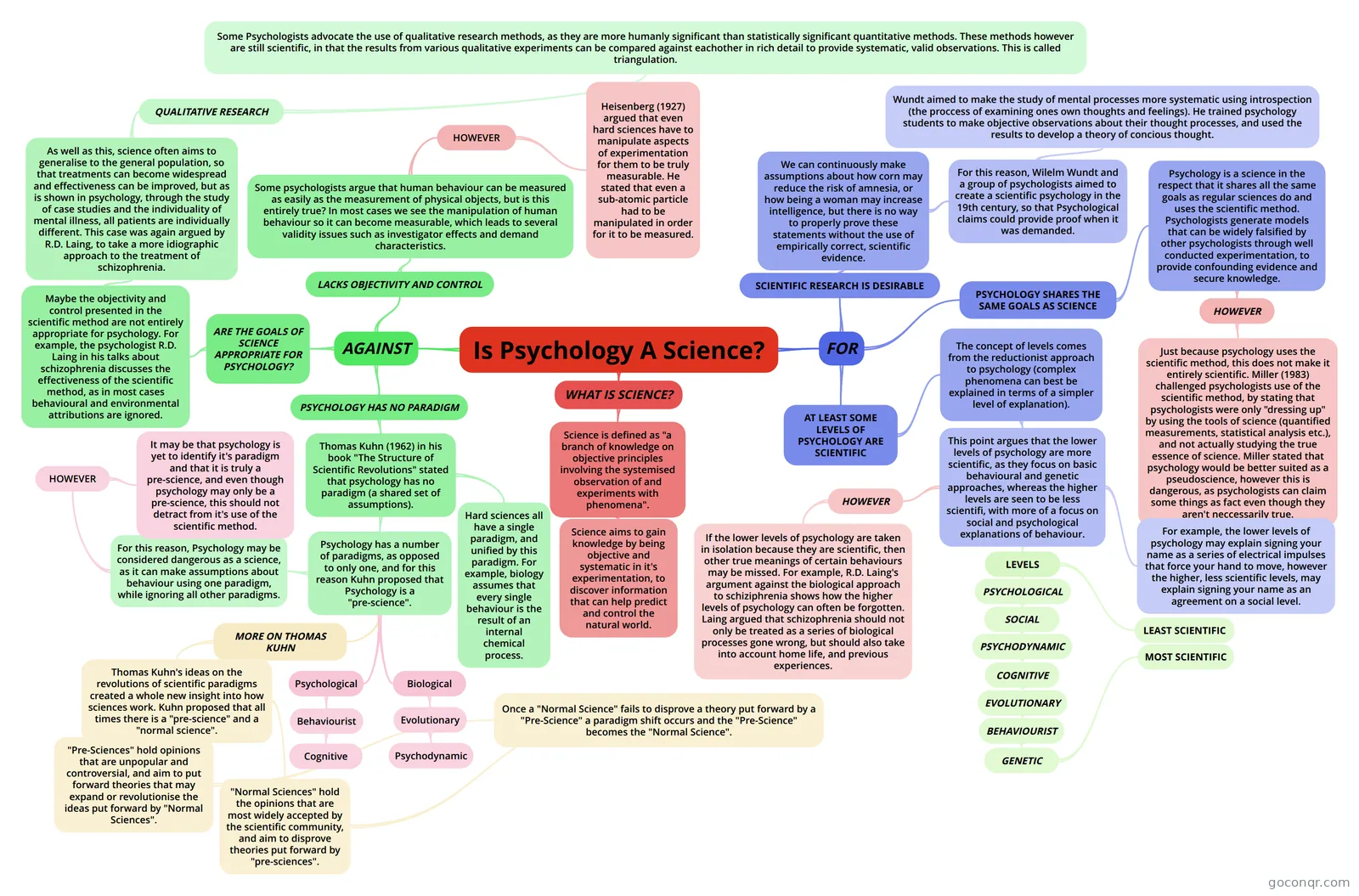 Is Psychology A Science?
-
 The Evolution of Psychology Psychology 104
-
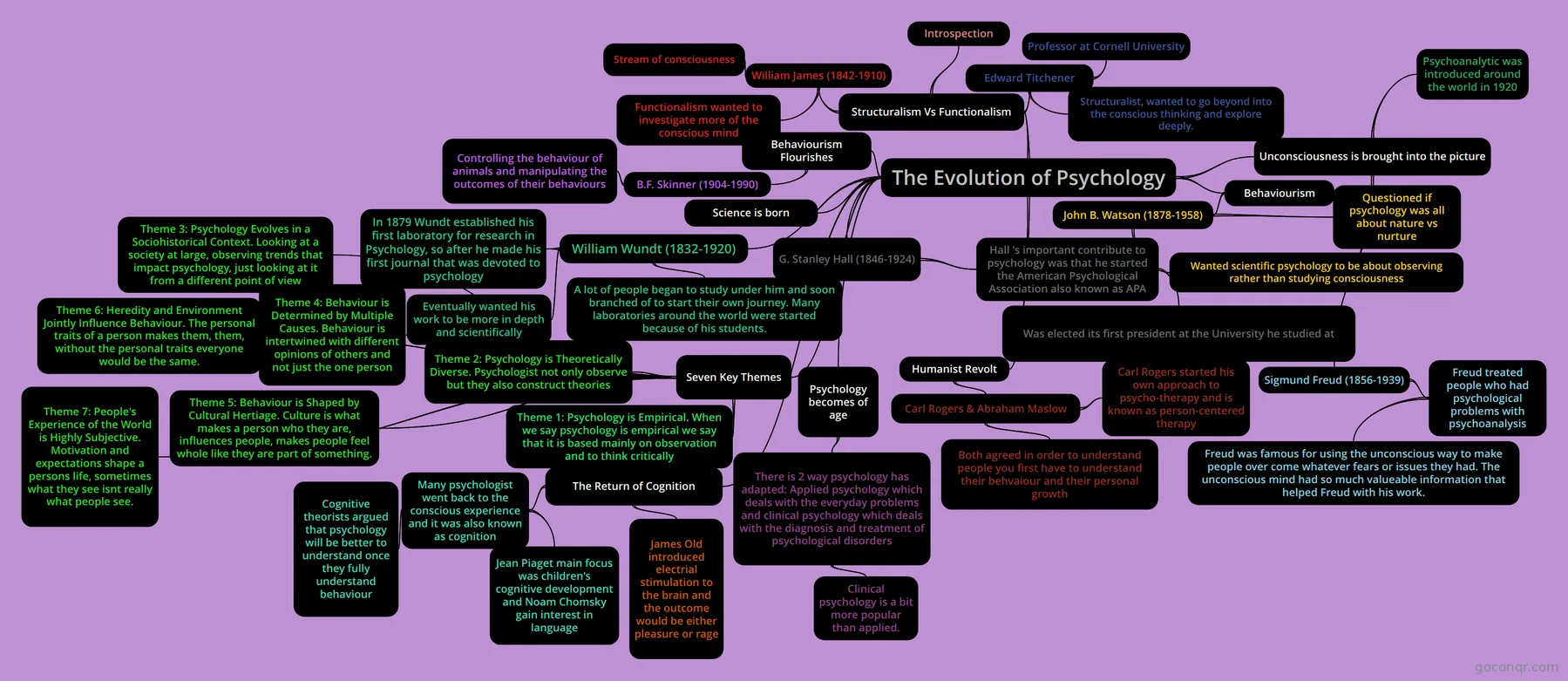 The Evolution of Psychology Chapter 1
-
PSYCHE, meaning Soul, & LOGOS, meaning study of a subject. Chapter 1 a concept map covering unit 1
-
 Contemporary Approaches contemporary approaches
-
Evolution of Psychology Study Notes for Evolution of Psychology
Flashcards
See all 94 flashcards-
103 cardsPsychology Exam review What school of psychology stated that the task of psychology is to analyze conscious experience into its ba...
-
60 cardsAP Psychology Chpt. 2 Chpt. 1 Introducing Psychology Vocabulary
-
59 cardsPsyc concepts chapter 1 Brief overview of concepts from Psychology chapter one. Course 260.
-
25 cardsIntro to Psychology Ch. 1
-
20 cardsLesson 1-2 Quiz Through their research on human responses to physical stimuli, both Helmholtz and Fechner contributed to th...
-
41 cardsCh. 1 Introducing Psychology Chapter 1 Psychology Vocabulary words
-
42 cardsA-level Psychology Key Terms & Definitions Test your knowledge of the key terms and definitions you need to know for your A-level Psychology exam with...
-
32 cardsPsychology Vocabulary Chapter 1 Psychology Vocabulary Chapter 1
Flowcharts
Notes
See all 13 notes-
Understanding Psychology: Chapter 1-3 Notes Chapter 1: Intro to Psychology MODULE 1-1 (1) - Intro to Psychology Introduction to Psychology Word Bank Clinical = mental health disorder Psychology = scientific study of behavior and mental processes Subfield...
-
Unit 1: Study Questions Identify the origins of the word psychology and the two disciplines that were the intellectual parents of psychology. (p. 3) Which of Descartes' ideas advanced the naturalistic study of psychology. (pp. 3-4) Summarize...
-
Chapter 1 Definition of Psychology No single definition Historically defined as study of: The psyche, or mind The spirit Consciousness Behavior Activities of Contemporary Psychologists Research and study in: Biological correlat...
-
Source Ideas/Mind Map Forensic Psychology/Source ideas: Australian Psychological Society (APU): http://www.wearepsychology.com/forensic-psychologyWeiner & Hess (2006). Handbook of Forensic Science Retrieved from https://books.google.com/bo...
-
INTRODUCTION TO PSYCHOLOGY Introduction to Psychology Psychology has been in existence since the beginning of mankind. In other words, the beginning of psychology coincides with the emergence of human history. However, people were not yet consc...
-
Chapter 1 & 2 What is psychology?It is the scientific study of how we think, feel and act. It can help us understand how individuals behave in a groups. On larger scales it can be applied to society as a whole.Psychology is a scien...
-
The Nature and Scope of Psychology Notes 1: Introduction Psychology can be described through numerous phrases, and can branch out to different to different professions because of it. Psychology can be clarified as the study of human behaviour which is ...
-
Levels of Explanation Biological The physical processes underlying behaviour – What is happening to the body? Involves: -Brain structure & function -Sensory receptors & the motor system -Hormones -Genetics Physiological Features -Chan...
Slides
More Psychology topics
About Introduction and History of Psychology
GoConqr OriginalWhat the resources cover
This unit looks at where psychology came from and how it became a science. The mind map THE EVOLUTION OF PSYCHOLOGY opens with psychology's intellectual parents, philosophy and physiology. The map on origins of psychology - Wilhelm Wundt follows the belief that the human mind could be studied scientifically, and Wundt as the first person to call himself a psychologist.
Other maps cover structuralism, Gestalt psychology, Sigmund Freud, Hermann Ebbinghaus, Jean Piaget, The Humanists Revolt and Contemporary Approaches. Several maps share the title The Evolution of Psychology, each made by a different user, so you can compare how they organise the same ground.
Where to start
Begin with Psychology's Four Big Ideas and Is Psychology A Science? for the basics. Then open the flashcards on the scientific attitude, critical thinking and developing arguments, which cover curiosity and scepticism. After that, move to the Wundt and structuralism maps, then the later schools.
Using quizzes and maps together
- Read a map to see how the ideas connect.
- Take a quiz such as Psy 101-Chapter 1 or History of Psychology - Introduction.
- Note the questions you miss and go back to the matching map branch.
- Retry the quiz later.
The quiz Psychology Edexcel AS level adds research methods, such as sampling and hypotheses. A-level Psychology Key Terms & Definitions is a deck for building vocabulary. There are also AP Psychology and MCAT items for those exam routes.
Where this unit fits
This unit sits in the Foundations of Psychology strand of the Psychology subject. It gives the background that later topics build on, so it works well as a first stop or a refresher.
Choose one resource that suits your course and give it a go, then add your own maps and flashcards where the community material leaves gaps.
Frequently asked questions
Which resource should I open first?
Start with the mind map THE EVOLUTION OF PSYCHOLOGY, which sets out how philosophy and physiology led to the new science. Then try the Psy 101-Chapter 1 quiz to see what stuck. If you prefer flashcards, the deck on the scientific attitude and critical thinking is a good opener.
What do the mind maps in this unit cover?
The maps trace psychology's origins in philosophy and physiology, Wilhelm Wundt, structuralism, Gestalt psychology, Freud, Ebbinghaus and Piaget. Others cover the humanist revolt, contemporary approaches and the question of whether psychology is a science. Several different users have mapped the evolution of psychology.
Are these resources free to use?
Yes. Every resource on this page is free to open, study and take, with no account needed. They were made by GoConqr users, not by GoConqr itself. A free account also saves your quiz scores and lets you make your own quizzes, mind maps, flashcards and notes.
Which levels and exams do the resources suit?
Most are aimed at university students, with a smaller share for school students. Listed items mention A-level Psychology, AP Psychology, GCSE Psychology, AQA Psychology and the MCAT. Check each resource's title and contents to see whether it matches your course.
What if I cannot find the topic I need?
Try a nearby resource first, such as a chapter quiz or a map on the relevant psychologist or school of thought. If the topic still isn't covered, you can make your own map, flashcards or notes and use them alongside the community material.