
Mycology
201 resources created by 148 users
This Mycology page on GoConqr gathers community-made flashcards, mind maps, quizzes and notes on fungi, from hyphae and fungal growth to Candida, Aspergillus and dermatophytes. It's built for university students revising medically important fungi, and for teachers after ready-made material. There are over 190 resources here, including more than 20 quizzes, over 70 mind maps and over 80 flashcard decks. Open a deck, try a quiz to find your gaps, then see what you recall.
Select topic
- Fungal structure and reproduction24
- Fungal classification and growth forms14
- Fungal identification and diagnosis8
- Mycotoxins and aflatoxins5
- Fungal infections38
- Superficial, cutaneous and subcutaneous mycoses19
- Systemic and pulmonary mycoses15
- Candida and candidiasis11
- Cryptococcus and cryptococcosis8
- Opportunistic and invasive fungal infections10
- Antifungal treatment and resistance6
Top Mycology resources
-
6 cardsMycology A multidisciplinary branch of biological sciences dealing with the study of fungi, knowledge of which is re...
-
13 cardsIdentify this mould Identify this mold
-
4 cardsIntroduction to mycology Why are antibiotics, like penicillins, and cephalosporins, not effective against fungi?
-
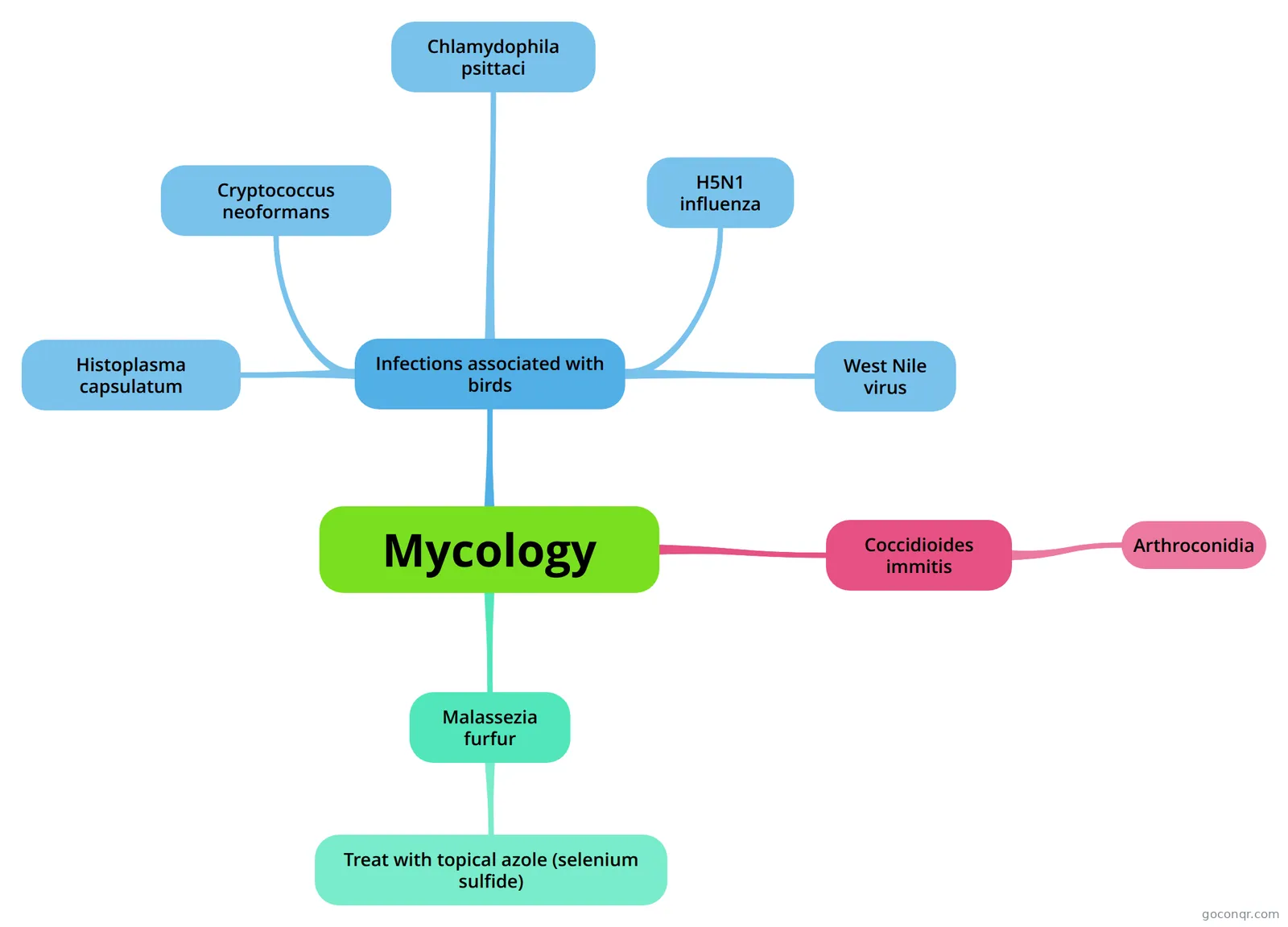 Mind map Mycology Notes from Doctors in Training
-
55 cardsFungi What is mycology?
-
19 cardsPhysiology of Fungal Growth Introduction to fungi
-
34 cardsDr Hall, Lec 2, Candida albicans C.albicans is in fungal family Candidemia. Other examples?
-
Mind map Fungal pathology
Quizzes
See all 21 quizzes-
76 questionsFood and Drug What is the study of mycology
-
93 questionsWks 3 and 4 Fungi differ from animals by having a cell wall
-
35 questionsMicrobiology A HIV patient presents with pneumonia in the ER. Physical examinations show erythema nodosum. Ultrasound re...
-
97 questionsMicro LABMED Yeasts are microscopic multicellular organisms that reproduce by budding
-
16 questionsFungal Diseases Which of the following does NOT describe the fungal pathogen Histoplasmosis?
-
72 questionsMicro - Lecture One (Fungi)
-
38 questionsCh. 12 In the table, which of these spores are characteristic of Penicillium?
-
69 questionsMicro Studying Unicellular fungi that have a single nucleus and reproduce either asexually by budding and transverse divis...
Mind maps
See all 75 mind mapsFlashcards
See all 94 flashcards-
6 cardsMycology A multidisciplinary branch of biological sciences dealing with the study of fungi, knowledge of which is re...
-
13 cardsIdentify this mould Identify this mold
-
4 cardsIntroduction to mycology Why are antibiotics, like penicillins, and cephalosporins, not effective against fungi?
-
55 cardsFungi What is mycology?
-
19 cardsPhysiology of Fungal Growth Introduction to fungi
-
34 cardsDr Hall, Lec 2, Candida albicans C.albicans is in fungal family Candidemia. Other examples?
-
20 cardsFungi Introduction How does the way yeast and mold REPRODUCE differ?
-
8 cardsCandida **** What are the 5 most common Candida spp causing human infection?
Flowcharts
Notes
-
intro to fungi What are fungi? Moulds Most common Grow in damp, wet and badly aerated conditions Mushrooms Food industry Yeasts Microscopic Food industry Smuts Found on maize Truffles Food industry Terminology&nb...
-
HUMAN DISEASES CAUSED BY FUNGI FUNGIeukaryoticnon-photosyntheticnot much tissue differentiationhave cell walls (made of chitin)propagate by spores YEASTmoist appearancespherical to egg shapedunicellularsingle nucleuscommonly exists in large cluster...
-
Types of Pathogenic Fungi Moulds- Filamentous- Examples:a) Dermatophytes: able to digest keratin (hair, skin & nails)b) Aspergillus fumigatosTrue yeast- Unicellular- Oval or Round- Eg. Cryptococcus neoformansYeast-like fungi- Eg. Candida albic...
-
GENERAL CHARACTERISTIC OF FUNGI - created from Mind Map DIMORPHIC FUNGI TYPE OF HYPHAE REPRODUCTION
-
BacT Lab 1-Mycology Outline
Slides
Topics in Mycology
More Microbiology and immunology topics
About Mycology
GoConqr OriginalWhat this unit covers
The resources here follow fungi from basic biology to disease. The deck Identify this mould opens with hyphae and mycelium, the tubular structures that make up a fungus. The Introduction to mycology deck asks why penicillins and cephalosporins do not work on fungi, and about the fungal cell wall and caspofungin.
Where to start
Begin with the basics. The Mycology flashcard deck covers the definition of a fungus, a eukaryotic, spore-producing organism, and the origin of the word. Fungi Introduction compares yeast and mould in structure and reproduction. Physiology of Fungal Growth then looks at hyphal structure and the apical growth zone.
- Read a definition deck such as Fungi.
- Move to growth and identification.
- Finish with specific diseases.
Diseases and pathogens
Once the basics feel familiar, the page lists decks and maps on particular infections. There are decks on Candida, Cryptococcosis, Histoplasma capsulatum and Pneumocystic jirovecii. Mind maps cover Dermatophytosis, Aspergillosis, Subcutaneous Mycoses, Opportunistic Mycoses and Respiratory Mycoses. The Medically important fungi map includes Coccidioides immitis and its biphasic life cycle, and the Fungal pathology map covers the three dermatophyte groups.
Using quizzes and maps together
Read a mind map first to see how a topic fits together. Then take a quiz such as Fungal Diseases, Intro to Mycology or Mycology Structures to see what stuck. Go back to the map or deck for anything you missed. Teachers can use the notes and the slide set on human diseases caused by fungi as ready-made starting points.
Where it sits
This unit belongs to the Medically Important Microorganisms strand of Microbiology and immunology. Pick a map or quiz that matches your next topic and work through it at your own pace.
Frequently asked questions
Which resource should I open first?
Start with the Mycology flashcard deck, which covers what a fungus is and where the word comes from. Then try Fungi Introduction, which compares yeast and mould. Once those feel comfortable, move on to the decks on Candida, Cryptococcosis and Histoplasma capsulatum.
What do the mind maps cover?
The mind maps range from definitions and fungal identification methods to disease groups such as Dermatophytosis, Subcutaneous Mycoses, Opportunistic Mycoses and Respiratory Mycoses. There are also maps on single conditions, including Aspergillosis, Candidiasis, Cryptococcosis and Tinea capitis. There are over 70 in total.
Are the resources free to use?
Yes. Every resource on this page is free to open, study and take, with no account needed. They were made by GoConqr users, not by GoConqr itself. A free account also saves your quiz scores and lets you make your own quizzes, mind maps, flashcards and notes.
Who is this page for?
It suits university students who want to revise fungi and the infections they cause, and teachers looking for ready-made material. Nearly all the resources are at university level. You can use them to test recall, check definitions and review disease groups.
Are there quizzes I can use to test myself?
Yes, there are more than 20 quizzes. Examples include Fungal Diseases, Intro to Mycology, Mycology Structures and fungi of medical importance. Try one after reading a mind map, then return to the related deck for any questions you got wrong.
What if I cannot find a topic I need?
Check the related decks and maps first, since topics often overlap. If something is still missing, you can build your own flashcards, mind maps, quizzes or notes. The resources here were made by other users, so your own material can fill the gap.