
Head and Neck
574 resources created by 307 users
This Head and Neck page on GoConqr gathers community-made quizzes, mind maps, flashcards and notes, from the tongue, larynx and oral cavity to the scalp, face and triangles of the neck. It's built for university students testing their recall and teachers after ready-made material. There are over 500 resources here, including more than 160 quizzes, over 110 mind maps and more than 260 flashcards, shared by over 290 contributors. Pick a topic, try a quiz, then see what you can recall.
Select topic
- Skull Anatomy17
- Face and Scalp Anatomy32
- Temporomandibular Joint and Muscles of Mastication30
- Neck Anatomy and Triangles63
- Head and Neck Muscles26
- Cranial Nerves16
- Head and Neck Blood Vessels and Lymphatics18
- Oral Cavity, Tongue and Palate44
- Nose and Paranasal Sinuses8
- Pharynx and Larynx39
- Eye and Ear Anatomy5
- Speech and Hearing Anatomy6
Top Head and Neck resources
-
10 cardsAnatomy X-ray Anatomy practical midyear flashcard revision
-
98 questionsHead, Neck and Back 2nd Sem- Anatomy 2nd Year- PMU Regio Scapularis is a back region
-
65 cardsRCA head and neck questions Why do facial lacerations tend to gape (part widely)?
-
31 questionsHEAD, NECK AND NEURO: Week 5 - Tongue & Vision Label these lymph nodes and associated structures. There are 11 sets/specific lymph nodes altogether.
-
41 questionsTongue Alexandria university year 2 2017
-
20 questionsMuscles of the Tongue Name the extrinsic muscles of the tongue (check all that apply).
-
49 questionsNMS 1 Anatomy booklet - The skull, muscles of mastication and muscles of the neck. What is the following muscle called and what is its innervation?
-
29 cardsOral cavity What 5 muscles make up the soft palate?
Quizzes
See all 165 quizzes-
98 questionsHead, Neck and Back 2nd Sem- Anatomy 2nd Year- PMU Regio Scapularis is a back region
-
31 questionsHEAD, NECK AND NEURO: Week 5 - Tongue & Vision Label these lymph nodes and associated structures. There are 11 sets/specific lymph nodes altogether.
-
41 questionsTongue Alexandria university year 2 2017
-
20 questionsMuscles of the Tongue Name the extrinsic muscles of the tongue (check all that apply).
-
49 questionsNMS 1 Anatomy booklet - The skull, muscles of mastication and muscles of the neck. What is the following muscle called and what is its innervation?
-
10 questionsscalp and face 1- Regarding the scalp ,all the followings are true EXCEPT :-
-
10 questionsface and scalp 1 The frontal belly of occipito-frontalis is supplied by:
-
14 questionsDevelopment of the tongue (H&N) Alexandria university year 2 2017
Mind maps
See all 119 mind maps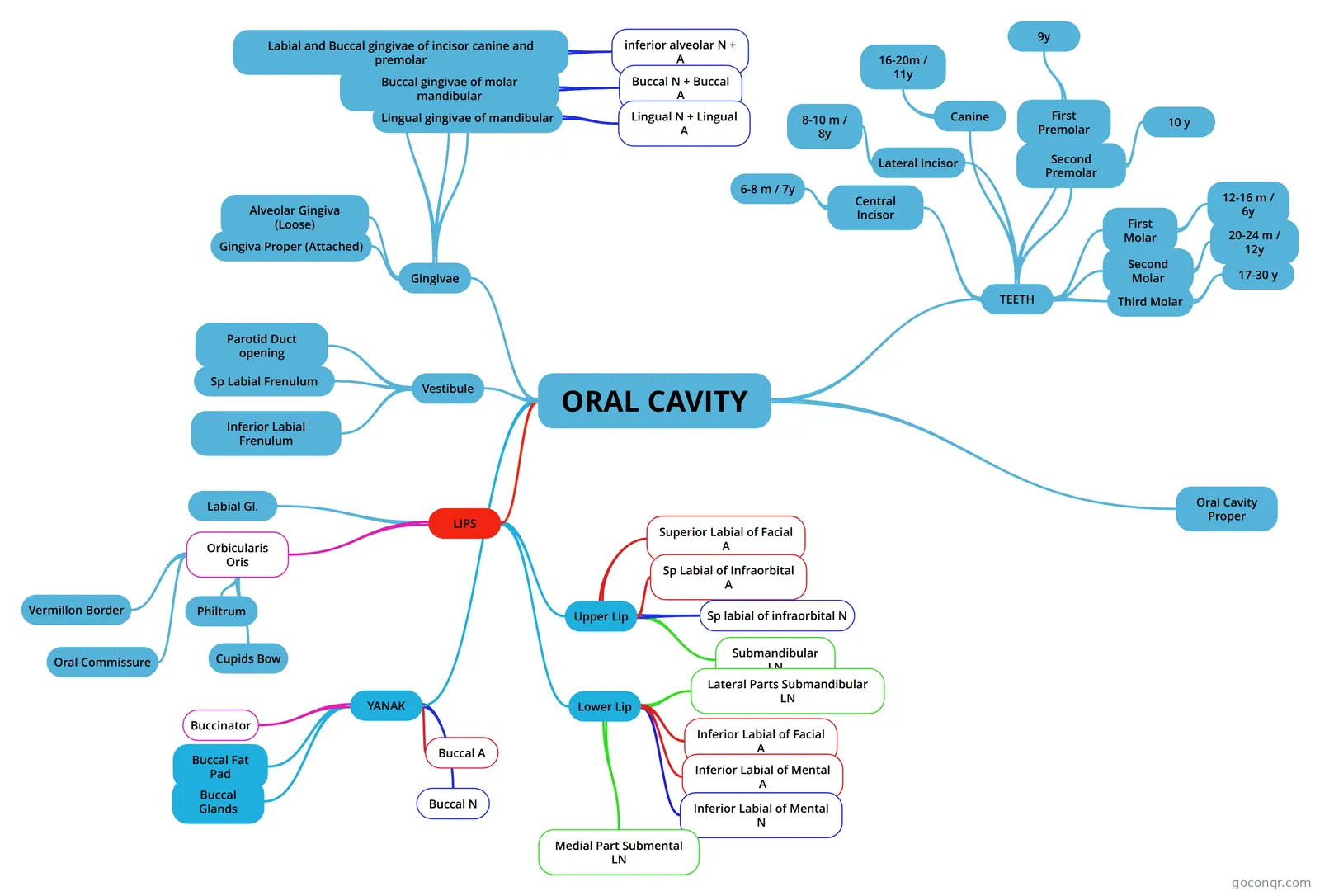

Flashcards
See all 278 flashcards-
10 cardsAnatomy X-ray Anatomy practical midyear flashcard revision
-
65 cardsRCA head and neck questions Why do facial lacerations tend to gape (part widely)?
-
29 cardsOral cavity What 5 muscles make up the soft palate?
-
42 cardsAnatomy of the Head and Neck 1. Head of Mandible
-
22 cardsMuscles of facial expression Name the origin, insertion, innervation and action of the mentalis
-
200 cardsNeuroanatomy 2 - The Ear, Brainstem, Cranial Nerves and Limbic system How can the ear be divided?
-
144 cardsThe neck - Anatomy What is the anterior triangle?
-
200 cardsEENT Anatomy Name the cranial nerve/path: nasociliary n.
Flowcharts
Notes
-
the tempromandbular joint type : bicondylar synovial bones: head of mandible , manndibular fossa of temporal bone, and artecular tubercle structure : the arteculating bones are enclosed within a fibrous capsule and attached to its inner side a...
-
Phonation - created from Mind Map Larynx Vocal Folds Intrinsic Laryngeal Muscles
-
Cutaneous sensory innervation of the head and neck by trigeminal and cervical nerves SENSORY INNERVATION In the maxillofacial region, the motor nerves that are likely to be under consideration are the facial nerve, the hypoglossal nerve (par XII: The nerve is involved in controlling tongue movements r...
-
Anatomy of the thyroid gland The thyroid gland lies at the C5-T1 vertebral level, anterior to the trachea, and is a ductless endocrine gland that weighs about 20 grams. The thyroid gland has two lateral lobes connected by an isthmus that lies ant...
-
Unit 1 Head notes -Skull is made up of 28 separate bones. -Regions of the skull include: (in the cranium) -Cranial vault (upper dome part of the skull) -Cranial base -Facial skeleton -Upper jaw -Acoustic cavities (ears) -Interior cavit...
Slides
Topics in Head and Neck
More Anatomy topics
About Head and Neck
GoConqr OriginalWhat this unit covers
This unit sits in the strand Regional Anatomy: Head, Neck and Back, within Anatomy. The resources work through the region piece by piece. You will find the tongue, the larynx, the oral cavity, the skull, the scalp and face, the orbit, the temporomandibular joint and the neck triangles.
Where to start
For a first look, open the mind map ORAL CAVITY. It lays out the vestibule, the oral cavity proper, the lips and their parts, such as the philtrum and the oral commissure. The larynx map gives its position in the anterior neck and its main function of protecting the lower airway.
Then move to the tongue. The quiz Muscles of the Tongue asks you to pick out the extrinsic and intrinsic muscles. Development of the tongue (H&N) goes further, with questions on the origin of the tongue muscles and their nerve supply.
Using quizzes and maps together
- Read a mind map and note the branches you cannot explain.
- Take a quiz on the same topic and mark what you missed.
- Go back to the map for those gaps.
- Use a flashcard deck for quick repeat recall.
For the scalp and face, try scalp and face and face and scalp 1. They ask about the layers of the scalp, where infection spreads, the blood supply and nerve injuries. For lymphatic drainage, HEAD, NECK AND NEURO: Week 5 - Tongue & Vision has labelling tasks and a table to complete.
Images and labelling
The deck Anatomy X-ray pairs images with labels such as the frontal and maxillary air sinuses and the cervical vertebrae. The quiz on the skull, muscles of mastication and muscles of the neck is built around numbered labels, so it suits practice with diagrams.
Your next step
Choose one region, such as the neck or the oral cavity, and work through a map, a quiz and a deck in turn. You can also make your own versions as you go.
Frequently asked questions
Which resource should I open first?
A good first step is the ORAL CAVITY mind map, which sets out the lips, vestibule and oral cavity proper. After that, try the Muscles of the Tongue quiz. It checks whether you can name the extrinsic and intrinsic muscles, which shows quickly where to revise.
What do the mind maps cover?
The maps include the larynx, the oral cavity, the skull, cranial nerves, muscles of mastication, the extrinsic muscles of the tongue, the orbital cavity and the nasal cavity. Others cover cervical triangles, the masticator space and suprahyoid neck spaces, so you can pick the region you are studying.
Are the resources free to use?
Yes. Every resource listed here is free to open, study and take, with no account needed. They were made by GoConqr users, not by GoConqr itself. A free account also saves your quiz scores and lets you make your own quizzes, mind maps, flashcards and notes.
Who are these resources for?
They suit university students who want to practise recall across the head and neck, and teachers looking for ready-made quizzes, maps and decks to point students towards. Almost all of the material is at university level, with a small share aimed at professionals.
Is there anything on the scalp and face?
Yes. The quizzes scalp and face and face and scalp 1 ask about scalp layers, infection spread, arterial branches and nerve supply. There is also a flashcard deck on muscles of facial expression, so you can move from questions to quick recall.
What if I cannot find my topic?
Look at the neighbouring resources first, as topics often sit under broader titles such as Neck or Head and Neck anatomy. If something is still missing, you can build your own quiz, mind map or flashcards to fill the gap.