
Place Value and Whole Numbers
142 resources created by 113 users
This Place Value and Whole Numbers page on GoConqr gathers community-made quizzes, mind maps, flashcards and notes, from counting and ordering numbers to rounding, estimating and upper and lower bounds. It's built for primary pupils, school students revising a topic, and teachers after ready-made material. There are over 130 resources here, including more than 30 quizzes, more than 40 mind maps and more than 40 flashcard decks, with GCSE Maths mentioned in some of them. Pick a quiz to find your gaps, then build your own revision.
Top Place Value and Whole Numbers resources
-
14 questionsWorking with Whole Numbers (multiple choice) L1 A customer’s car needs a service at 48 000 miles. His car has done 33 650 miles. How many more miles can he...
-
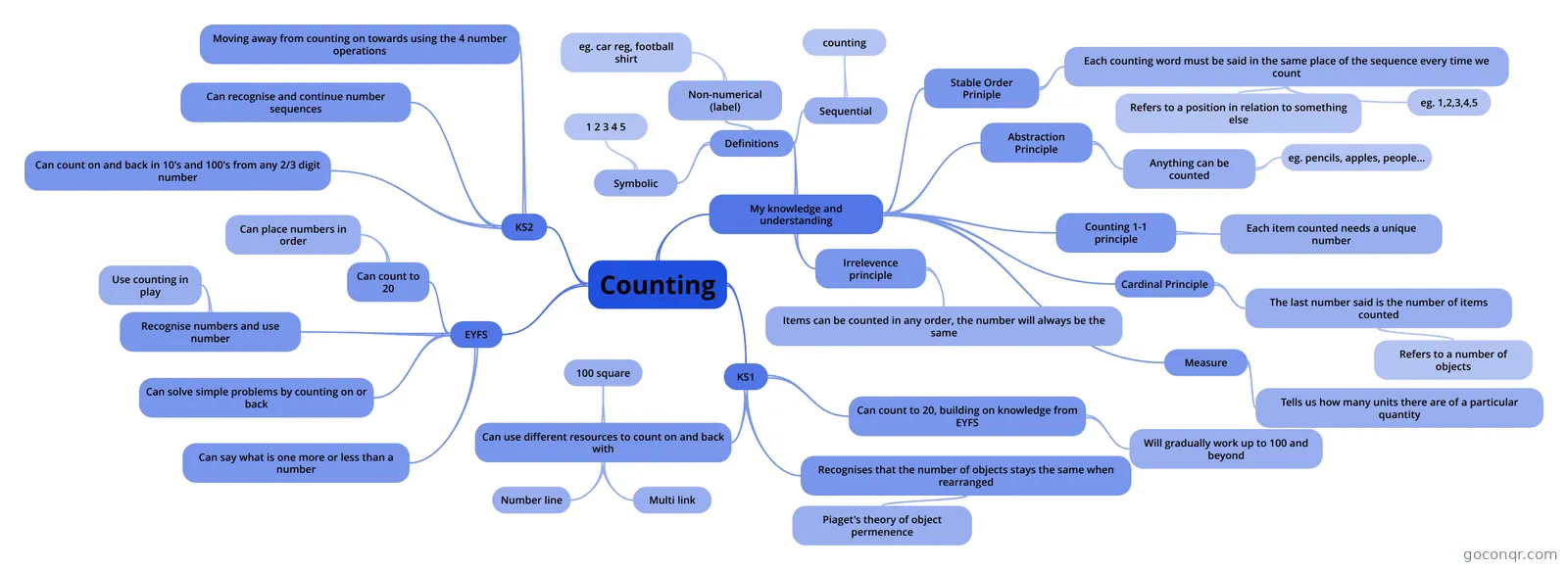 Mind map Counting Revising my knowledge of counting in order to teach KS! and KS2 children
-
7 questionsUpper and Lower Bounds What is the lower bound of 32 if it has been rounded to the nearest unit?
-
40 questionsReview numbers to 1,000 Write the number nine hundred and fifty-four.
-
8 questionsA. Place Value
-
10 questionsAdding whole numbers L1 13 236 + 2 592
-
7 questionsSubtracting whole numbers L1 13,436 – 7,392
-
24 cardsNumber and Place Value Ben's dad won one million, three hundred and sixty two thousand, four hundred and eight pounds on the lotte...
Quizzes
See all 43 quizzes-
14 questionsWorking with Whole Numbers (multiple choice) L1 A customer’s car needs a service at 48 000 miles. His car has done 33 650 miles. How many more miles can he...
-
7 questionsUpper and Lower Bounds What is the lower bound of 32 if it has been rounded to the nearest unit?
-
40 questionsReview numbers to 1,000 Write the number nine hundred and fifty-four.
-
8 questionsA. Place Value
-
10 questionsAdding whole numbers L1 13 236 + 2 592
-
7 questionsSubtracting whole numbers L1 13,436 – 7,392
-
8 questionsB. Place Value Each move to the right the place value is divided by a power of 10
-
5 questionsPop Quiz 1 Daniel is the events manager at a Perth hotel. He is coordinating a conference and currently has 263 delega...
Mind maps
See all 42 mind maps-
Counting Revising my knowledge of counting in order to teach KS! and KS2 children
-
Chapter 1: Whole Numbers: How to Dissect and Solve Word Problems
-
Math 4th Grade T1 Francy Sepúlveda 2019-20 Math Mind map for the first trimester at Rochester 2019 - 2020
-
Whole numbers
-
Number and Place Value (F-3)
-
Whole Numbers
-
Whole numbers
-
Math 4th Grade T1 Francy Sepúlveda 2019-20 Math Mind map for the first trimester at Rochester 2019 - 2020
Flashcards
See all 48 flashcards-
24 cardsNumber and Place Value Ben's dad won one million, three hundred and sixty two thousand, four hundred and eight pounds on the lotte...
-
18 cardsKey Terms Chapter 1: Whole Numbers *Reading, Writing, and Rounding Whole Numbers *Adding and Subtracting Whole Numbers *Multiplying and Dividi...
-
18 cardsChapter 1 Key Terms
-
11 cardsWhole Number Glossary L1 Every digit in a number has a value, depending on its position in the number. This is called its
-
17 cardsComparing and Ordering Whole Numbers Compare the numbers correctly. Yes or No
-
11 cardsWhole Number Glossary L1 Every digit in a number has a value, depending on its position in the number. This is called its
-
31 cardsNatural Numbers What does N stand for?
-
8 cardsNatural Numbers
Flowcharts
Notes
-
Natural numbers and mathematical induction Natural numbers and mathematical induction Calculus takes its origin in the properties of natural numbers,The formal definition of natural numbersis based onPeano axioms.A set A of elements is called natural numbers i...
-
Upper and lower bounds Make a 2x2 table putting upper and lower bound at the top and the two objects at the side:------------------------- Lb | UP | Cup |  ...
-
Ordering whole numbers Place values are used to order whole numbers. Example Which of the following four sportspeople earns more in a week? Player A - £310,500 Player B - £309,500 Player C - £295,500 Player D - £315,500 First, put each...
-
Bounds (upper and lower) Step 1: find the level of accuracy e.g. 0.1Step 2: half of the level of accuracy . this is the tolerance, hoe much of the rounded off number will be changed by e.g. 0.05Step 3: add this to find the upper bound, take i...
-
Untitled
-
Place Value & Decimal Number understanding - Wk1 To fully understand decimals, you must first study the idea of place value Place value tells you how much each number is worth. Look at the drawing: when you use a decimal point, the ones, ten...
-
Ordering numbers and place value - created from Mind Map Always look at big numbers In groups of 3 Putting numbers in Oder of size Addition / subtraction and decimals
Slides
Topics in Place Value and Whole Numbers
More Mathematics topics
About Place Value and Whole Numbers
GoConqr OriginalWhat the page covers
The resources start with the basics of number. The mind map Counting lists skills such as counting to 20, placing numbers in order and saying what is one more or less than a number. Quizzes such as Review numbers to 1,000 ask pupils to write numbers in words, like nine hundred and fifty-four.
Further along, you will find work on rounding, estimating and operations with whole numbers. The mind map Whole numbers sets out the rounding rule: look at the digit in the next place, round down if it is smaller than 5 and up if it is 5 or more. Another mind map on rounding shows a worked example of a number rounded to the nearest hundred.
Where to start
- Begin with Counting if you are working on early number sense.
- Move to Review numbers to 1,000 to check reading and writing numbers.
- Use the place value quizzes and flashcard decks to practise digit values and ordering.
- Try Working with Whole Numbers (multiple choice) L1 for word problems on adding and subtracting large numbers, such as car mileage.
Bounds and rounding
Older students can go to Upper and Lower Bounds, a quiz that asks for the bounds of a number rounded to the nearest unit. The note Bounds (upper and lower) gives a step-by-step method: find the level of accuracy, halve it to get the tolerance, then add and subtract it. Since GCSE Maths is mentioned in some resources, this is a useful place for those students to practise.
Using quizzes and maps together
Read a mind map first to see the whole idea on one screen. Then take a quiz on the same topic and note where you slip. Go back to the map for that branch, and use a flashcard deck such as Rounding Whole Numbers to fix the vocabulary and rules.
Where this unit fits
This unit sits in the Number strand of Mathematics. Whenever you are ready, open a quiz, then make a mind map of your own to sum up what you learned.
Frequently asked questions
Which resource should I start with?
For early number work, open the Counting mind map, then try the quiz Review numbers to 1,000. Both are simple and show quickly what you already know. If you are older and working on rounding, go to the Upper and Lower Bounds quiz.
What do the mind maps cover?
They cover counting skills, place value, ordering numbers, rounding and estimating whole numbers, and upper and lower bounds. The Whole numbers map explains the rounding rule: round down when the next digit is less than 5 and up when it is 5 or more.
Are the resources free to use?
Yes. Every resource listed here is free to open, study and take, with no account needed. A free account also saves your quiz scores and lets you make your own quizzes, mind maps, flashcards and notes.
Which levels do these resources suit?
Most are made for primary pupils, with a good share for school students and some GCSE Maths material such as bounds. Teachers can use the ready-made quizzes and flashcard decks for starters, plenaries and quick checks in class.
Who made these resources?
They were made by GoConqr users, not by GoConqr itself. Over 100 contributors have added quizzes, mind maps, flashcards and notes, so the style and level vary from one resource to the next.
What if I cannot find what I need?
Try a nearby topic, such as rounding for estimating, or place value for ordering numbers. You can also build your own quiz, mind map or flashcards to fill the gap and share them with your class.