
Situation Ethics
58 resources created by 39 users
This Situation Ethics page on GoConqr gathers community-made mind maps, flashcards, quizzes and notes, from Fletcher's four working principles and six fundamental principles to agape, legalism and applied topics such as euthanasia. It's built for school students revising for GCSE or A-level Religious Studies, and for teachers after ready-made material. There are over 50 resources here, including 39 mind maps, 14 flashcard decks and 3 quizzes. Start with a quiz to spot your gaps, then make your own maps.
Top Situation Ethics resources
-
11 questionsSituation Ethics Robinson said, “The Situationist follows a moral law or violates it according to love’s need”
-
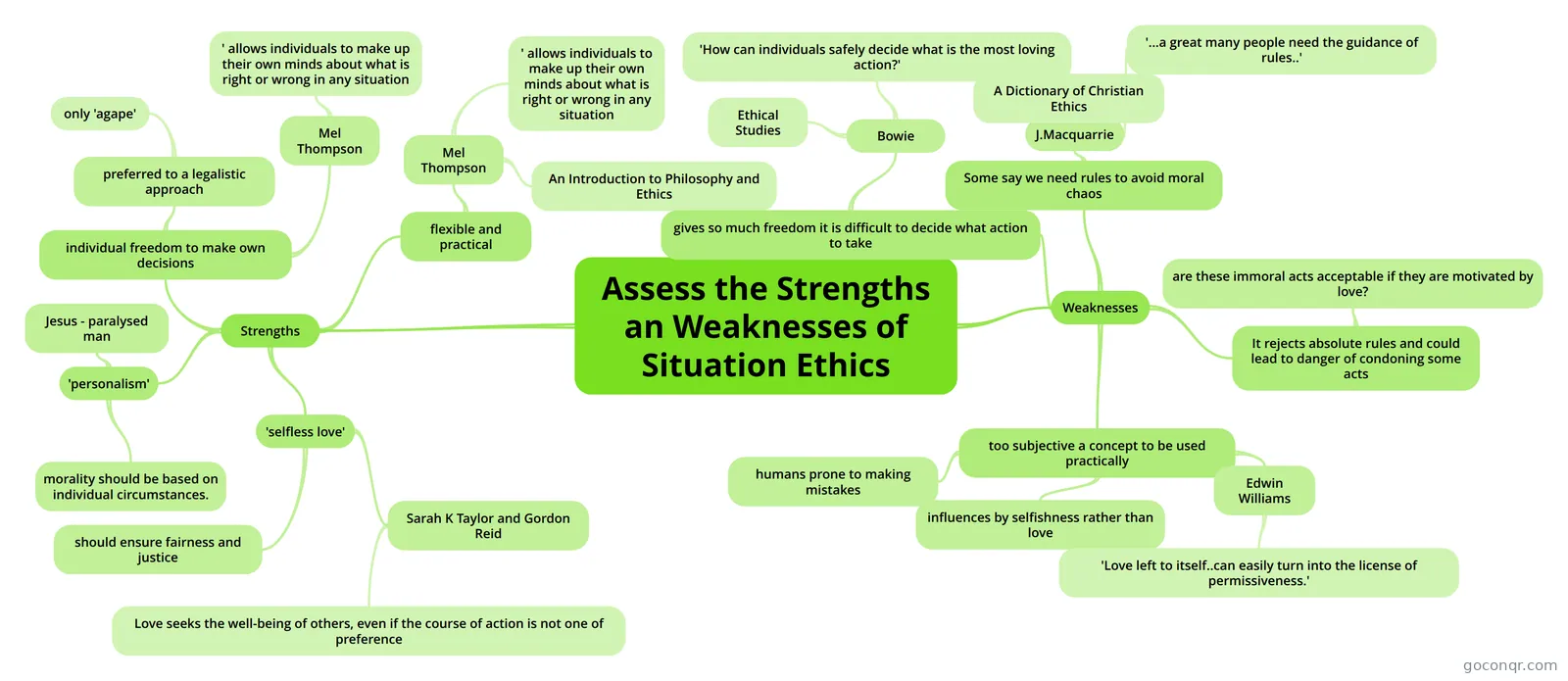 Mind map Assess the Strengths an Weaknesses of Situation Ethics
-
9 cardsSituation Ethics
-
24 questionsSituation Ethics Quotes Teleological
-
Mind map SITUATION ETHICS
-
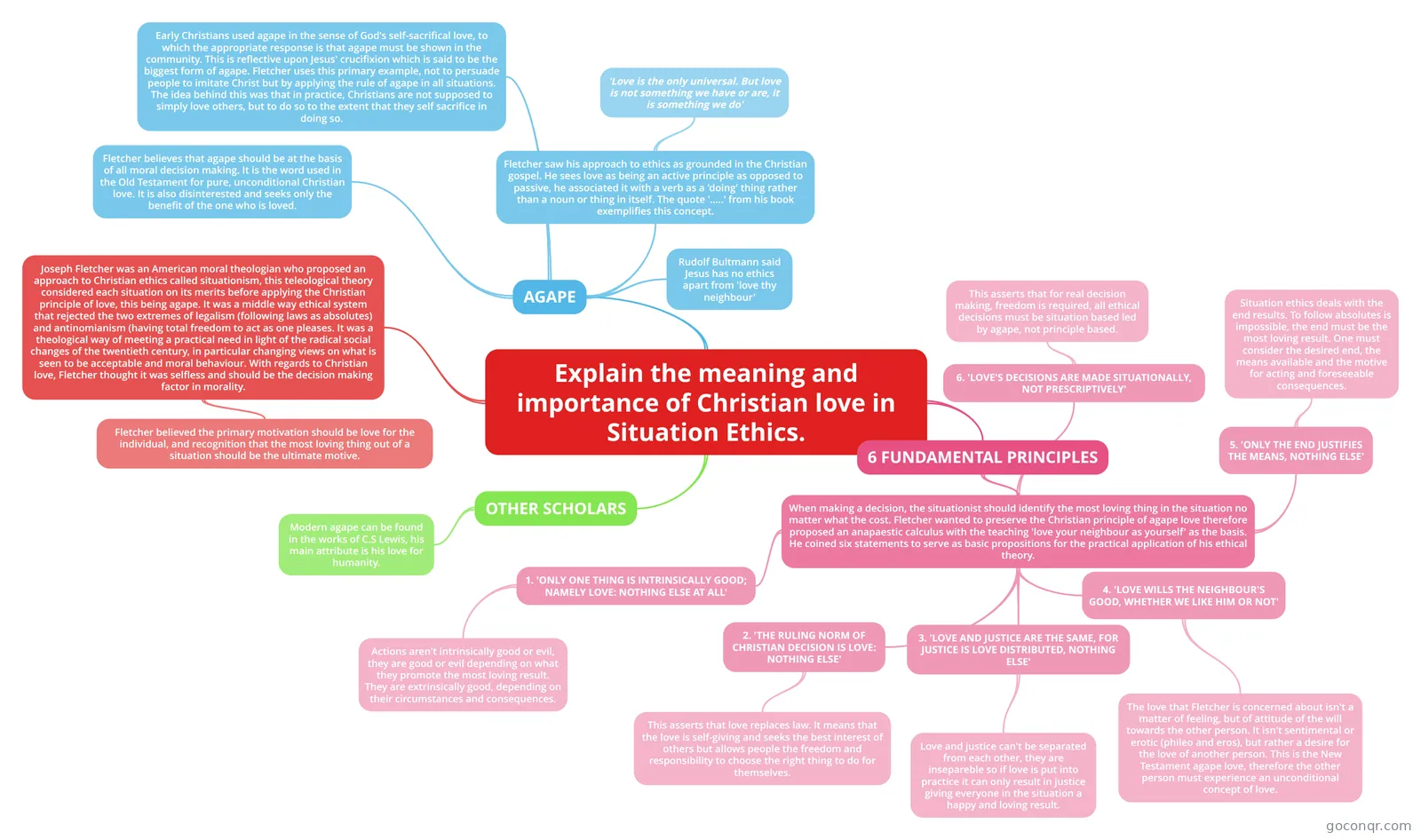 Mind map Explain the meaning and importance of Christian love in Situation Ethics.
-
Mind map Explain the meaning and importance of Christian love in Situation Ethics.
-
28 cardsSituation ethics (not complete)
Quizzes
Mind maps
See all 39 mind maps-
Assess the Strengths an Weaknesses of Situation Ethics
-
SITUATION ETHICS
-
Explain the meaning and importance of Christian love in Situation Ethics.
-
Explain the meaning and importance of Christian love in Situation Ethics.
-
Situation Ethics 2
-
Situation Ethics Criticisms
-
Situation Ethics
-
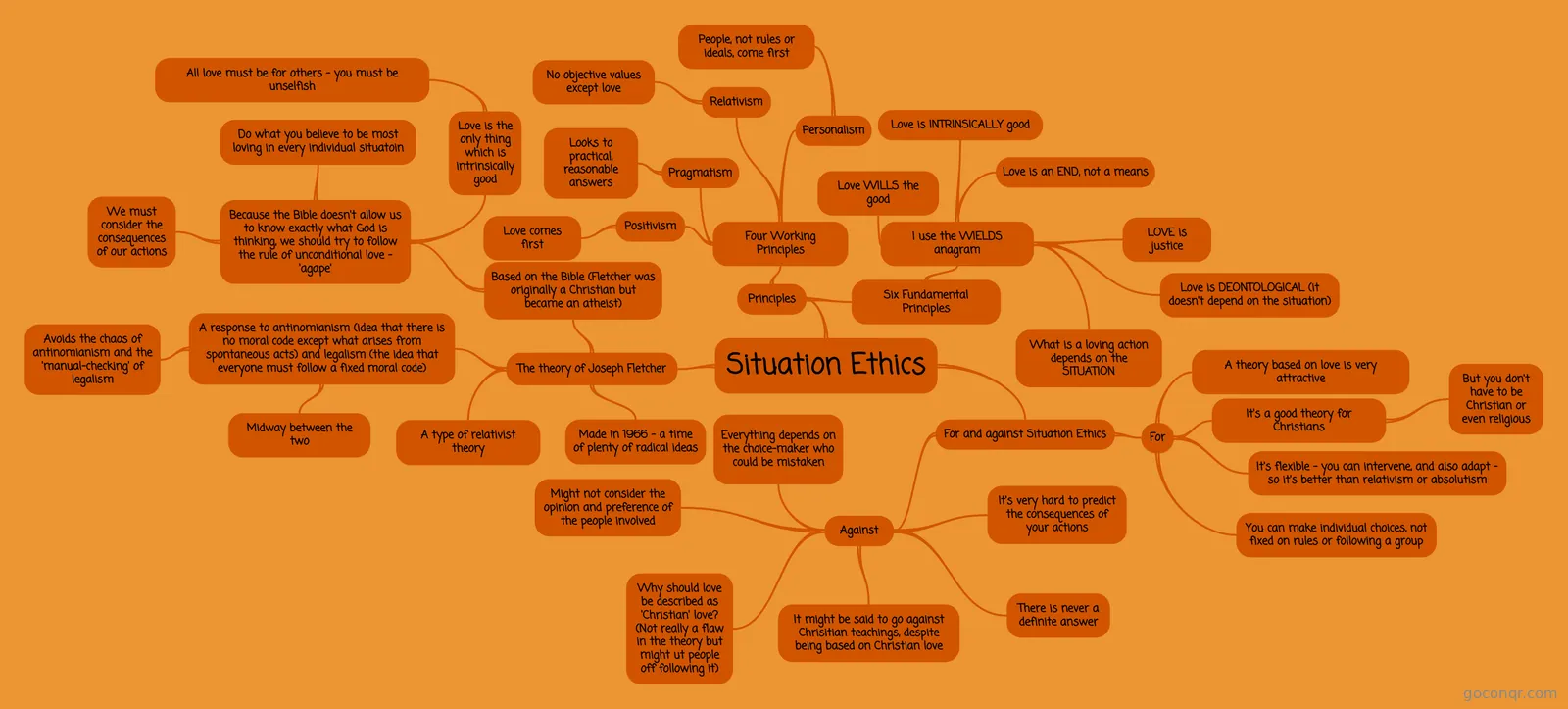 Situation Ethics
Flashcards
See all 14 flashcards-
9 cardsSituation Ethics
-
28 cardsSituation ethics (not complete)
-
6 cardsSituation Ethics (general evaluation) A strength of SE is...
-
8 cardsSex Ethics - Situation ethics How would SE approach sex before marriage?
-
6 cardsFletcher's 6 Fundamental Principles 1. 'ONLY ONE THING IS INTRINSICALLY GOOD; NAMELY LOVE: NOTHING ELSE AT ALL'
-
19 cardsUntitled What type of ethical theory is situation ethics?
-
5 cardsThe four working principles
-
4 cardsThe Four Working Principles
Notes
Slides
Topics in Situation Ethics
More Philosophy topics
About Situation Ethics
GoConqr OriginalWhat the page covers
The resources here follow Joseph Fletcher's approach, set out in Situation Ethics 1966. The central idea is agape, selfless love, as the one guiding principle. Most of the page is mind maps, with flashcard decks, quizzes, a set of notes and a slide set on euthanasia.
Where to start
Begin with the mind map called Situation Ethics 1966. It sets out Fletcher, agape and the relativistic outlook. Next, open the mind map Situation Ethics Key Words and their meanings, which explains antinomianism and legalism. Then look at the map on why Fletcher rejected antinomianism and legalism.
Then the principles
- The notes on Fletcher's four presumptions and six fundamental principles, which cover pragmatism and relativism.
- The Four Working Principles flashcards: pragmatism, relativism, positivism and personalism.
- The Fletcher's 6 Fundamental Principles flashcards, which begin with the claim that only love is intrinsically good.
Bible, strengths and weaknesses
The mind map Situation Ethics: The Bible looks at Matthew 22:35-40 and the command to love God and your neighbour. For evaluation, try the mind map on the strengths and weaknesses of Situation Ethics. It covers points such as individual freedom and a preference over a legalistic approach. Separate maps on Situation Ethics Strengths and Situation Ethics Criticisms let you split the two sides.
Applying it
Several resources apply the theory to issues. You will find mind maps on Situation Ethics and Animals, on euthanasia and Situation Ethics, and on embryo research, cloning and designer babies. There is also a flashcard deck on sex ethics. These help with exam answers that need examples.
Using quizzes and maps together
Read a map, then take the quiz called Situation Ethics Quotes to check you can place key sayings, such as Robinson's lines on love's need. Note what you missed, go back to the matching map, and try again. Teachers can pick a map or deck to use in a lesson. When you are ready, build your own maps and flashcards from what you have learned. This unit sits in the Ethics and Value Theory strand of Philosophy.
Frequently asked questions
Which resource should I open first?
Open the mind map Situation Ethics 1966. It introduces Joseph Fletcher, agape as the single guiding principle and the relativistic outlook. After that, move to the key words map, which explains antinomianism and legalism, before you try the principles flashcards.
What do the quizzes cover?
There are 3 quizzes on this page. One is titled Situation Ethics, one is called Situation Ethics Quotes, and a third is on the same topic in lower case. They test recall of key ideas and quotations, including Robinson's remarks about love's need.
Which exams do these resources suit?
The listed resources mention GCSE Religious Studies and A-level Religious Studies. Most of the material is aimed at school students at that level. Teachers can also use the maps and decks as ready-made material for revision lessons.
Are the resources free to use?
Yes. Every resource listed here is free to open, study and take, with no account needed. They were made by GoConqr users, not by GoConqr itself. A free account also saves your quiz scores and lets you create your own quizzes, mind maps, flashcards and notes.
Is there anything on applying Situation Ethics to real issues?
Yes. There are mind maps on animals, euthanasia, and embryo research, cloning and designer babies, plus a slide set on euthanasia and a flashcard deck on sex ethics. They show how the principles are used on specific moral questions.
What if I cannot find the topic I need?
Try a related map first, such as the key words map or the strengths and criticisms maps, as they overlap with many topics. If something is still missing, you can make your own mind map or flashcards to fill the gap.