
Critical Thinking
180 resources created by 153 users
This Critical Thinking page on GoConqr gathers community-made quizzes, mind maps, flashcards, notes and slide sets on arguments, conclusions, assumptions and the obstacles to clear reasoning. It's built for university students and professional candidates, school students, and teachers after ready-made material. There are over 170 resources here, including more than 10 quizzes and over 100 mind maps, from first definitions to evaluating evidence. Pick a resource, test yourself, then make your own set.
Select topic
- Elements of Thought21
- Intellectual Standards8
- Critical Thinking Process and Models8
- Barriers to Critical Thinking and Cognitive Biases5
- Language and Meaning7
- Argument Structure14
- Deductive, Inductive and Abductive Reasoning14
- Analyzing and Evaluating Arguments17
- Evidence, Credibility and Belief9
- Logical Fallacies9
Top Critical Thinking resources
-
200 cardsCR 1.1- CR 6.5.3 Introduction to Critical Reasoning
-
40 questionsStructure of an argument Identify the conclusion of the following argument.
-
64 questionsChapter 4 (Reasons for Belief and Doubts)
-
110 cardsUntitled
-
87 cardsPHIL 105 ch. 1-6 What is an argument?
-
42 questionsBasics Quiz One What is the meaning of the term "independent thinking?"
-
39 cardsB&K ch 2 (language and rhetoric)
-
Mind map Critical Thinking
Quizzes
See all 11 quizzes-
40 questionsStructure of an argument Identify the conclusion of the following argument.
-
64 questionsChapter 4 (Reasons for Belief and Doubts)
-
42 questionsBasics Quiz One What is the meaning of the term "independent thinking?"
-
10 questionsCritical thinking Which of the following are statements?
-
9 questionsHornbook Chapter 2 Quiz Common ground is what we can agree on without argument and provides a starting point for discussions.
-
6 questionsPhilosophy and Ethics: Reasoning and inquiry skills (2013 examination from scsa) Australia Day is the most important day in the life of the Australian nation, so we must act with dignity i...
-
24 questionsUntitled According to UnSpun 1, SPIN is
-
10 questionsExam quiz Reminders: Need to be specific (what's written) when describing analogues rather than trying to state somet...
Mind maps
See all 116 mind maps-
Critical Thinking
-
1_Critical Thinking Unit 1 (F501) OCR AS level critical thinking unit 1 overview
-
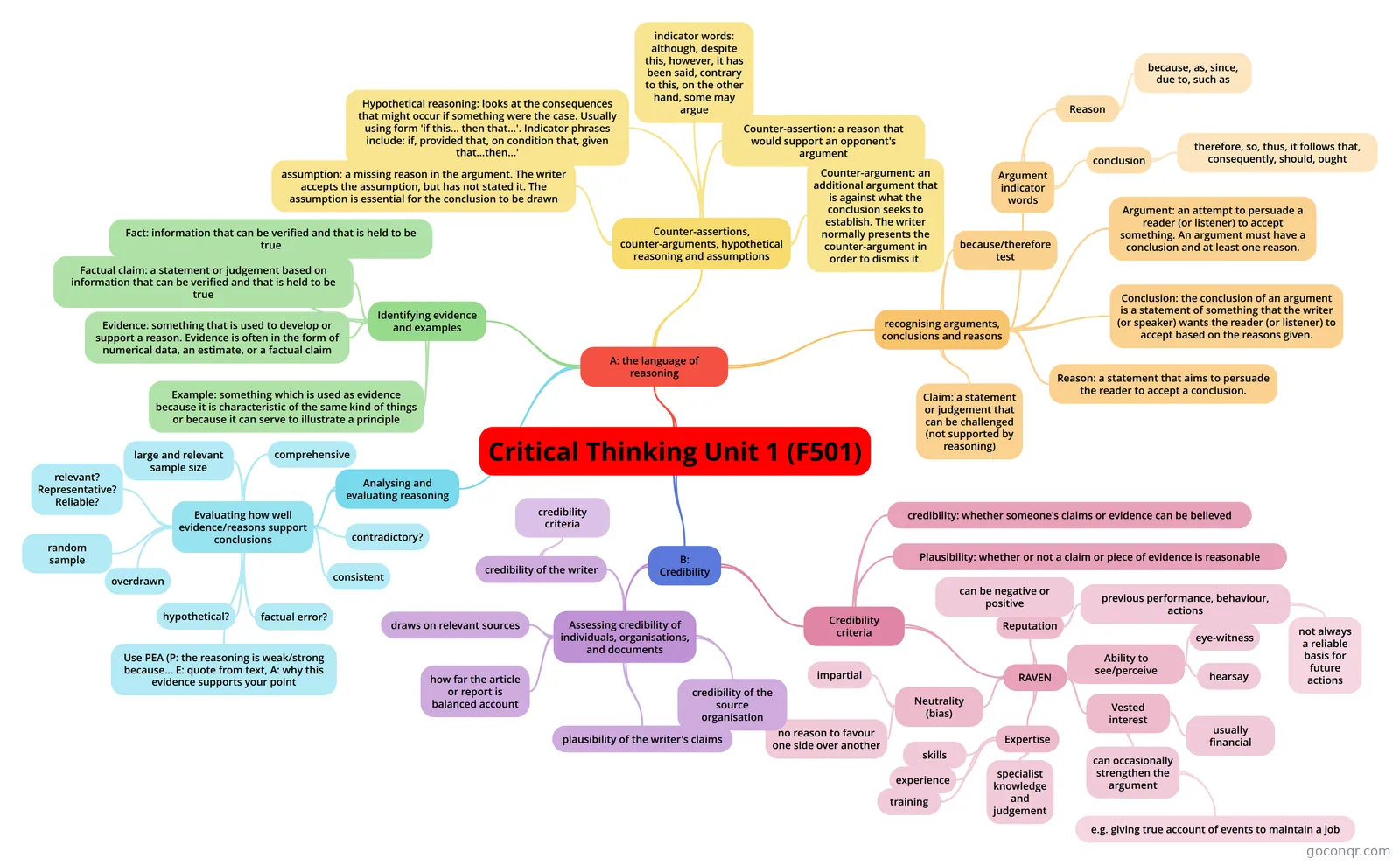 Critical Thinking Unit 1 (F501) OCR AS level critical thinking unit 1 overview
-
Critical Thinking Unit 1 (F501) OCR AS level critical thinking unit 1 overview
-
critical thinking
-
critical thinking unit 2
-
Critical thinking - intro Introduction to critical thinking university undergraduate year 1 level module
-
Parallel Thinking
Flashcards
See all 34 flashcards-
200 cardsCR 1.1- CR 6.5.3 Introduction to Critical Reasoning
-
110 cardsUntitled
-
87 cardsPHIL 105 ch. 1-6 What is an argument?
-
39 cardsB&K ch 2 (language and rhetoric)
-
14 cardsPhilosophy Critical Thinking Question Formats State whether the italicized phrase in the following sentence identifies a necessary condition, a *sufficie...
-
31 cardsEvaluating Argument In critical thinking, what does relevant mean
-
30 cardsAnalysis of Argument What is an opinion
-
32 cardsUnit 1 Keywords
Flowcharts
Notes
-
Ch.3 - Making Sense of Arguments SummaryArguments come in two forms: deductive and inductive. A deductive argument is intended to provide logically conclusive support for a conclusion; an inductive one, probable support for a conclusion. Deductive ar...
-
Ch.1 - The Power of Critical Thinking SummaryCritical thinking is the systematic evaluation or formulation of beliefs, or statements, by rational standards. It is systematic because it involves distinct procedures and methods. It entails evaluation and fo...
-
Ch. 2 - Obstacles to Critical Thinking Summary Critical thinking takes place in a mental environment consisting of our experiences, thoughts, and feelings. Some elements in this inner environment can sabotage our efforts to think critically or at least mak...
-
U1: Section B Credibility- Always name criterion being used and say whether this strengthens or weakens the credibilityReputation- Must be validated with independent sourceAbility to perceive- Ability to see/hear/touch/taste/smellV...
-
Reading 20 - Frustrated with the Russia Investigation Frustrated with the Russia investigation, Trump demands Democrats and Hillary Clinton face more scrutiny A second component is an unjustified attempt to deflect from the current situation by asking that we focus on an...
-
critical thinking - created from Mind Map critical thinking should not be confused with being argumentative or being critical of other people. althougn critical thinking skills can be used in exposing fallacies and bad reasoning, critical thinking can also pl...
-
critical thinking - creado desde un Mapa Mental theory The problem in general ... Our quality of life depends on our .. .
-
BSCOM/210T: Logic and Rhetoric Week 1 Topic 1.1: Critical Reasoning Critical reasoning is the study of how to think carefully about issues that matter to you. Thinking carefully is the gateway to a formal study of logic, arguments, persuasion, and rhetori...
Slides
Topics in Critical Thinking
More Philosophy topics
About Critical Thinking
GoConqr OriginalWhat the resources cover
This unit page is mostly mind maps, with flashcard decks, quizzes, notes, slide sets and a couple of flowcharts alongside. The core idea running through them is the structure of an argument: reasons, a conclusion, indicators, counter arguments and evidence. The flashcard deck Unit 1 Keywords lists terms such as claim, assumption, hypothetical reasoning and the reverse test. Other decks cover credibility, hearsay, inconsistency and the difference between necessary and sufficient conditions.
Where to start
Begin with the mind map C.T. Revision, which sets out argument, conclusion, reasons and key terms in one view. Then read the notes on the power of critical thinking, obstacles to it, and making sense of arguments. The slide set on the R.E.D model walks through recognising assumptions and evaluating information, which is a handy way to see the skills used in order.
Using quizzes and maps together
Study a map, close it, then try a quiz. Basics Quiz One checks ideas such as independent thinking and confident claims. The quiz on the structure of an argument tests whether you can spot reasons and conclusions. Wrong answers show which branch of a map to revisit. The mind maps titled Critical Thinking Unit 1 (F501) suit anyone working through the first unit of the OCR AS Critical Thinking course, which some resources mention.
Where it sits
This unit belongs to the strand Introduction to Philosophy and Reasoning within Philosophy. It gives a base in argument analysis that other reasoning topics in that strand can build on.
Next step
Choose one map, one deck and one quiz, work through them in turn, then try writing your own summary of an argument from a news article or a set text.
Frequently asked questions
Which resource should I open first?
Try the mind map C.T. Revision for a quick overview of arguments, reasons, conclusions and key terms. Then move to the Unit 1 Keywords flashcards to fix the vocabulary, and finish with Basics Quiz One to see which ideas still feel shaky.
What do the mind maps cover?
There are over 100 of them. They cover components of arguments, the critical thinker, hindrances to critical thinking, the questions critical thinkers ask, skeptical reading, justification and evidence, and the differences between types of reasoning. Several follow a Unit 1 course structure.
Are the resources free to use?
Yes. Every resource on this page is free to open, study and take, with no account needed. They were made by GoConqr users, not by GoConqr itself, so styles and depth vary. A free account also saves your quiz scores and lets you build your own.
Which levels and exams do they suit?
Most resources suit university students and professional candidates, with a good share for school students. At least one listed resource mentions OCR AS Critical Thinking. Teachers can use the notes, slide sets and maps as ready-made classroom material.
Are there quizzes to test myself?
Yes, there are over 10 quizzes. Examples include Basics Quiz One, a quiz on the structure of an argument, and one on reasons for belief and doubts. They are a good way to check what you have learned from the maps and flashcards.
What if the topic I need is missing?
Look through the flashcards, notes and slide sets, since the same idea often appears in a different format. If you still can't find it, make your own mind map, flashcards or quiz for that topic and use it alongside the community resources.