
Physics Equations and Formulae
181 resources created by 177 users
This Physics Equations and Formulae page on GoConqr gathers community-made flashcards, mind maps, quizzes and notes, from weight, work done and kinetic energy to wave speed, electrical power and the power of a lens. It's built for school students revising for GCSE, IGCSE, A-level or IB Physics, and for teachers after ready-made material. There are over 170 resources here, including more than 140 flashcards and more than 20 mind maps. Pick a deck, test yourself with a quiz, then make your own set.
Top Physics Equations and Formulae resources
-
20 questionsAQA GCSE physics equations quiz What is the calculation for weight?
-
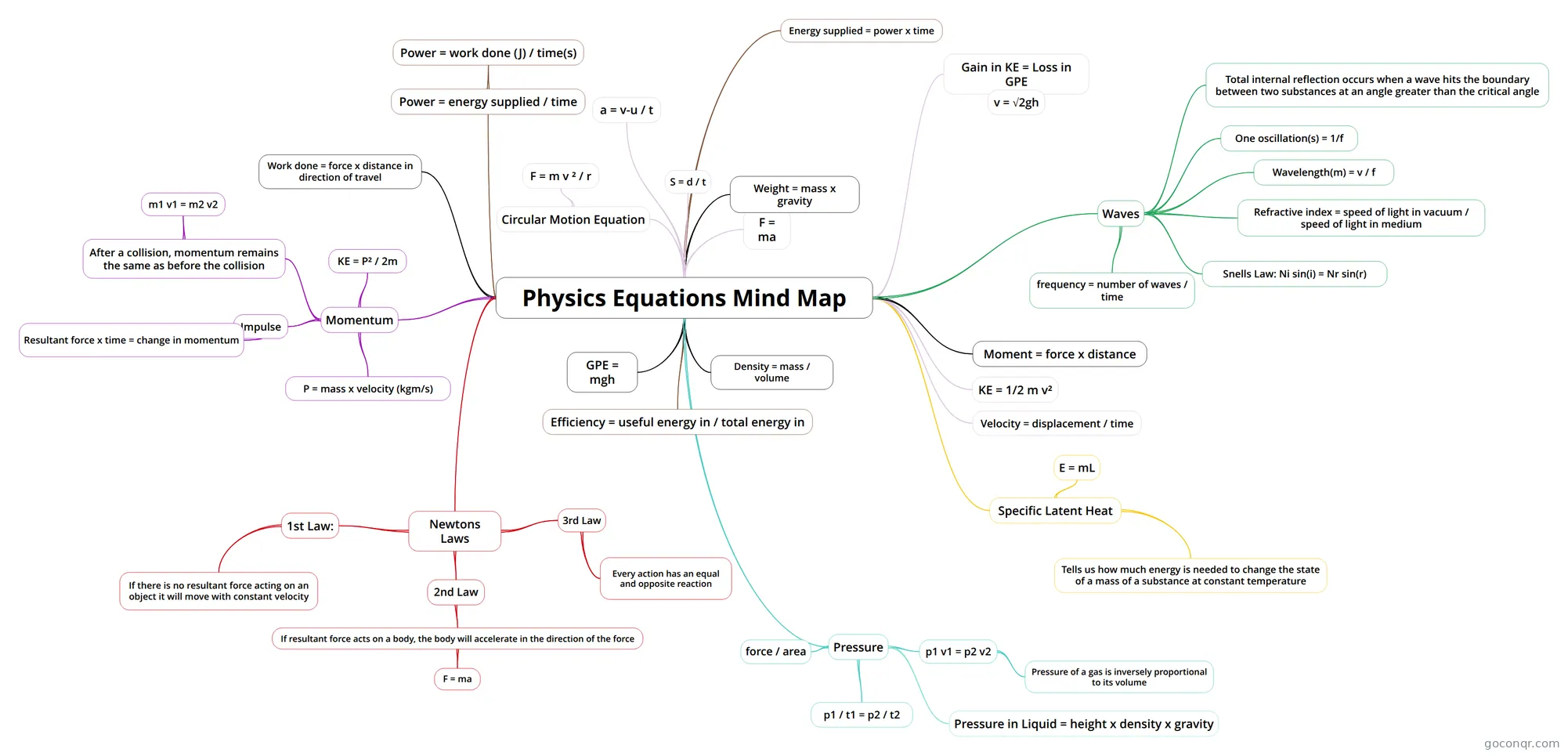 Mind map Physics Equations Mind Map iGCSE physics main equations
-
13 cardsA-Level Physics OCR B - Equations You Should Know Power Of A Lens In Dioptres
-
22 cardsFormula for Physics IGCSE edexcel For Physics IGCSE Edexcel course
-
33 cardsPhysics Formulae for IGCSE Edexcel Equation for Speed
-
25 cardsGCSE Combined Science Equations The equations to know for Combined Science at GCSE level.
-
26 cardsPhysics Equations for IGCSE Speed Distance Time
-
23 cardsUseful equations
Quizzes
See all 11 quizzesMind maps
See all 21 mind maps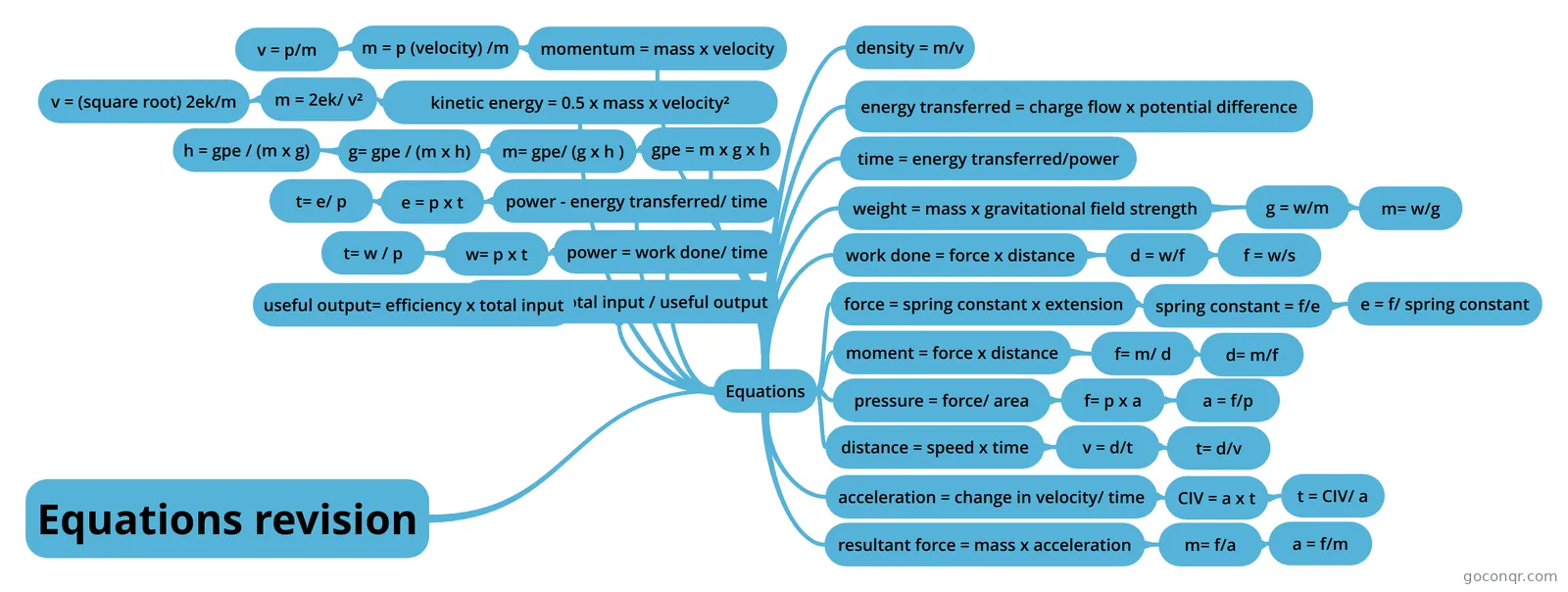
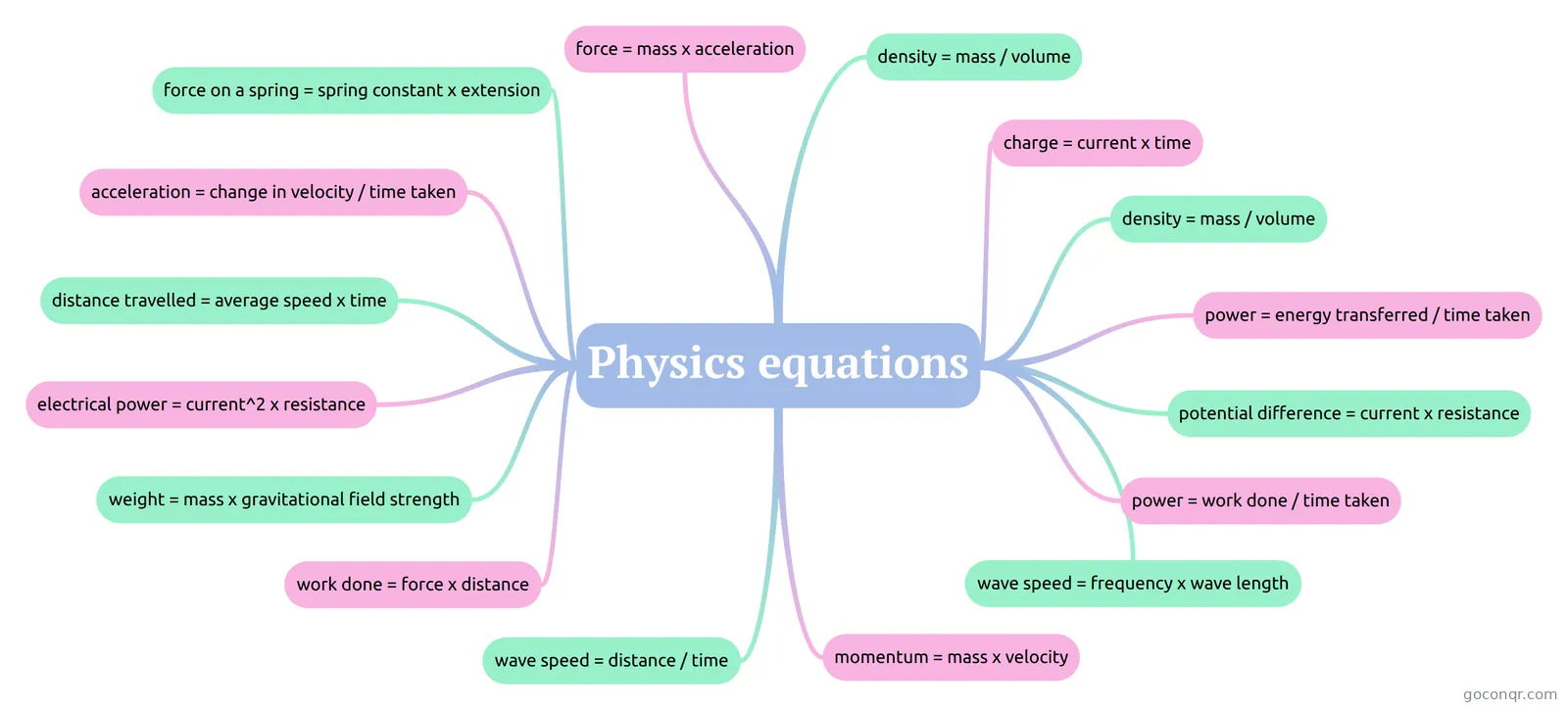
Flashcards
See all 144 flashcards-
13 cardsA-Level Physics OCR B - Equations You Should Know Power Of A Lens In Dioptres
-
22 cardsFormula for Physics IGCSE edexcel For Physics IGCSE Edexcel course
-
33 cardsPhysics Formulae for IGCSE Edexcel Equation for Speed
-
25 cardsGCSE Combined Science Equations The equations to know for Combined Science at GCSE level.
-
26 cardsPhysics Equations for IGCSE Speed Distance Time
-
23 cardsUseful equations
-
18 cardsPhysics equations All the equations you need to know for Physics GCSE
-
40 cardsPhysics PH4 Period, T, for a point describing a circle
Flowcharts
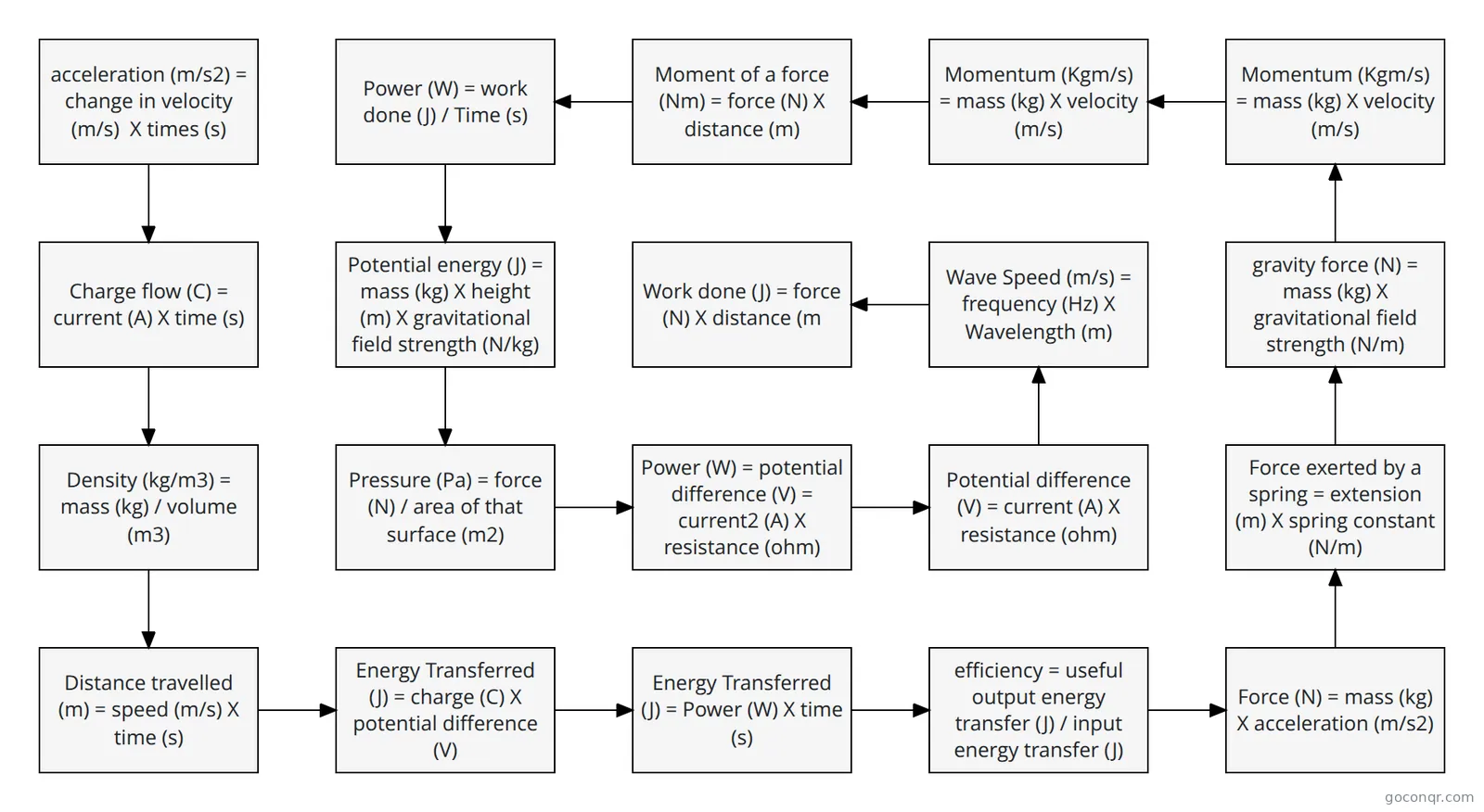
Notes
-
Key Physics Equations Units are in red.Velocity = Distance/Time m/sSpeed=Distance/Time m/s or mphAcceleration=Change in velocity/Time m/s2)Force (N) =Mass x Acceleration NForce=k (spring constant) x elasticity. NPressure (S&G) = force/area...
-
Physics Equations Equations about electricity: V = Voltage I = Current R = Resistance P = Power Q = Charge E = Energy t = time Vp=Voltage in prim...
More Physics topics
About Physics Equations and Formulae
GoConqr OriginalWhat this unit covers
This unit collects the equations school physics asks you to know. Most of the listed resources are flashcard decks, with mind maps, quizzes, notes and one flowchart alongside them. The decks run from basics such as speed, acceleration, weight and density to pressure, moments, springs, charge, voltage, electrical power and wave speed.
Where to start
If you are revising for a GCSE or IGCSE course, begin with a deck that names your exam. GCSE physics equations and Physics Formulae for IGCSE Edexcel pair each quantity with its equation and units. Formula for Physics IGCSE edexcel lists average speed, force, momentum, work done and input power. For A-level, the OCR B deck on equations you should know adds lens power, magnification, resistance, conductance and average velocity.
Using quizzes and maps together
Start with a mind map to see how the equations connect. The Physics Equations Mind Map sets out Newton's laws in plain wording. Then check what you remember with the AQA GCSE physics equations quiz, which asks things like the calculation for weight, W = mg, and charge as current multiplied by time. Note the ones you miss, go back to the flashcards for those, and try the quiz again.
- Read a mind map.
- Run through a flashcard deck.
- Take a quiz.
- Return to the cards you missed.
Where it sits
This unit belongs to the Foundations of Physics strand in Physics. The equations here are the working tools you will meet again across other topics.
Next step
Choose one deck or map that matches your course and work through it today. When you want something tailored, you can build your own cards from the equations you find hardest.
Frequently asked questions
Which resource should I start with?
Pick a flashcard deck that matches your course. For GCSE, the GCSE physics equations deck is a good first look. For IGCSE Edexcel, try Physics Formulae for IGCSE Edexcel. For A-level OCR B, start with the equations you should know deck. Then test yourself with a quiz.
What do the mind maps cover?
The mind maps gather equations in one view. The Physics Equations Mind Map includes Newton's laws, with the first law stated as constant velocity when there is no resultant force. Other maps include AQA GCSE PHYSICS EQUATIONS 9-1 and Physics IGCSE Equations, so you can choose one that fits your exam.
Are the resources free to use?
Yes. Every resource listed here is free to open, study and take, with no account needed. They were made by GoConqr users, not by GoConqr itself. A free account also saves your quiz scores and lets you make your own quizzes, mind maps, flashcards and notes.
Which exams do these resources suit?
The listed resources mention GCSE Physics, AQA GCSE Physics, IGCSE Physics, A-level Physics and IB Physics. Most are aimed at school students at secondary level. Check the title and the cards inside to see whether a resource matches your exam board before you start.
How can teachers use this page?
Teachers can pick ready-made decks, maps and quizzes for revision. A quiz such as the AQA GCSE physics equations quiz works as a quick check on weight, work done and charge. Flashcard decks suit starter activities, and mind maps help show how the equations link.
What if the equation I need is missing?
Try another deck, since the equations vary from one to the next. Some cover moments, springs or gases, and others cover waves or lenses. If you still cannot find it, you can make your own flashcards or mind map for that equation.