
Religion and Beliefs in Society
130 resources created by 85 users
This Religion and Beliefs in Society page on GoConqr gathers community-made mind maps, flashcards, quizzes, slides and notes, from definitions of religion and secularisation to Marxist, feminist and functionalist theories. It's built for school students revising for A-level Sociology, GCSE Sociology or similar courses, and for teachers after ready-made material, with a little for university students too. There are over 1,100 resources here, including more than 30 quizzes and over 700 mind maps. Try a quiz to find your gaps, then make your own revision cards.
Top Religion and Beliefs in Society resources
-
80 cardsCIE A Level Sociology - Religion Sociological Perspectives on Religion Defining Religion
-
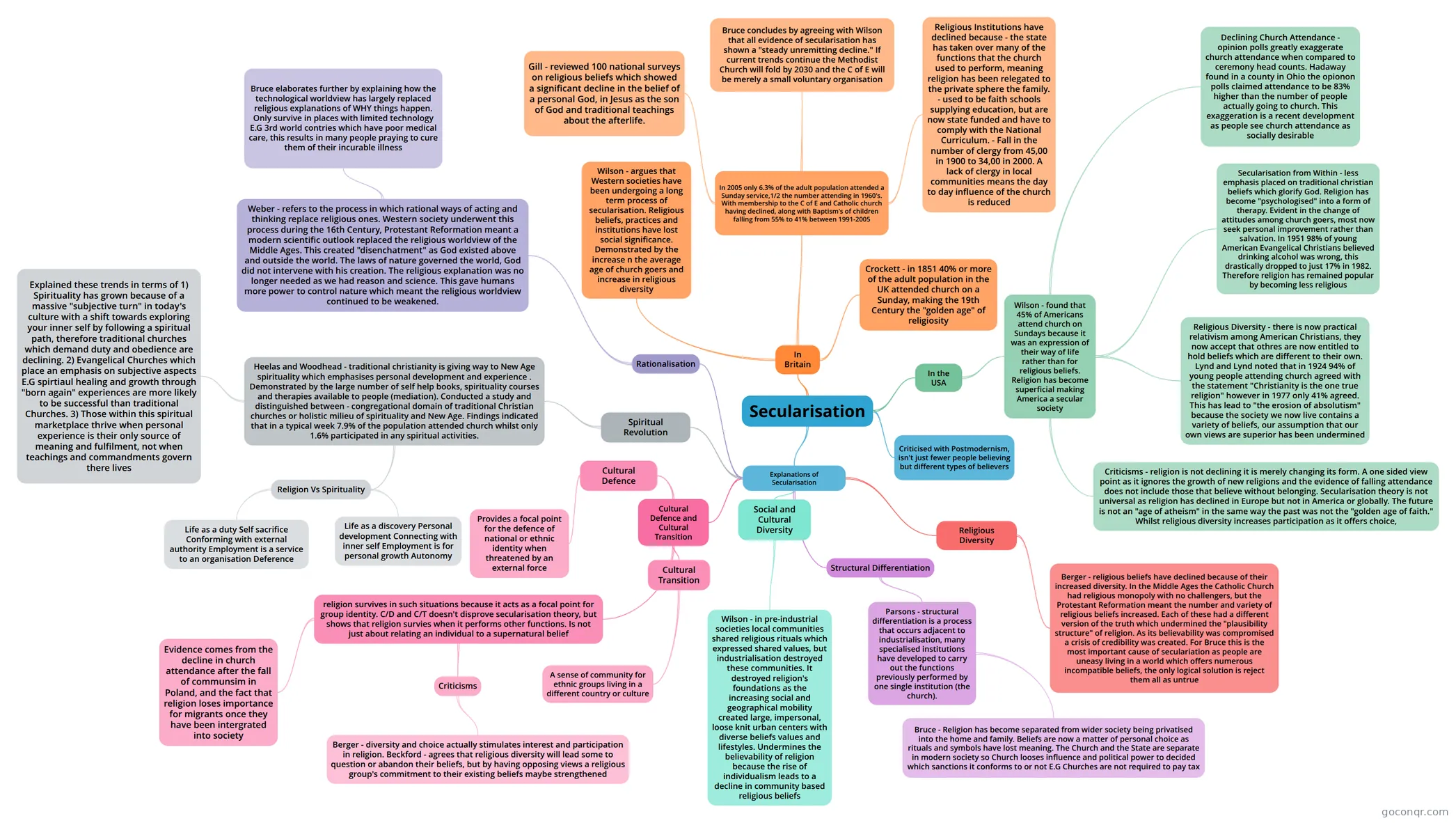 Mind map Secularisation
-
Mind map Organisations, Movements and Members
-
 Mind map Religion Renewal and Choice mindmap summary of topic 4
-
 Mind map Sociology- Beliefs in Society
-
28 cardsMarxist and Feminist view on religion How do the Marxists see religion?
-
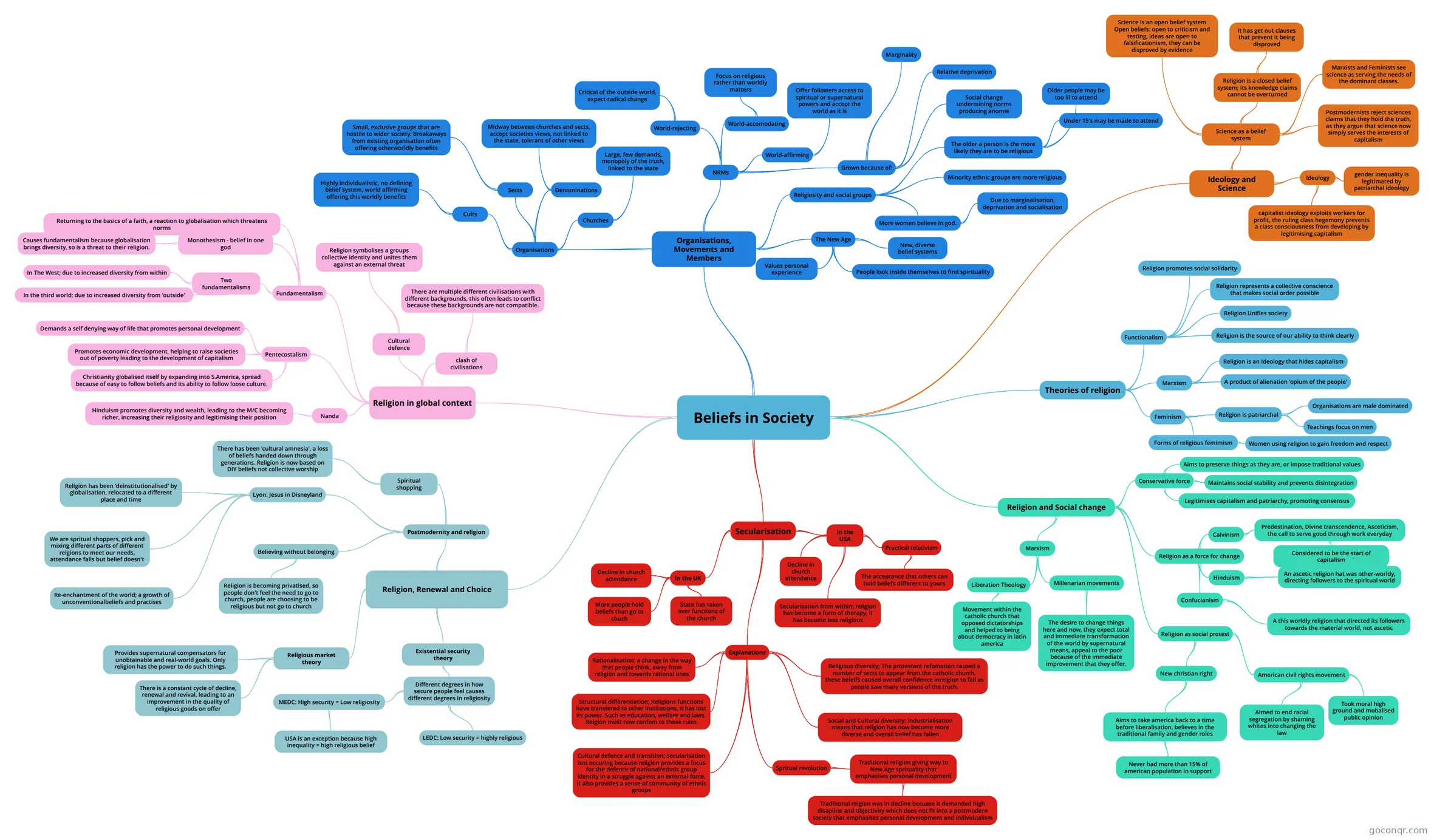 Mind map Beliefs in Society Beliefs in Society
-
15 cardsSociology: beliefs in society Durkheim: The sacred and the profane
Quizzes
Mind maps
See all 77 mind maps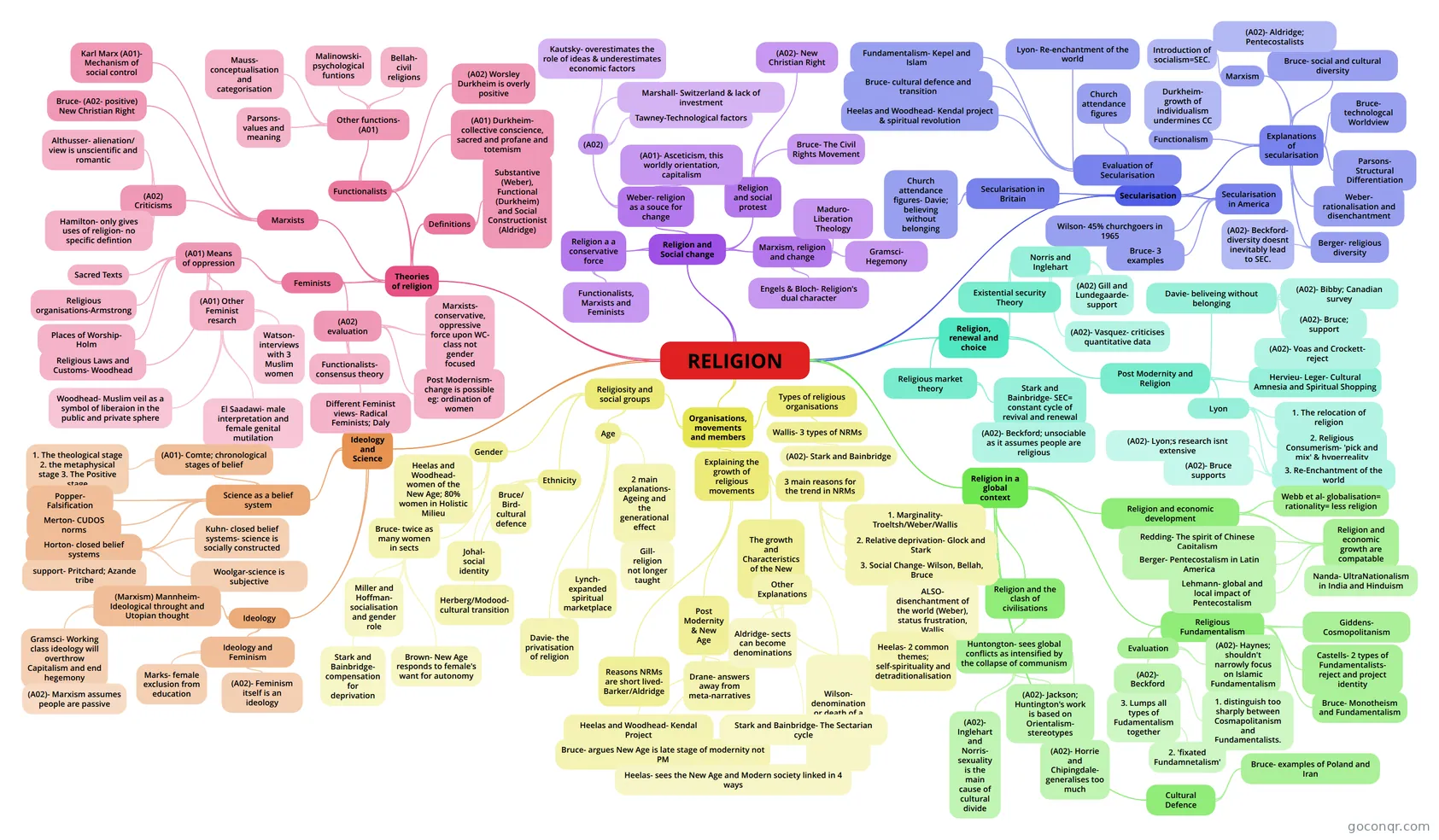
Flashcards
See all 40 flashcards-
80 cardsCIE A Level Sociology - Religion Sociological Perspectives on Religion Defining Religion
-
28 cardsMarxist and Feminist view on religion How do the Marxists see religion?
-
15 cardsSociology: beliefs in society Durkheim: The sacred and the profane
-
28 cardsGOD AND GLOBALISATION IN INDIA
-
11 cardskendal project Who conducted the Kendal Project?
-
45 cardsTheories of Religion Functionalists see society as...
-
131 cardsbeliefs
-
42 cardsReligion, Renewal and Choice & New forms of religion Q1: Explain why people challenge the theory that religion is declining. (Religion, Renewal and Choice & New...
Flowcharts
Notes
-
Sociology Essay - Is religion a tool for opression? Introduction Re - word the question Acknowledge that there are a number of sociological viewpoints and ideas on the area Hint at what your viewpoint may be Paragraph One Introduce the second sociological theory (femin...
-
Factors Affecting Religiosity Key trends More women than men participate in religious activities and believe in God, sin, evil, the Devil and life after death Miller and Hoffman - women express greater interest in religion, have a stronger persona...
-
Karl Marx Karl MarxSocialist and later developed communism with the "Communist Manifesto" in the 1800's MArx spent his time developing the impact of a feudel system on the working class. He emphasised the exploitation of the pr...
-
Religious Pluralism - created from Mind Map Classical Sociology religion would eventually dissappear society would become more rational, science more tangible evidence of Religious Pluralism New Religious Movements growth of older religions i.e. Pentecostalism,...
Slides
More Sociology topics
About Religion and Beliefs in Society
GoConqr OriginalWhat the resources cover
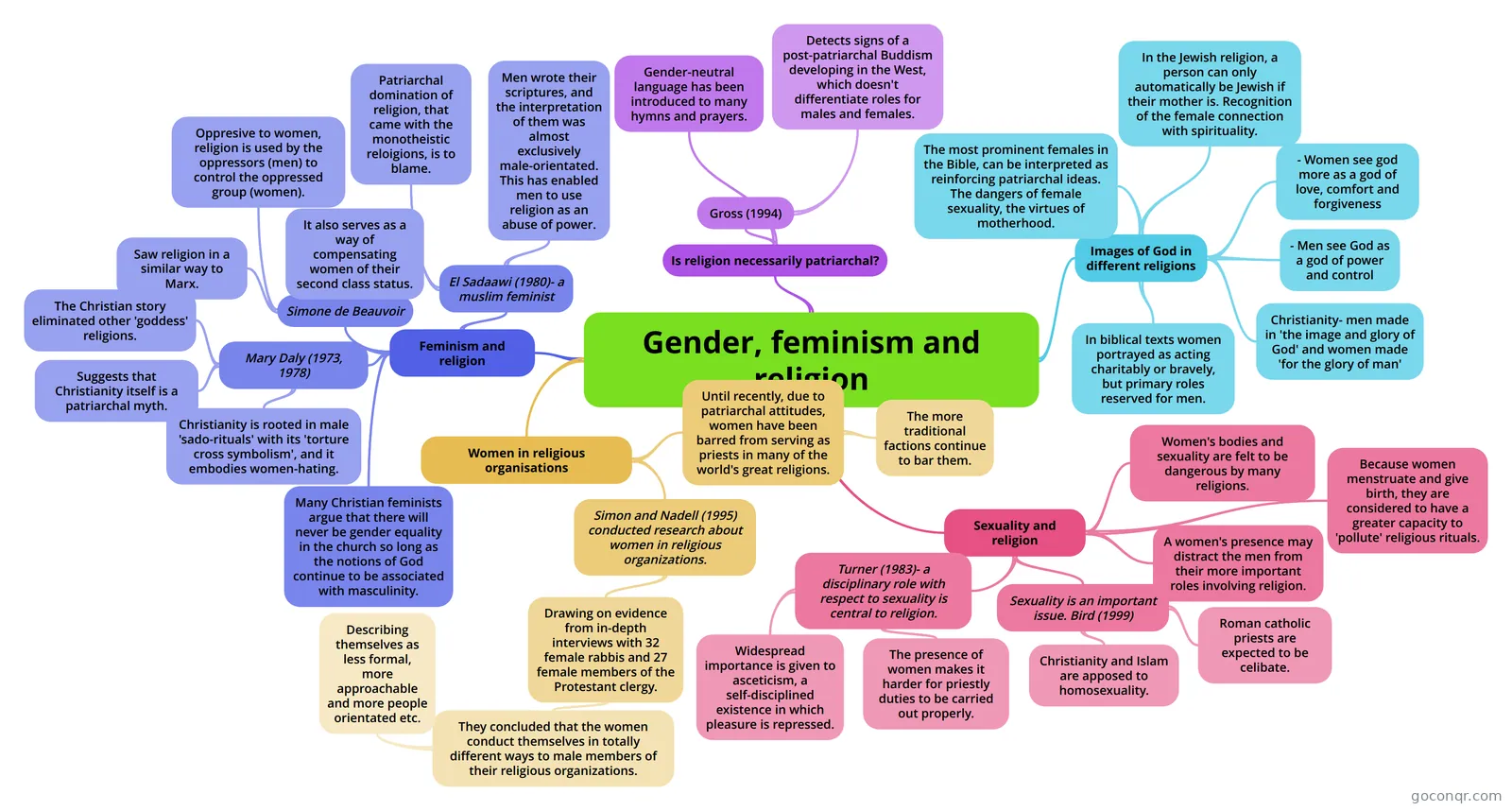
The page is built around the main topics of beliefs in society. Several mind maps look at Secularisation, including the argument that church attendance in Britain was once far higher than it is now, and the way the growth of religious pluralism and the mass media fit into the debate. Others cover Religion and Social change, where religion is treated as a conservative force, and Feminist Theory of Religion, which looks at patriarchy in religious organisations.
Theory is well served. You will find mind maps, notes and flashcards on Marxism, neo-Marxism, feminism, functionalism and the Weberian approach. The flashcards on Sociology: beliefs in society run through Durkheim on the sacred and the profane, totemism and the collective consciousness, then Parsons and Malinowski.
Where to start
- Begin with the mind map Sociology- Beliefs in Society for an overview of religion, science and ideology, organisations and movements, and social change.
- Move to the Theories of Religion resources, then the Functionalist and Marxist ones.
- Take on secularisation, a topic that rewards careful evaluation.
- Finish with newer forms of belief, such as the mind map on NEW RELIGIOUS MOVEMENTS and NEW AGE MOVEMENTS, and the flashcards on religious fundamentalism.
Using quizzes and maps together
Read a mind map first, then test yourself. The quiz on Functionalist theories of religion suits a first check, and the quiz on religion: theories and social change widens it. Whatever you get wrong tells you which map or card deck to reopen. Teachers can set a map as a starter and a quiz as a plenary.
Where it sits
This unit belongs to the strand Beliefs, Media and Everyday Life in Sociology. Some listed items reach beyond the core theories, such as the flashcards on God and globalisation in India and the Kendal project, which give you real examples to use in essays.
Next step
Choose one topic, work through its map and quiz, and then build your own flashcards to fill any gaps you find.
Frequently asked questions
Which resource should I open first?
Start with the mind map Sociology- Beliefs in Society. It sets out the whole topic in one place, including religion, science and ideology, organisations and movements, social groups, social change and secularisation. After that, pick a theory such as functionalism or Marxism and go deeper.
Are there quizzes on this page?
Yes. There are more than 30 quizzes. Examples include Functionalist theories of religion, Interpretivist response to religion, religion: theories and social change, and social groups - religion. They work well after you have read a mind map on the same topic.
Which exams do these resources suit?
The listed resources mention A-level Sociology, GCSE Sociology, AQA Sociology, AQA A-level Sociology and IB. Most of the material is aimed at school level, so it suits school students, and teachers can use it for ready-made starters and revision tasks.
Do I need an account to use them?
No. Every resource listed here is free to open, study and take, with no account. If you want to save quiz scores or make your own quizzes, mind maps, flashcards and notes, you can add a free account.
Who made these resources?
They were made by GoConqr users, not by GoConqr itself. Over 500 contributors have added maps, flashcards, notes and slides. Styles differ, so compare a couple of resources on the same topic and use what suits you.
What if I cannot find my topic?
Look at the related titles first, as many topics appear under different names, such as Secularisation and Explanations of secularisation. If something is still missing, you can make your own mind map or flashcards on it.