
Igneous Rocks
32 resources created by 25 users
This Igneous Rocks page on GoConqr gathers community-made notes, mind maps, flashcards and quizzes on textures, classification, magma differentiation, intrusive and extrusive rocks, and mafic and silicic types. It's built for school students revising a topic, university students filling gaps, and teachers after ready-made material. There are over 120 resources here, including more than 60 flashcards and over 30 mind maps, pitched at secondary and university level. Pick a starting point, then try a quiz to see what sticks.
Top Igneous Rocks resources
-
20 cardsUnit 1.1 Igneous Rocks How are igneous rocks formed?
-
41 questionsIgenous Rock Classification! What is the composition of the rock "Granite" ?
-
20 cardsIgneous rocks unit 1.1 flashcards:( What is geology?
-
15 cardsGeology- Igneous Rocks 2 Classification of magma/ Igneous Rocks
-
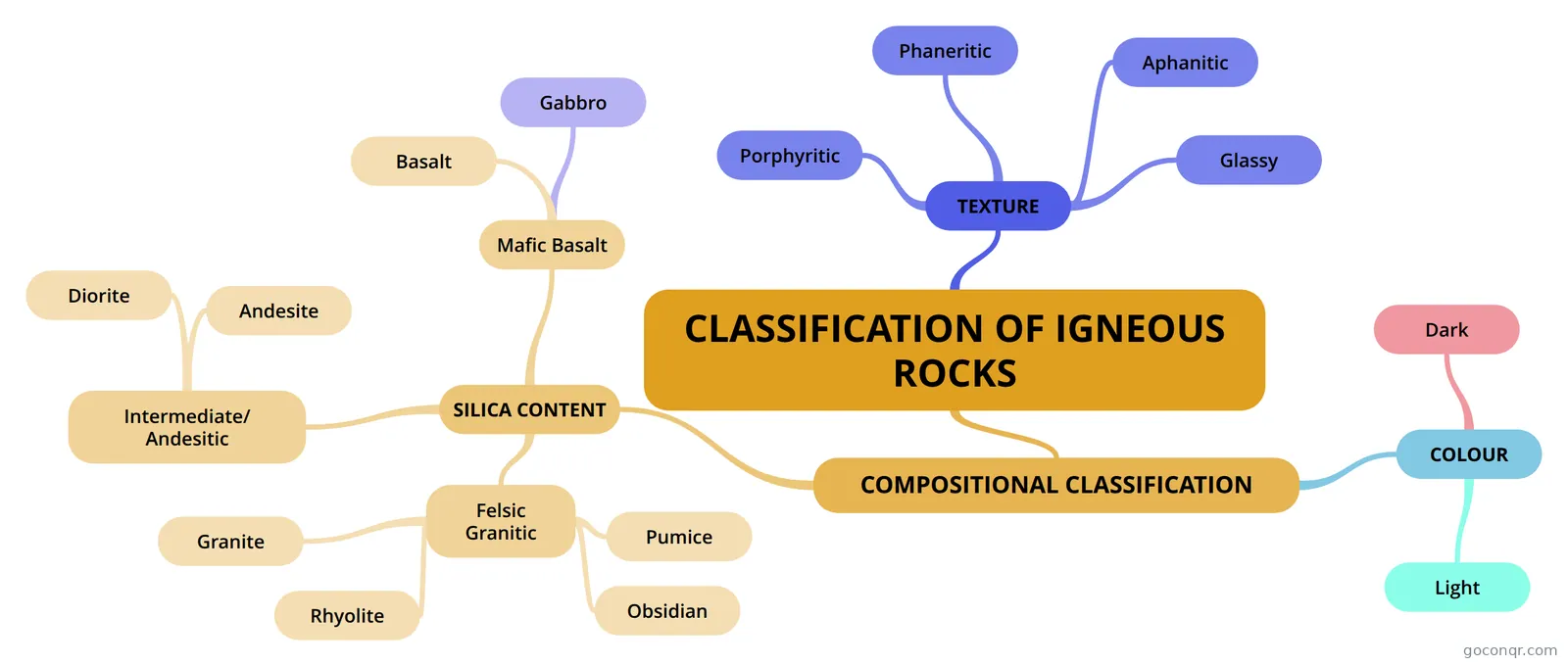 Mind map CLASSIFICATION OF IGNEOUS ROCKS This has to do with the classification of Igneous rocks.
-
12 cardsIgneous Rocks
-
3 questions2.2 Igneous Products and Processes What is a Xenolith?
-
13 cardsGeology Igneous
Quizzes
Mind maps
See all 10 mind mapsFlashcards
See all 11 flashcards-
20 cardsUnit 1.1 Igneous Rocks How are igneous rocks formed?
-
20 cardsIgneous rocks unit 1.1 flashcards:( What is geology?
-
15 cardsGeology- Igneous Rocks 2 Classification of magma/ Igneous Rocks
-
12 cardsIgneous Rocks
-
13 cardsGeology Igneous
-
14 cardsGeology Lab Midterm Igneous rocks
-
20 cardsIgneous Rock examples
-
9 cardsIgneous Rocks Ig Rocks man
Notes
-
Differences Between Intrusive and Extrusive Rocks Chilled Margin the edge of the igneous intrusion, which is closest to the cold country rock, cools more rapidly than the rest of the intrusion and forms the chilled margin the chilled margin may only be a few centimen...
-
Igneous Textures Igneous rocks generally consist of interlocking crystals, which gives them a crystalline texture. Pyroclastic rocks will have a fragmental texture as they consist of fragments of glass, crystal and rock, as a result o...
-
Differentiation of Magma Bowen's Reaction SeriesNorman L Bowen was an American geologist who, during the 1920s, carried out a series of experiments to find the temperatures at which minerals in igneous rocks crystallised. He used powdered roc...
-
The Results of Magmatic Differentiation If a parent rock is mafic in theory it will produce: peridotite at the base of the intrusion, rich in dense olivine gabbro forming the main part of the intrusion diorite may exist towards the top of the intrusion gran...
-
Igneous Rocks Classification of Igneous RocksIgneous rocks make up about 95% of the Earth's surface. There are sedimentary rocks are the surface, metamorphic rocks are also found in the crust.Crystal Grain SizeIf no crystals can be...
-
Igneous Rocks and Rates of Cooling Crystal Grain SizeExamining crystals in igneous rocks is one of the quickest ways to identify rocks in the field or from samples.The rate of cooling is the main factor that controls crystal size. The general rule is t...
-
Identifying Mafic and Ultramafic Igneous Rocks Mafic Igneous RocksShould be dark in colour - due to ferromagnesian minerals (pyroxne augite, and sometimes olivine with Ca-rich plagioclase but no quartz)Low silica magma only 45-52% silica Low viscosity, so reaches ...
-
Identifying Silicic and Intermediate Igneous Rocks crystal grain size to tell you the rate of cooling mineral composition and colour for silica content igneous textures for origin Silicic Igneous RocksHigh silica magma contains 66 to 75% silica and is mainly generated...
More Geology and earth sciences topics
About Igneous Rocks
GoConqr OriginalWhat this unit covers
The resources here follow igneous rocks from how they form to how you name them. The note Igneous Textures explains that most igneous rocks are made of interlocking crystals, while pyroclastic rocks have a fragmental texture made of glass, crystal and rock pieces. The note Differences Between Intrusive and Extrusive Rocks looks at features such as the chilled margin, where an intrusion cools fastest against cold country rock.
Where to start
Begin with the flashcard deck Unit 1.1 Igneous Rocks. It opens with basic questions, such as how igneous rocks form and what separates magma from lava. Then read the note Igneous Rocks and Rates of Cooling, which shows how crystal grain size is one of the quickest ways to identify a rock in the field or from samples.
Classifying by composition
Next, move to composition. Identifying Silicic and Intermediate Igneous Rocks covers high-silica magma, with 66 to 75% silica. Identifying Mafic and Ultramafic Igneous Rocks describes dark rocks rich in ferromagnesian minerals, from low-silica magma with 45 to 52% silica. Many mind maps on mafic and silicic rocks sit alongside these notes, so you can compare versions and pick the layout that suits you.
Using quizzes and maps together
Read a mind map first to see how the ideas link, then test yourself. Quizzes such as 2.2 Igneous Products and Processes and Unit 6 - Intrusive and Extrusive Rocks - Practice Quiz show quickly which areas need another look. Go back to the notes for those gaps, then retry.
Where it fits
This unit sits in the Earth Materials strand of Geology and earth sciences. For more depth, the mind maps on Small-fraction volatile-rich melts and the flashcards on magma mixing and assimilation go further into how magmas change.
Choose one resource that matches your level today, and make your own flashcards or map from it.
Frequently asked questions
Which resource should I open first?
Start with the flashcard deck Unit 1.1 Igneous Rocks. It asks basic questions, such as how igneous rocks form and the difference between magma and lava. Once those feel familiar, move on to the notes on textures and rates of cooling.
What do the mind maps cover?
The mind maps cover igneous rock classification, intrusive landforms, basalt, and many versions on mafic and silicic rocks. There is also a map on small-fraction volatile-rich melts, including kimberlites, and one called Earth Science 203: Igneous, which touches on elemental diffusion and glassy textures.
Are the resources free to use?
Yes. Every resource on this page is free to open, study and take, with no account needed. A free account also saves your quiz scores and lets you make your own quizzes, mind maps, flashcards and notes.
Who made these resources?
They were made by GoConqr users, not by GoConqr itself. More than 100 contributors have added notes, maps, flashcards and quizzes here, so styles and depth vary. Try a few on the same topic and keep the ones that explain it best.
Which levels do they suit?
Most resources are pitched at secondary level, with a good share at university level. School students can use the basic flashcards and notes on textures and classification, while university students may prefer the maps on magma differentiation and volatile-rich melts.
How can I check what I have learned?
Take one of the quizzes, such as Igneous Rocks or Igenous Rock Classification!. Then note which questions you missed and reread the matching notes, for example on silicic or mafic rocks. Retake the quiz afterwards to see whether those gaps have closed.