
Natural Hazards and Disasters
538 resources created by 479 users
This Natural Hazards and Disasters page on GoConqr gathers community-made mind maps, flashcards, quizzes, slide sets and notes, from tsunamis, earthquakes and volcanoes to hurricanes, landslides and floods. It's built for school students revising GCSE Geography or A-level Geography topics, and for teachers after ready-made material. There are over 480 resources here, including more than 20 quizzes, over 350 mind maps and more than 80 flashcard decks. Pick a case study, test yourself with a quiz, then make your own versions.
Top Natural Hazards and Disasters resources
-
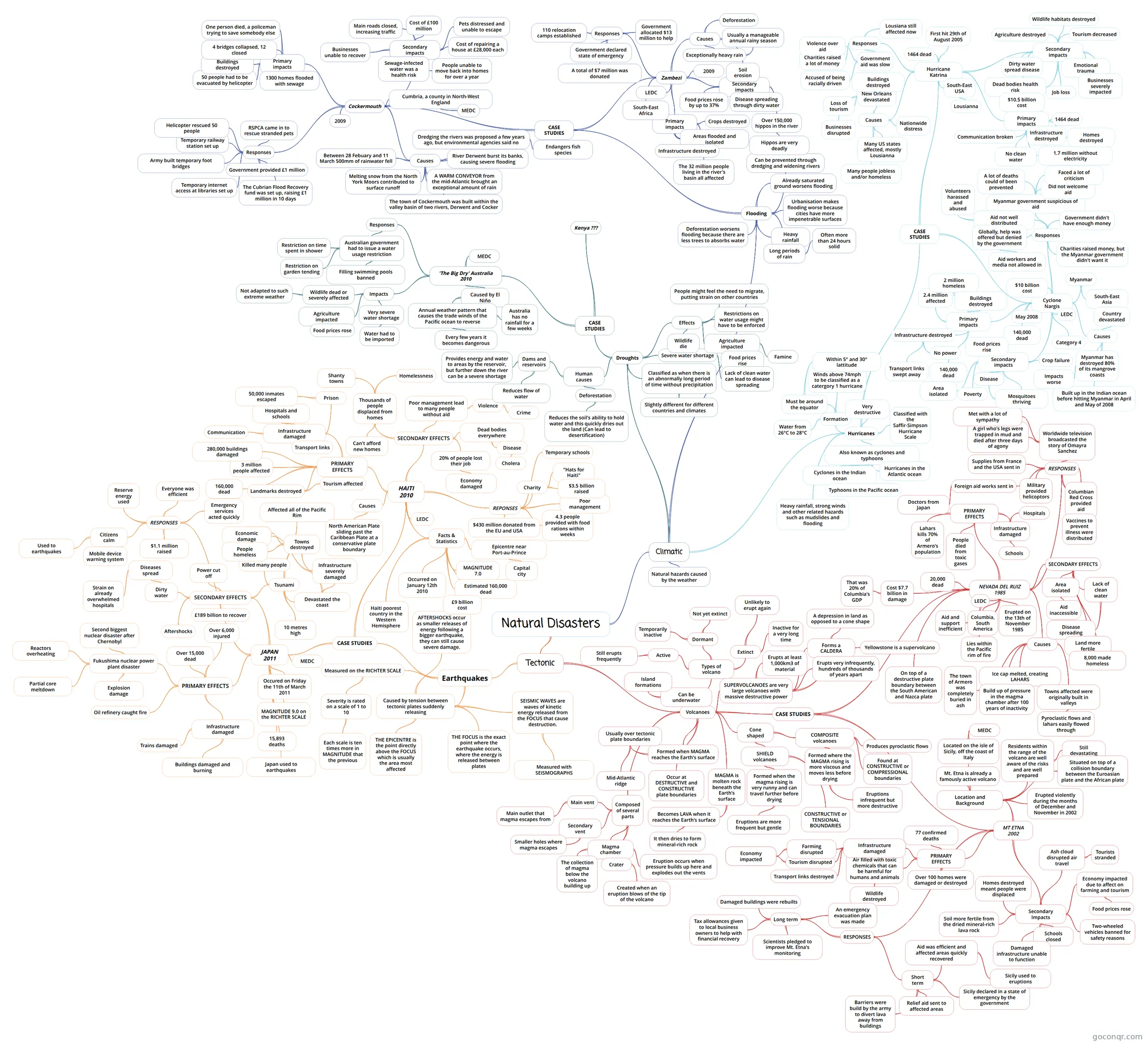 Mind map Natural Disasters
-
 Mind map Tohoku Earthquake and Tsunami : Japan, 2011
-
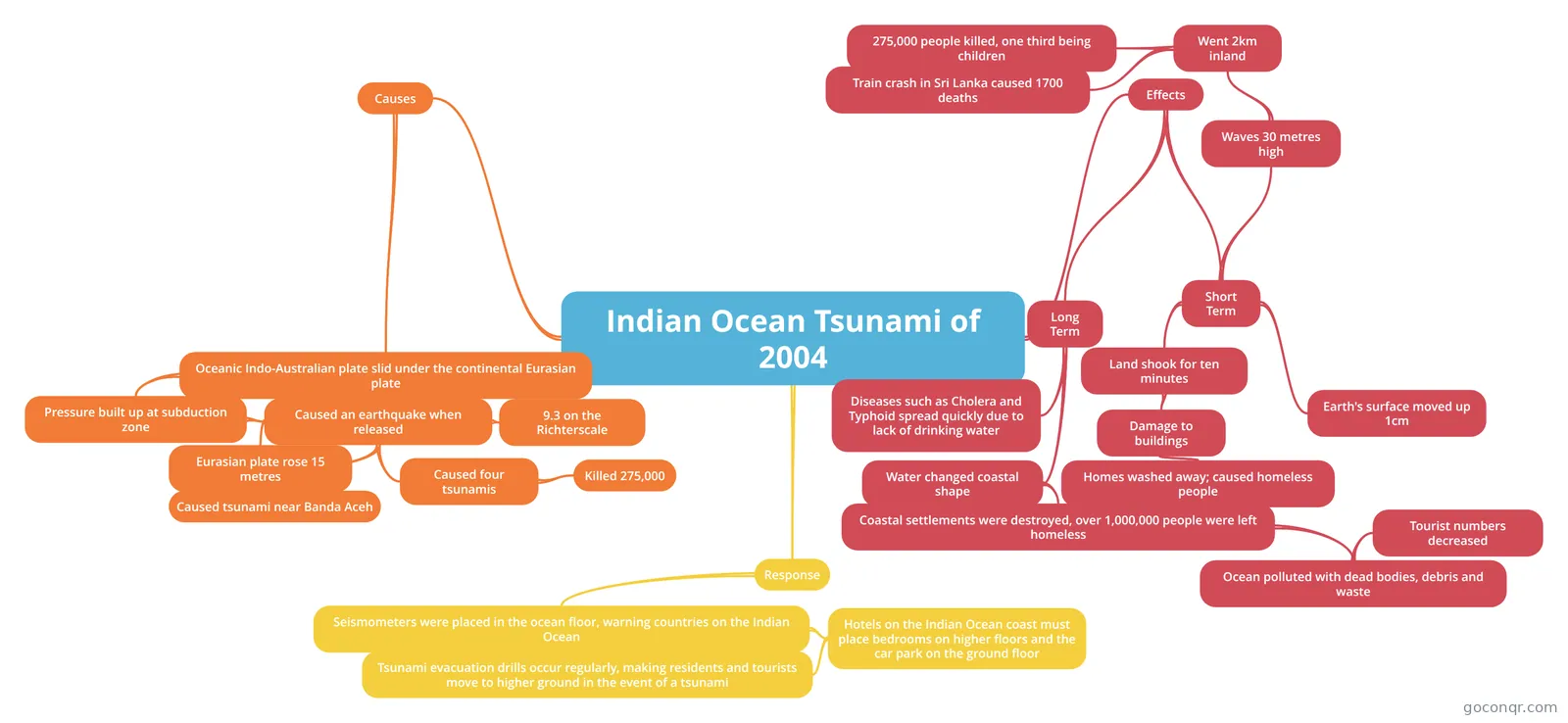 Mind map Indian Ocean Tsunami of 2004 A mind map discussing the causes, effects and response to the 2004 Indian Ocean tsunami.
-
Mind map Hurricane Katrina
-
5 cardsTectonics- EQ1, Key idea 1 Destructive plate boundaries
-
Mind map tsunami's factsheet for tsunamis mind map for school.
-
11 cardsNatural Disasters Quimestral Exam
-
Mind map TORNADO tarea inglés
Quizzes
See all 32 quizzes-
131 questionsGOPH Pre-MT1 and Post-MT2
-
200 questionsFinal In Canada, like in most industrialized nations, flood coverage is included in a typical homeowner insurance...
-
146 questionsGOPH 375 Though the US state of California controls less than 10 % of its land area, the US federal government blame...
-
27 questionsGEOL Make-Up Exam Air quality in Britain was not good last week and a natural event occurred which triggered a smog alert and...
-
44 questionsnatural disasters test 2 Subsidence due to the dissolving of bedrock is known as (blank):
-
46 questionsnatural disaster test final One of the fundamental principles in the study of natural disasters is that a(n) (blank) in population will...
-
5 questionsTropical Cyclone Signals
-
35 questions9/10
Mind maps
See all 385 mind mapsFlashcards
See all 96 flashcards-
5 cardsTectonics- EQ1, Key idea 1 Destructive plate boundaries
-
11 cardsNatural Disasters Quimestral Exam
-
16 cardsTsunamis What is a tsunami?
-
35 cardsHazards: Key Concepts What is a natural hazard?
-
13 cardsA2 Geography Hazards Key Terms
-
178 cards1011 Part 2 What are the main parts of earthquakes?
-
96 cardsNatural Disasters Exam 1 Which of the following is the definition of a scientific theory? a) The gathering of data through observati...
-
69 cardsTectonics Define Seismic hazards
Flowcharts
Notes
See all 14 notes-
Tectonic hazards Distribution of earthquakes and volcanoes Why is there a pattern in Earthquakes? Earthquakes are a sudden and violent shaking of the ground They are most commonly caused by sudden movement of rocks in the earths ...
-
Floods Contents Defination of floods Types of floods Causes of floods Cities that are prone to floods and why Factors which increase risk of flooding Impacts of floods Mitigation measures used to prepare for floods Definatio...
-
The Challenges of Natural Hazards - Case Studies Haiti Earthquake 2010 (LIC) Causes On a conservative plate margin involving the Caribbean and North American Plates. The magnitude 7.0 earthquake was only 15 miles from the capital...
-
What are floods? Types of floods floods -- overflows of large amounts of water onto land that is normally dry Coastal floodswhere?areas along the coast (especially low-lying coastal land - river mouths)how?caused by: tropical storms t...
-
Natural Disasters - Bush Fires Research Notes Questions: What condtion made the black saturday spread? - In February 2009, Southeastern Australia was hit by an unexpected heat wave causing dry fields and a fire. On Saturday, February 7t...
-
Untitled
-
Untitled Indonesian tsunami 26 December 2004 indio-Australian plate and Eurasian plate magnitude 9 on shore reached 15 meters quarter of a million deaths Thirteen countries Indonesia, Thailand, maldives Thailand- mangroves &nb...
-
hass hazards A natural hazard is a naturally occurring physical disaster. Caused by either a rapid or slow onset events which can be geophysicall or climatological. There are 2 types of natural hazards ...
Slides
Topics in Natural Hazards and Disasters
More Geology and earth sciences topics
About Natural Hazards and Disasters
GoConqr OriginalWhat the resources cover
Most of this page is mind maps, and many are case studies. The Indian Ocean Tsunami of 2004 map sets out causes, effects, long-term and short-term impacts and the response, starting with the Indo-Australian plate sliding under the Eurasian plate. The Tohoku Earthquake and Tsunami: Japan, 2011 map looks at why Japan is so exposed to earthquakes. The Hurricane Katrina map lists primary effects such as flooding in New Orleans and loss of electricity.
Other maps cover Mt. Pinatubo, Haiti earthquake, Soufriere Hills, Monserrat and MEDC Landslide: Aberfan, 1966. Shorter topic maps explain TORNADO and LANDSLIDES.
Where to start
- Open the Natural Disasters mind map for the big picture: tectonic and climatic hazards, and what causes earthquakes.
- Move to the flashcard deck Hazards: Key Concepts to learn the terms.
- Work through the plate boundary cards in the Tectonics- EQ1, Key idea 1 deck.
- Read the slide set how a tsunami is occurs, then choose a case study map.
Using quizzes and maps together
Read a map first, then close it and try a quiz such as Responding to Tectonic Hazards or Japan Earthquake and Tsunami Quiz. Note the questions you miss and go back to the matching map. The Tropical Cyclone Signals and Avalanche quiz pages help with hazards beyond plate movement.
Flashcard decks such as Mount etna case study and Haiti Earthquake are handy for recalling facts about places. Teachers can use the maps and slide sets as ready-made starting points for lessons.
Where this unit sits
This unit belongs to the strand Hazards, Resources and Environment in Geology and earth sciences. Its resources were made by GoConqr users, so styles and depth vary. Compare a couple of maps on the same event and keep the details that suit your course.
When you're ready, pick one case study and turn it into a set of flashcards of your own.
Frequently asked questions
Where should I start on this page?
Start with the Natural Disasters mind map, which sets out tectonic and climatic hazards, including earthquakes, volcanoes, hurricanes and droughts. Then try the Hazards: Key Concepts flashcards to learn the terms, and pick a case study map such as Hurricane Katrina or Tohoku Earthquake and Tsunami: Japan, 2011.
What do the mind maps cover?
They cover both general topics and named events. You will find maps on tornadoes, landslides, tsunamis, earthquakes and volcanoes, plus case studies including the Indian Ocean Tsunami of 2004, Haiti earthquake, Mt. Pinatubo and the Aberfan landslide of 1966. Many split causes, effects and responses.
Are the resources free to use?
Yes. Every resource listed here is free to open, study and take, with no account needed. They were made by GoConqr users, not by GoConqr itself. A free account also saves your quiz scores and lets you make your own quizzes, mind maps, flashcards and notes.
Which exams do these resources suit?
Most resources are aimed at school students, and the listed ones mention GCSE Geography and A-level Geography. Some decks are labelled for specific courses, such as Geography Paper 1 AQA and Volcanoes GCSE flashcards. Check each resource against your own course before relying on it.
How many quizzes are there?
There are more than 20 quizzes alongside over 80 flashcard decks and over 350 mind maps. Quiz topics include tectonic hazards, tropical cyclone signals, avalanches and the Japan earthquake and tsunami, so you can test yourself after reading a map.
What if I can't find the case study I need?
Try the related maps and decks first. For example, the Philippines, California and New Zealand each have maps, and there are decks on Mount etna and Lake Nyos, Cameroon 1986. If your case study still isn't here, you can build your own notes or mind map.