
Volcanoes and Volcanism
574 resources created by 473 users
This Volcanoes and Volcanism page on GoConqr gathers community-made mind maps, quizzes, flashcards, slide sets and notes, from how a volcano forms and the main types to case studies such as Eyjafjallajökull, Mount St. Helens and Montserrat. It's built for school students revising a topic, and for teachers after ready-made material. There are over 500 resources here, including more than 40 quizzes, over 350 mind maps and more than 100 flashcard decks, with GCSE Geography mentioned. Pick a case study, try a quiz to find your gaps, then make your own.
Top Volcanoes and Volcanism resources
-
4 questions11SCI Volcano Internal Mostly for personal use.
-
28 cardsVolcanoes What is the world's most active volcano?
-
Mind map Volcanoes A Mind-Map on Volcanoes!
-
Mind map MEDC Volcano Case Study: Eyjafjallajökull, Iceland
-
Mind map Volcanoes Mind map to support the study of junior cycle volcanoes
-
Mind map Tsunami: Krakatoa, Indonesia
-
7 questionsVolcano Quiz What is the top left of this diagram called?
-
Mind map Composite Volcanoes
Quizzes
See all 54 quizzes-
4 questions11SCI Volcano Internal Mostly for personal use.
-
7 questionsVolcano Quiz What is the top left of this diagram called?
-
16 questionsVolcanoes: Volcanic Landforms Vocab
-
18 questionsCh 7 Section 7.1 Volcanoes and Plate Tectonics Quiz 10/28/14 Lava released during volcanic activity builds up earth's surface.
-
17 questionsofficial vocab quiz effefefefefef
-
15 questionsVolcano A shield volcano is an alternating volcano. Ex. explosive or quiet
-
9 questionsIGNEOUS ROCKS What are the two types of magma?
-
16 questionsVolcanoes Volcanic activity occurs at...
Mind maps
See all 361 mind maps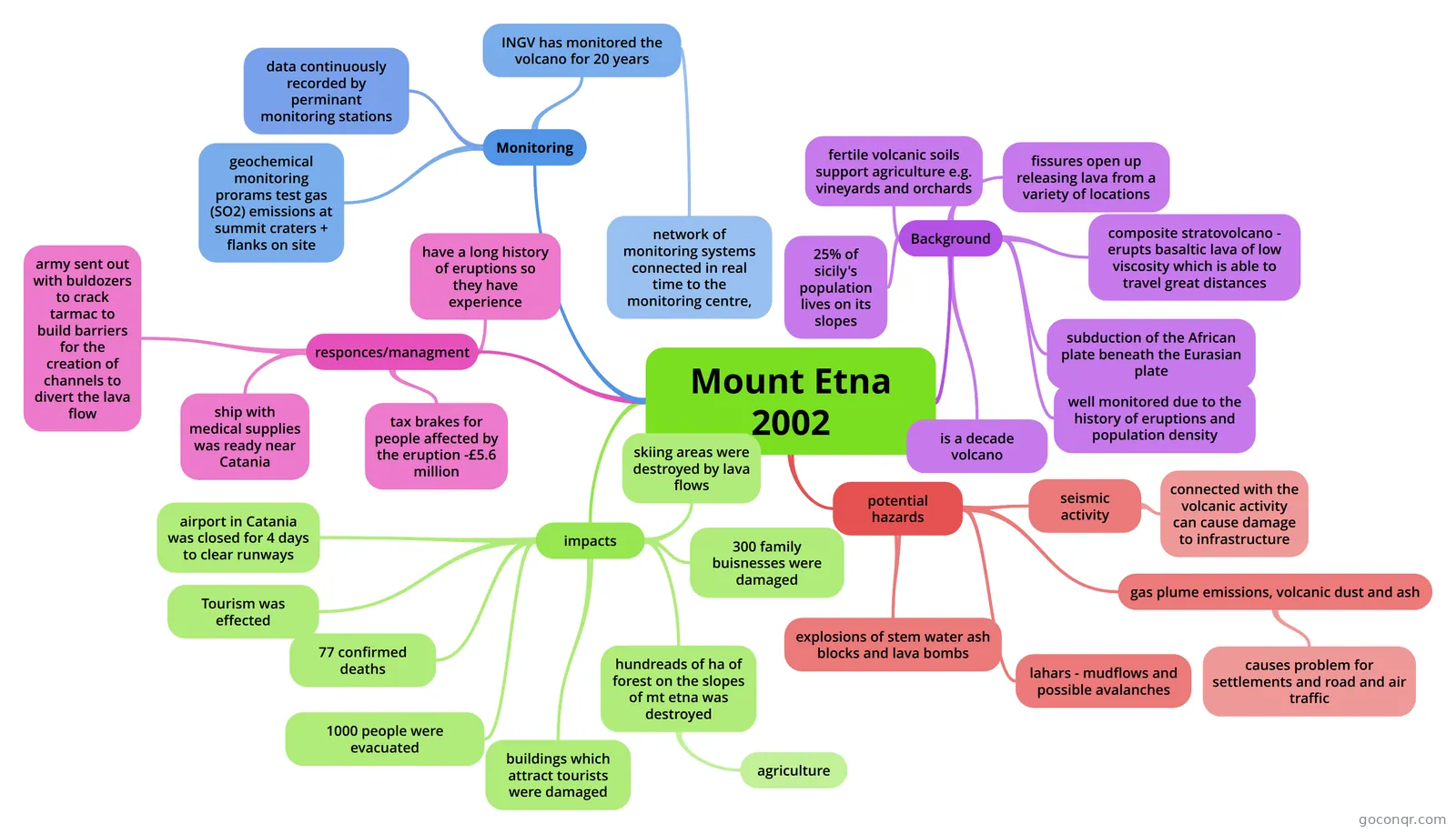
Flashcards
See all 118 flashcards-
28 cardsVolcanoes What is the world's most active volcano?
-
114 cardsEarth Systems Lecture Test #3 Where do earthquakes occur
-
34 cardsVolcanoes What are volcanoes built up by?
-
17 cardsVolcanoes + Volcanic eruptions - GCSE Facts about volcanoes
-
6 cardsDifferences in volcanic management and monitoring Differences in Nyiragongo and Etna Management - Monitoring
-
32 cardsVolcanoes Quiz Flashcards for Volcanoes Quiz
-
21 cardsCase Study: Volcanic Eruption - Soufrière Hills Volcano, Montserrat What volcano erupted?
-
18 cardsVolcanoes and Tectonics What is Magma?
Notes
See all 32 notes-
Mount St. Helens Mount St. Helens 18/05/1980 Info: Located in the Cascade mountains, Washington State, North-western USA Before the eruption there was 2months of increased seismic activity Causes: Plate boundary: It's a composite volc...
-
Where to find the pyroclasts Distribution by grain sizeCoarse bombs and blocks are dropped close to the vent and therefore found in a circular pattern around the vent. The finer pyroclastic material will be carried furhter away from the volcano a...
-
Hot Spots and Mantle Plumes Magma From the DeepThe 'Big Island' of Hawaii is built of five - three of them active - shield volcanoes. Mauna Loa is the highest (4100m) and Kilauea is the most acitve volcano on Earth, producing daily eruptions of ...
-
Products of Volcanoes Volcanic gasesAll atmospheric gases, except photosynthetic oxygen, were released by volcanic eruption. These gases are dissolved in the magma while it is under pressre at depth, then as the pressure decreases near the...
-
Predicting and Preparing for Volcanic Eruptions Predicting and Preparing for Volcanic Eruptions Predicting - Increasing amount of tiny earthquakes.- Escaping gases - the higher the amount of sulphur, the close the volcano is to erupting.- Changes in the shape of th...
-
Volcanoes Composite has steep sides, errupts irregulary and has layers of ash and lava Shield has gentle slopes, errupts frequently and is only made of lava Cinder cones form when lava flows from a vent, or hole, in the Earth's...
Slides
More Geology and earth sciences topics
About Volcanoes and Volcanism
GoConqr OriginalWhat this unit covers
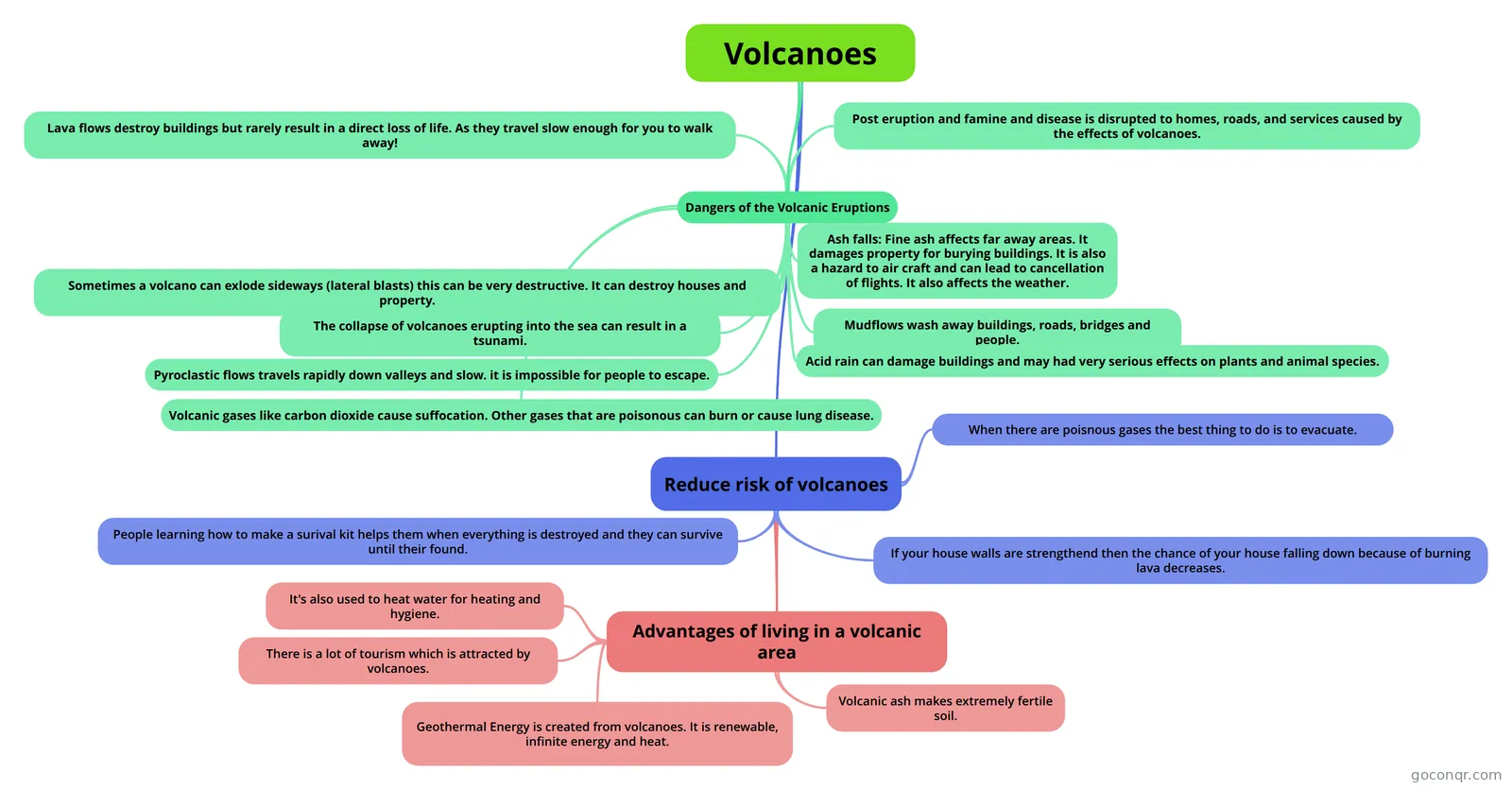
The page brings together material on volcanoes and volcanism, and most of it is mind maps. The first mind map, Volcanoes, walks through the formation of a volcano: magma reaches the surface through a narrow vent in the crust, then erupts with lava, ash and more. Another covers where volcanoes form, activity levels and how they change the Earth's surface. A third lists key words such as magma, lava, vent, crater and ash.
Types and features
For shapes and types, look at the mind map Composite Volcanoes. It notes steep slopes, violent eruptions and alternating layers of lava and ash, with examples such as Mount St. Helens, Mount Fuji and Mount Cotopaxi. There are also maps on active and extinct volcanoes, products of volcanoes, and intrusive and extrusive activity. Notes on hot spots and mantle plumes add the wider picture.
Case studies
Many listed resources are case studies, which suits GCSE Geography revision. Choose from:
- Eyjafjallajökull in Iceland, as a mind map, a slide set and flashcards
- Krakatoa, with its tsunami and pyroclastic flow
- Mount St. Helens, Mount Pinatubo and Mount Rainier
- Montserrat, in several flashcard decks and a mind map on the response to the 1997 eruption
- Nevado del Ruiz, as a quiz
There are also notes comparing Mount Etna and Mount Nyiragongo.
How to work through it
- Start with the mind map Volcanoes to get the basic vocabulary.
- Move to the maps on types of volcanoes.
- Read one case study in full, then compare it with another.
- Take the Volcano Quiz, which asks you to label a diagram, then try the case study quizzes.
- Use flashcards to fix key terms and facts.
Use maps to see how ideas connect and quizzes to check what stuck. Go back to the map for any question you miss.
Where it sits
This unit belongs to the strand Plate Tectonics and Internal Processes in Geology and earth sciences. When you are ready, pick a case study and try its quiz, or make your own map from what you have read.
Frequently asked questions
Which resource should I open first?
Start with the mind map called Volcanoes, which explains how a volcano forms, from magma rising through a vent to a violent eruption of lava and ash. Then open the Types of Volcanoes map. Together they give you the vocabulary you need before moving on to case studies and quizzes.
Are there case studies for GCSE Geography?
Yes. Listed resources mention GCSE Geography, and the page includes case studies on Eyjafjallajökull, Mount St. Helens, Montserrat, Mount Pinatubo, Krakatoa and Nevado del Ruiz. Some are mind maps, some flashcards, and some quizzes, so you can read first and test yourself afterwards.
What do the mind maps cover?
There are over 350 of them. They cover how volcanoes form, types such as composite volcanoes, key words, products of eruptions, hot spots, and the dangers and advantages of living near a volcano. Several also summarise case studies such as Krakatoa and Eyjafjallajökull.
Are the resources free to use?
Yes. Every resource listed here is free to open, study and take, with no account needed. They were made by GoConqr users, not by GoConqr itself. A free account also saves your quiz scores and lets you make your own quizzes, mind maps, flashcards and notes.
Who is this page for?
It suits school students revising volcanoes, from basic structure to eruption case studies, and teachers who want ready-made material for lessons or homework. Most of the resources are at secondary level, so they fit exam-style revision well.
What if I can't find a volcano I need?
Try the case study quizzes and flashcards first, since several volcanoes appear in more than one format. If your topic is still missing, you can build your own mind map, flashcards or notes on it and use the existing resources as a guide.