
Microorganisms: Bacteria, Viruses, Protists and Fungi
183 resources created by 161 users
This Microorganisms: Bacteria, Viruses, Protists and Fungi page on GoConqr gathers community-made mind maps, flashcards, quizzes and notes, from Kingdom Monera and culturing microorganisms to algae, protozoa and fungi. It's built for school students revising a topic, university students and professional candidates filling gaps, and teachers after ready-made material. There are over 1,600 resources here, including more than 130 quizzes and over 1,000 mind maps, with exam-style material for GCSE, A-level and AP Biology. Pick a mind map, then test yourself.
Top Microorganisms: Bacteria, Viruses, Protists and Fungi resources
-
145 questionsForest Pathology Midterm Questions Tree diseases, causal agents, and their anatomy
-
52 questionsBio test #2 actual The predatory bacterium Bdellovibrio bacteriophorus drills into a prey bacterium and, once inside, digests ...
-
78 cardsProtozoa BIO2135
-
72 questionsChapter 7 Viruses, Bacteria, Protists, and Fungi Viruses are cells
-
45 cardsBiology 108 - Lab 3 What is Endosymbiosis?
-
65 cardsBIO 1220L Practical 2 Review What are the main characteristics of fungi?
-
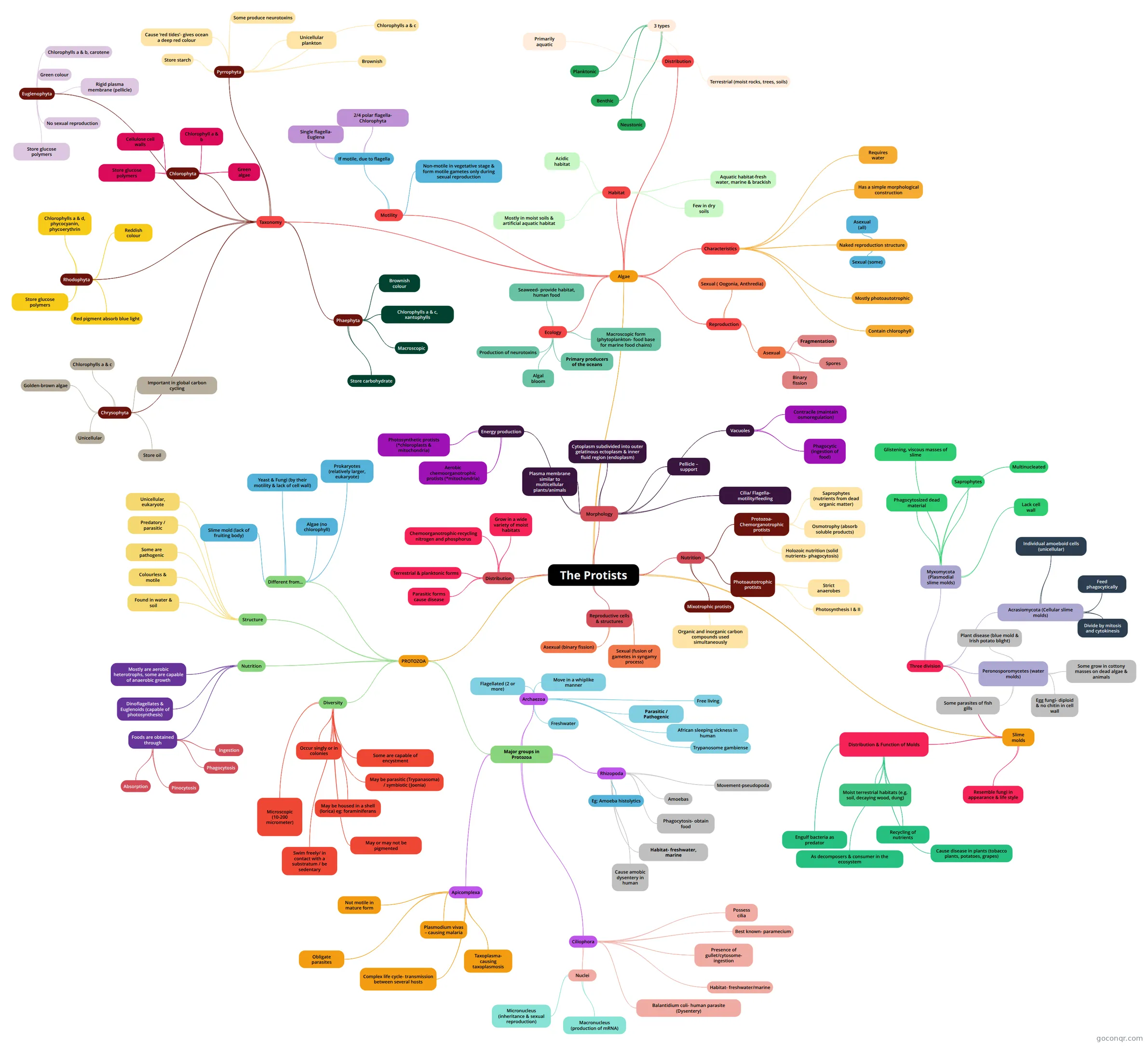 Mind map The Protists microbiology- the protists
-
52 cardsBiology 108 Lab - Lab 4 what two photosynthetic groups do we examine in this lab?
Quizzes
See all 38 quizzes-
145 questionsForest Pathology Midterm Questions Tree diseases, causal agents, and their anatomy
-
52 questionsBio test #2 actual The predatory bacterium Bdellovibrio bacteriophorus drills into a prey bacterium and, once inside, digests ...
-
72 questionsChapter 7 Viruses, Bacteria, Protists, and Fungi Viruses are cells
-
14 questionsModule 4: Kingdom Fungi Vocabulary Quiz Use your flashcards to study for the quiz
-
11 questionsQuiz 2 Label this structure of chlamydomonas.
-
5 questionsWood Decay Fungi 1. Which of the following is the type of fungi decaying wood:
-
102 questionsB6 Quiz What does the strand of DNA in a bacterial cell's cytoplasm do?
-
50 questionsTest 2 Biology Quiz on Test 2, created by Sean Corcoran on 03/04/2017.
Mind maps
See all 70 mind maps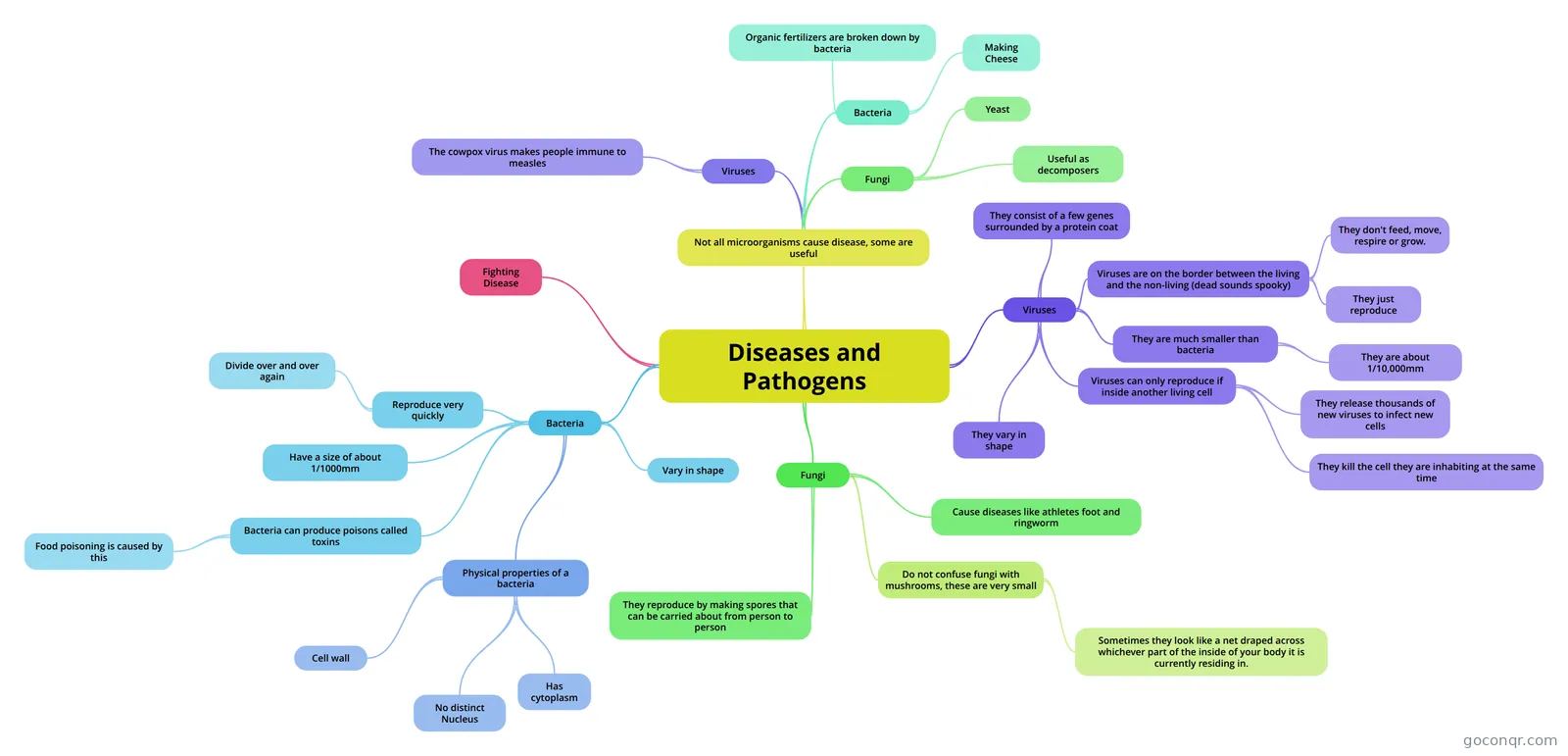
Flashcards
See all 62 flashcards-
78 cardsProtozoa BIO2135
-
45 cardsBiology 108 - Lab 3 What is Endosymbiosis?
-
65 cardsBIO 1220L Practical 2 Review What are the main characteristics of fungi?
-
52 cardsBiology 108 Lab - Lab 4 what two photosynthetic groups do we examine in this lab?
-
49 cardsCyanobacteria and Green Algae learn some algae pals
-
21 cardsMicrobiology and Biotechnology Microbiology and Biotechnology
-
8 cardsDoctors and diseases What does a white blood cell do?
-
68 cardsViruses, Bacteria & Archaea
Flowcharts
Notes
See all 10 notes-
Protista (Amoeba) Amoeba belong to the kingdom Protista. It is a microscopic unicellular organism that lives at the bottom of freshwater ponds and streams. Nutrition: Heterotrophic - gets food from external sources. Omnivorous - eats o...
-
Fungi
-
Algae What is algae? -simple plant -have chlorophyll for photosynthesis Plant VS Algae -algae lack of vascular conducting system -algae have a simple reproductive system compared to ordinary plant Characteristic of algae -p...
-
Bio yr8 1st exam 2013 notes Simple, single celled. No true nucleus, just coils of DNA. Cell wall (not made of cellulose) and cell membrane. Small, approx 1/1,000mm (=1μm) Multiply quickly and release poison (toxins) which attack cells. These tox...
-
Effect of garlic and mint on bacterial growth Independent: Presence garlic/mint Dependent: Zone inhibition around disc Control: Conc. plant material Lawn bacteria on petri dish Contamination petri dish by other microbes Same vol. plant material on each ...
-
Protist Kingdom “Kingdom Protista" is a mix kingdom; it contains organisms which are more closely related to members of other kingdoms than they are to other protists. Many studies used the word "protist" as a convenient term ...
-
Archaea Archaea 3 groups of Archaea:1. Thermoacidophiles (acidothermophiles): -anerobic -can survive in high temperatures and high acid2. Halophiles -aerobic -live in areas with high salt 3. Methanogens -anerobic -use carbon ...
-
Bacteria Bacteria ClassificationShape: Round (cocci)Rod (bascilli)Spiral (spirilli)Diplo (pairs)Staphylo (clusters)Strepto (chains)Reproduction:Asexual- Binary fission"Sexual"- ConjugationSpores- Grow endospores and hibernate ...
Slides
More Biology and natural sciences topics
About Microorganisms: Bacteria, Viruses, Protists and Fungi
GoConqr OriginalWhat this unit covers
The resources here follow the main groups of microorganisms. Bacteria are covered in the Kingdom Monera mind map, which starts from the idea that all members of Monera are prokaryotes with no membrane-bound organelles, then moves on to bacterial structure. Protists and algae have their own maps, including PROTOZOA, Classification of Algae and The Protists. Fungi appear in several mind maps, flashcard decks and quizzes. Viruses are covered too, in quizzes such as Viruses and Baltimore Virus Classification flowcharts.
Where to start
Begin with a broad mind map, then narrow down.
- Open Kingdom Monera for bacterial structure.
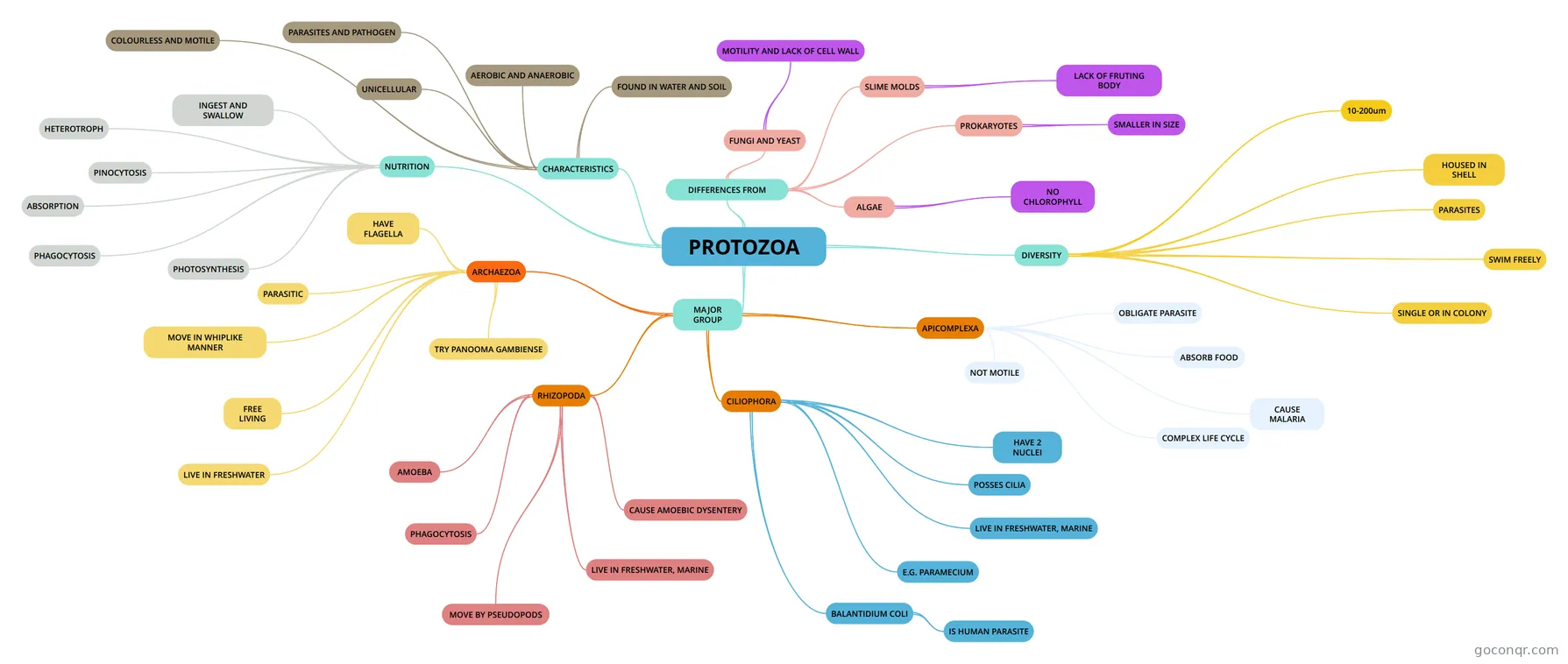
- Move to The Protists and the PROTOZOA maps, which sort protists by features such as motility, nuclei and habitat.
- Read the Fungi maps and the Kingdom Fungi (4 phyla) map.
- Finish with Diseases and Pathogens to see how the groups connect to health.
Applied topics
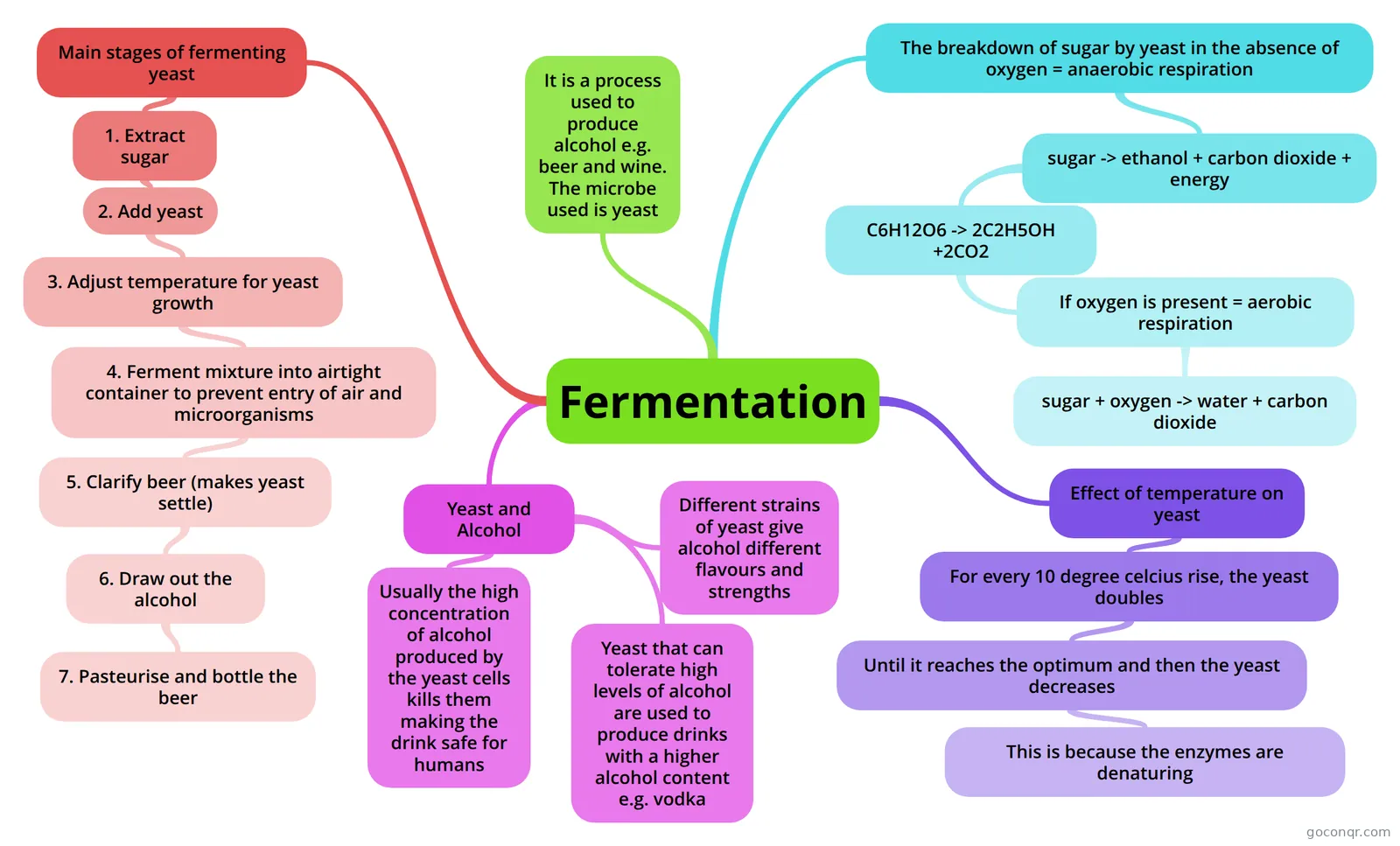
Some resources look at what microorganisms do. The Fermentation mind map walks through the main stages of fermenting yeast: extract sugar, add yeast, adjust temperature. Culturing Microorganisms explains how bacteria grow in a culture medium with carbohydrates, minerals, proteins and vitamins. You will also find Making Yoghurt, Waste water Treatment and a flowchart on investigating the action of antibiotics.
Using maps and quizzes together
Read a map first, then take a quiz on the same group. Chapter 7 Viruses, Bacteria, Protists, and Fungi is a good all-round check, while Wood Decay Fungi and Cyanobacterial Blooms are narrower. Note the questions you miss, return to the map, and then try flashcard decks such as Main groups of fungi or Viruses, Bacteria & Archaea to fix the terms. Most of the material suits secondary students, and about a quarter is aimed at university level, including notes such as MCAT Biology Review: Fungi.
Where it sits
This unit belongs to the Diversity of Life strand in Biology and natural sciences. Choose one group of organisms, work through it, and then build your own maps and flashcards to fill any gaps.
Frequently asked questions
Which resource should I open first?
Start with the Kingdom Monera mind map if you want bacteria, or The Protists if you prefer protists. Both give a quick overview of structure and classification. Once you have read one, try the Chapter 7 Viruses, Bacteria, Protists, and Fungi quiz to see what has stuck.
What do the mind maps cover?
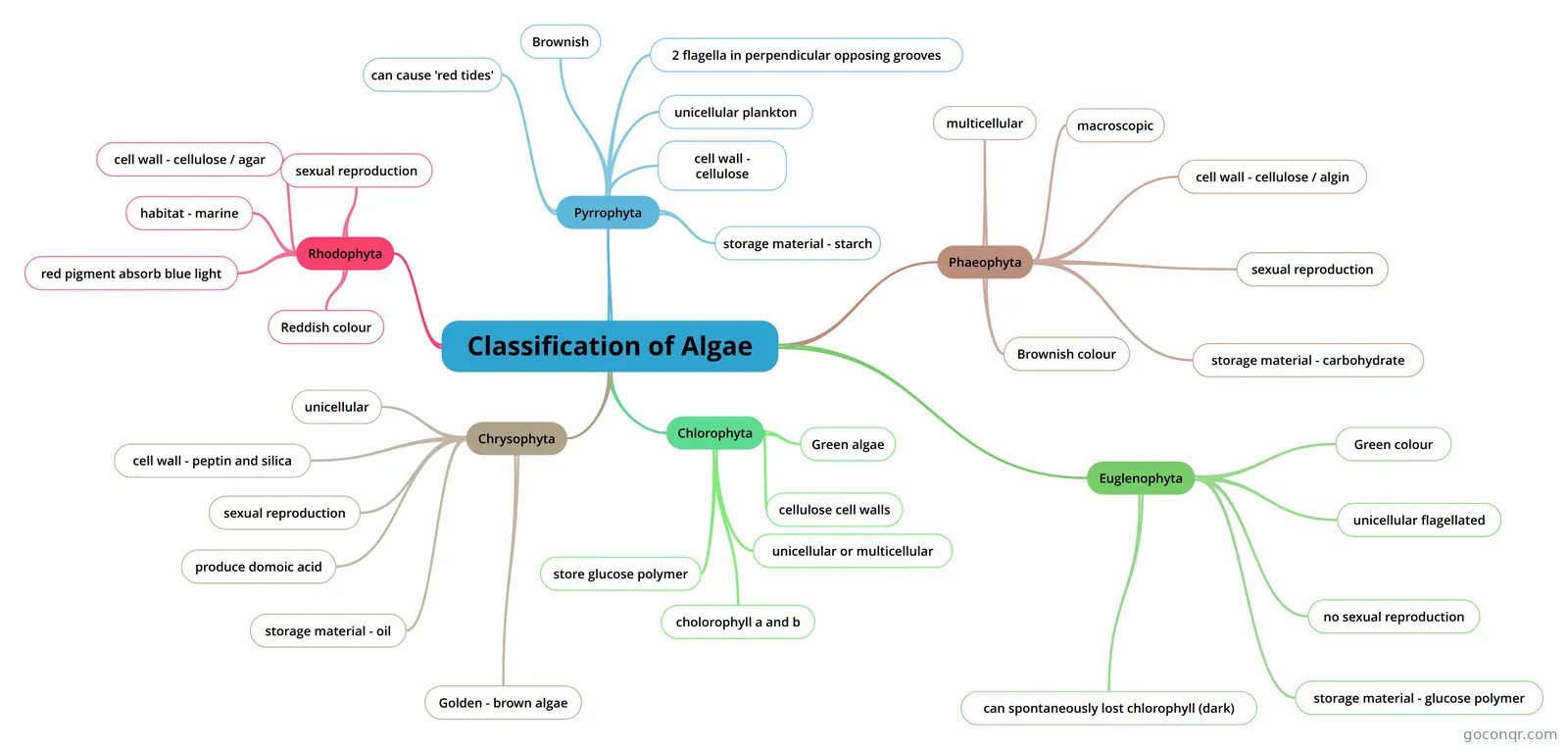
They cover bacteria, protozoa, algae and fungi, plus applied topics. Examples include Classification of Algae, which lists groups such as Chlorophyta and Rhodophyta, Fermentation with its yeast stages, and Culturing Microorganisms, which explains culture media for growing bacteria in the lab.
Are the resources free to use?
Yes. Every resource on this page is free to open, study and take, with no account needed. They were made by GoConqr users, not by GoConqr itself. A free account also saves your quiz scores and lets you make your own quizzes, mind maps, flashcards and notes.
Which levels and exams do these suit?
Most resources are at secondary level, with about a quarter at university level. Listed resources mention GCSE Biology, A-level Biology, Leaving Certificate Biology, AP Biology and MCAT, so school students, university students and professional candidates can all find something relevant.
Is there anything on viruses?
Yes. Look for the quizzes Viruses, Prions, Viruses and L5 Structure and Function of viruses, plus the Baltimore Virus Classification flowchart and the bio ch 19 viruses flashcards. They sit alongside the bacteria, protist and fungi material on this page.
What if I can't find the topic I need?
Try the broader resources, such as Microorganisms, Microbes or Microbiology, which cover several groups at once. If your topic is still missing, you can build your own mind map, flashcards or quiz using the material here as a starting point.