
History and Varieties of English
80 resources created by 71 users
This History and Varieties of English page on GoConqr gathers community-made mind maps, flashcards, quizzes, notes and flowcharts, from Old English and Early Modern English to language change theorists, accents, dialects and global Englishes. It's built for school students revising a topic, university students and professional candidates filling gaps, and teachers after ready-made material. There are over 700 resources here, including more than 20 quizzes and over 500 mind maps, shared by over 500 contributors. Pick a topic, try a quiz to find your gaps, then build your own revision sets.
Top History and Varieties of English resources
-
122 cardsLanguage Variety Peter Trudgill, Norwich Study 1974
-
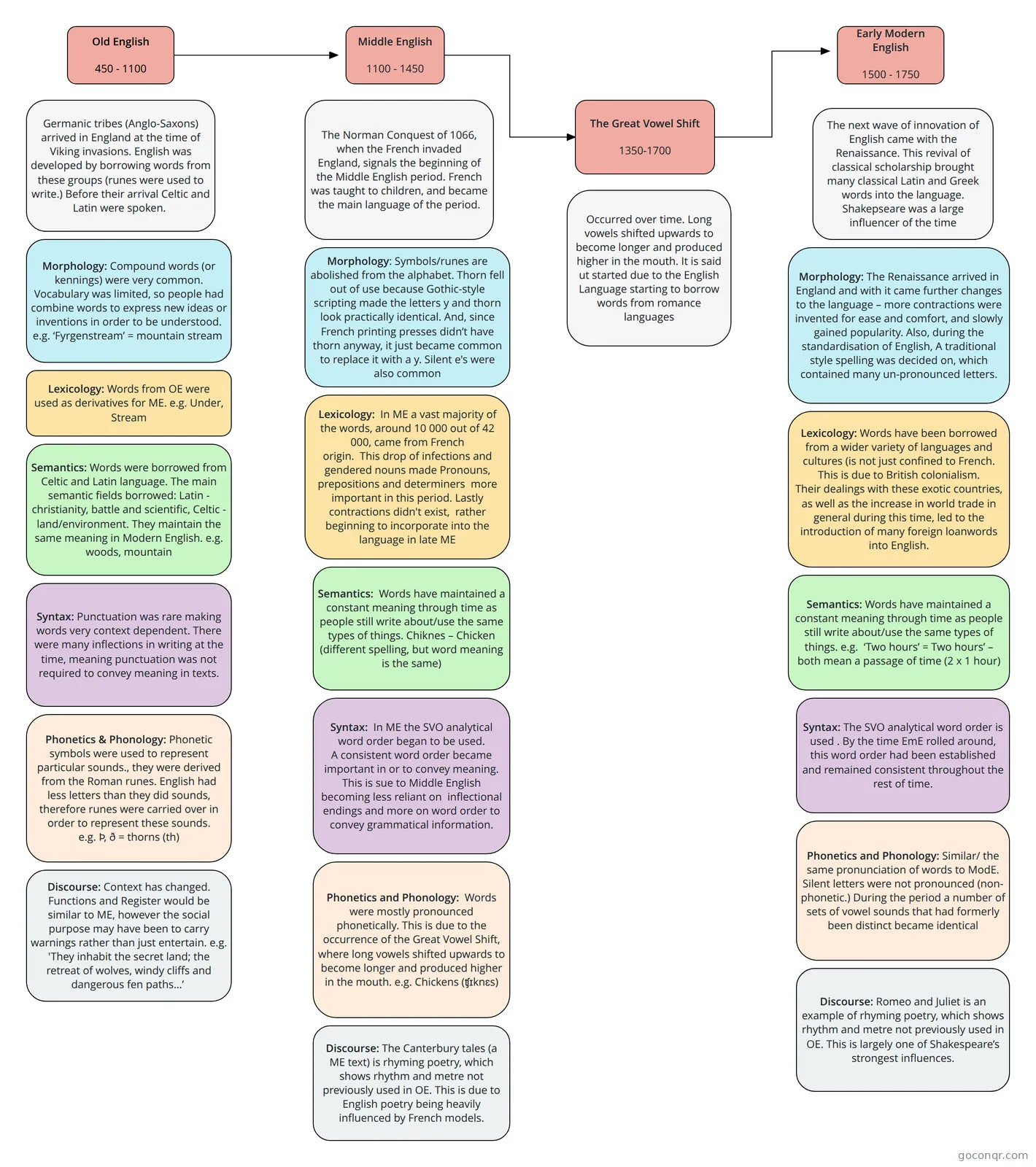 Flowchart English Language Timeline English throughout time, from Old English - Modern English.
-
Mind map THREE MOMENTS OF ENGLISH (OLD , MIDDLE AND MODERN) The selection of events is my own, and the dates are approximate in some cases, but it gives at least some ...
-
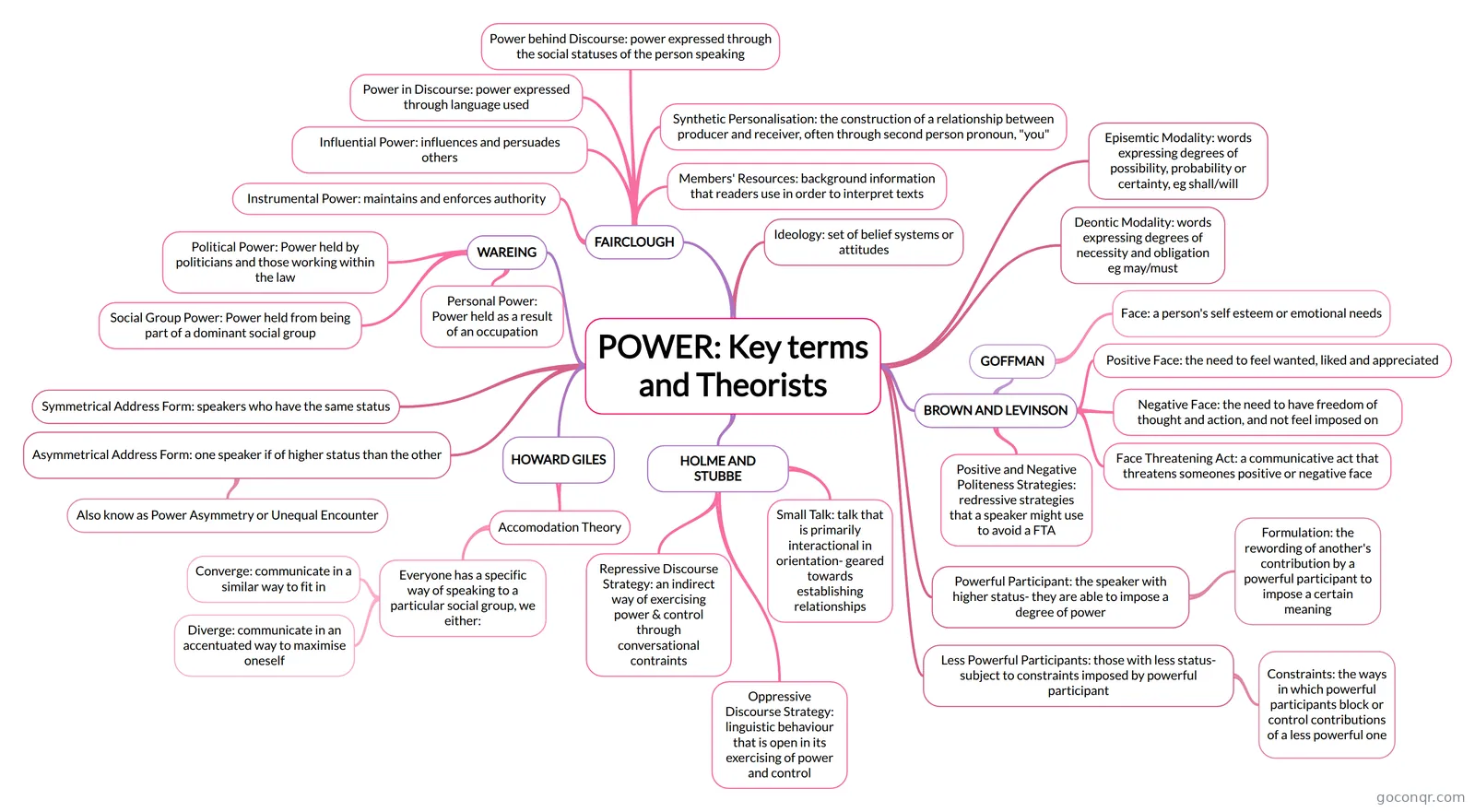 Mind map POWER: Key terms and Theorists
-
5 cardsStandardisation in the 18th century Summary of the People who began the standardisation of the English Language in the 1700s (AQA B Language Ch...
-
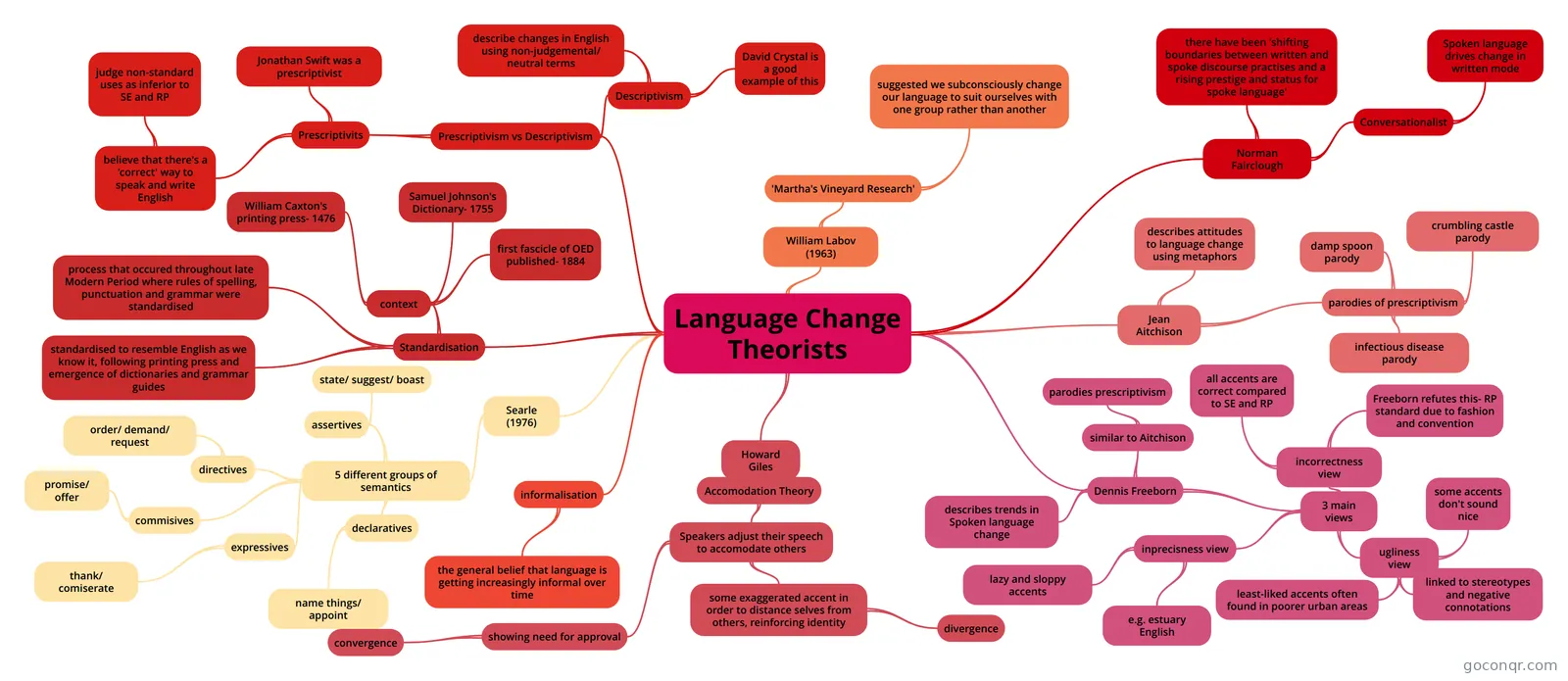 Mind map Language Change Theorists
-
Flowchart History of english Trabajo de Alejandro Burgos Fernández 305
-
Mind map English Language History Mental map.
Quizzes
-
3 questionsAmerican English vs. British English ---------------------------------------------------------------------------------------- Listen to the conv...
-
37 questionsLANGUAGE CHANGE CONCEPT QUIZ Quiz on LANGUAGE CHANGE CONCEPT QUIZ, created by Natasha Shah on 02/06/2018.
-
23 questionsLanguage change theorist The accommodation theory is all about upwards and downwards convergence in style to become more distant wit...
-
9 questionsLanguage change quiz What does standardisation mean?
-
7 questionsEnglish Language Change What is the word for 'loaning' words from another language? For example, 'barbecue' comes from Spanish.
-
22 questionsUNIT 10
-
3 questionsEvolution if language Geographical separation, as well as mixture and unification of people, are major factors in
-
2 questionsHistory of Language Quiz Who invaded England and brought the French language with him?
Mind maps
See all 40 mind maps-
THREE MOMENTS OF ENGLISH (OLD , MIDDLE AND MODERN) The selection of events is my own, and the dates are approximate in some cases, but it gives at least some ...
-
POWER: Key terms and Theorists
-
Language Change Theorists
-
English Language History Mental map.
-
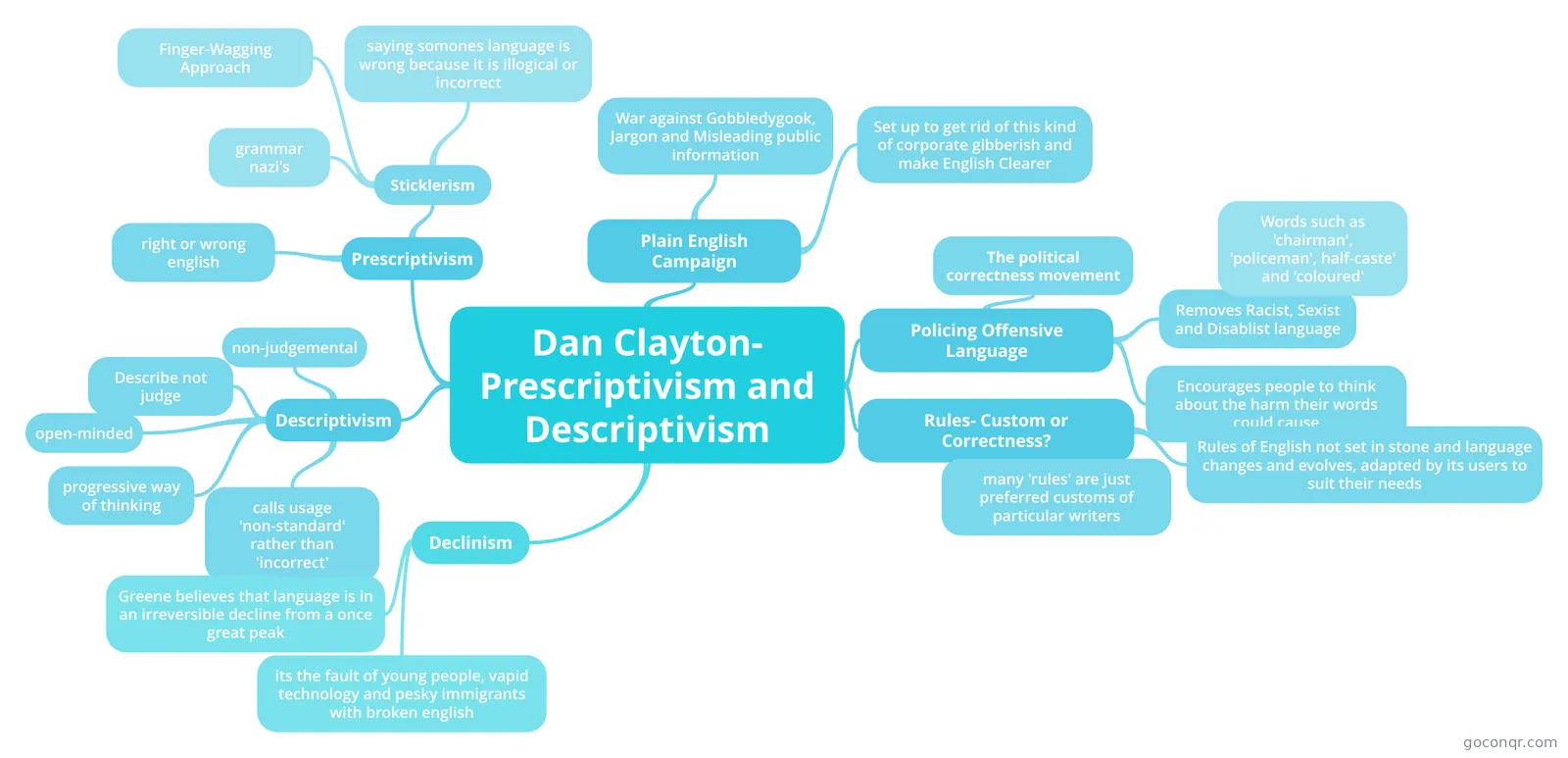 Dan Clayton- Prescriptivism and Descriptivism
-
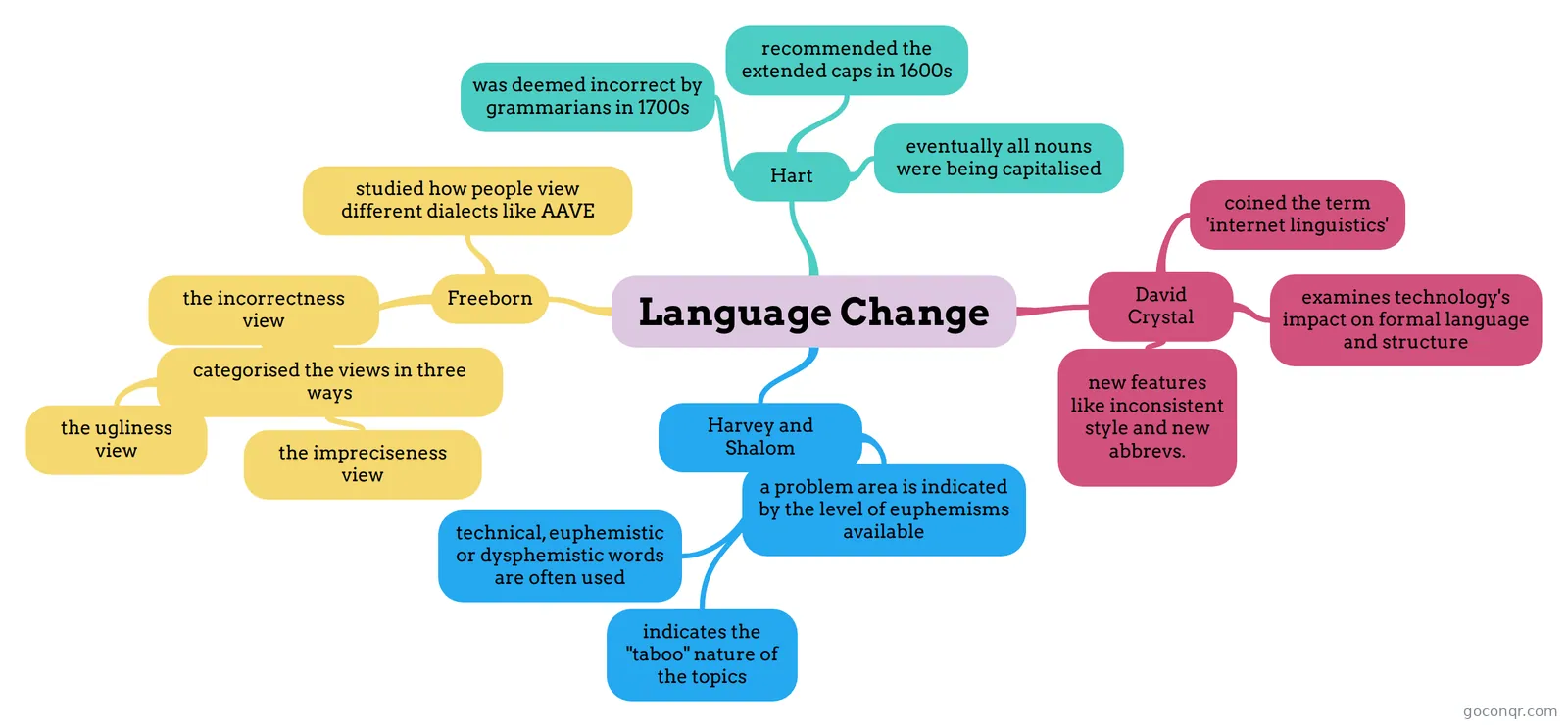 Language Change
-
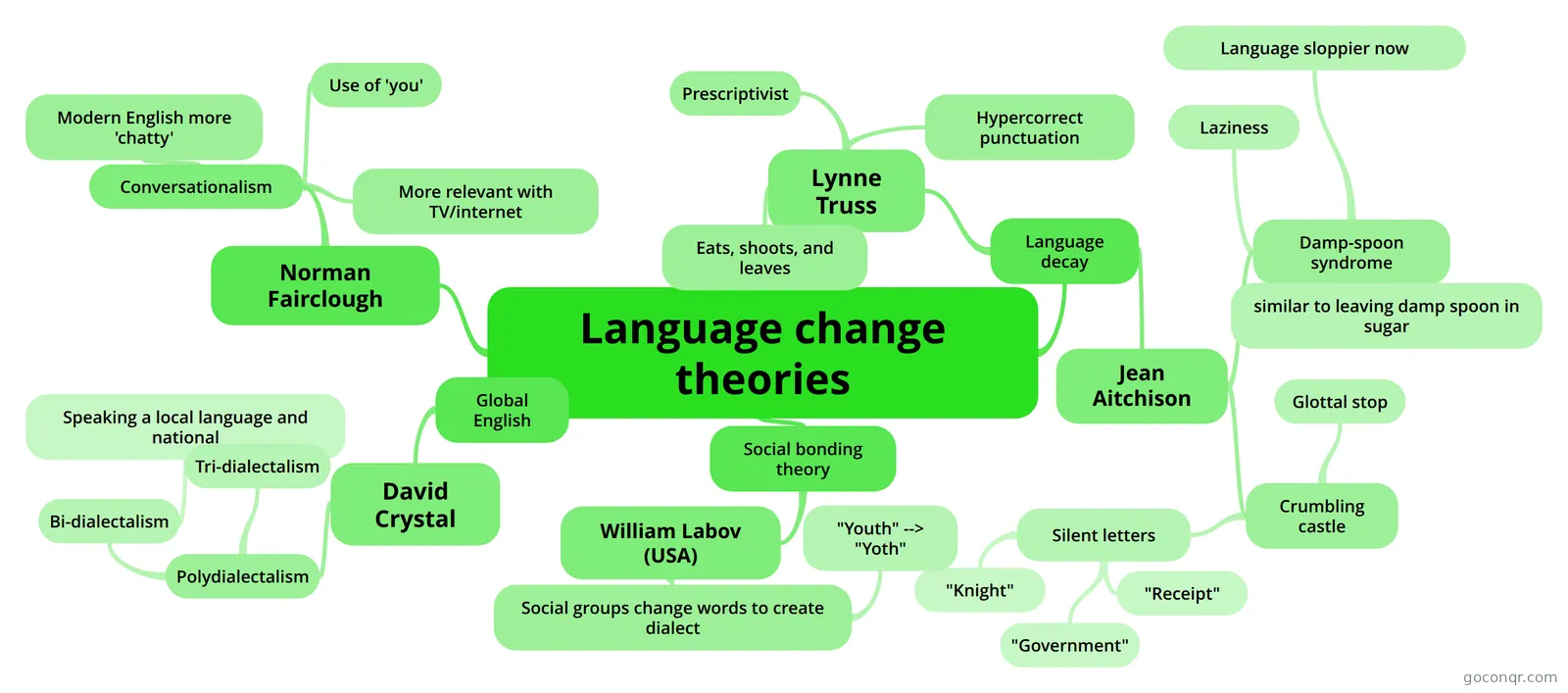 Language change theories
-
 OLD ENGLISH
Flashcards
See all 20 flashcards-
122 cardsLanguage Variety Peter Trudgill, Norwich Study 1974
-
5 cardsStandardisation in the 18th century Summary of the People who began the standardisation of the English Language in the 1700s (AQA B Language Ch...
-
12 cardsLanguage Change Genre change and the language of chat rooms
-
44 cardsLanguage Change Terms
-
9 cardsPaper 2- Language Variety What is Codification?
-
18 cardsEnglish around the World English around the World
-
15 cards2: History of English up to Old English Who spoke Indo-European, when and where did they live
-
28 cardsA2 english language language change theorists
Flowcharts
-
English Language Timeline English throughout time, from Old English - Modern English.
-
History of english Trabajo de Alejandro Burgos Fernández 305
-
Key English Texts Across Time A timeline of English texts throughout history that have contributed to or had influence on the English Lan...
-
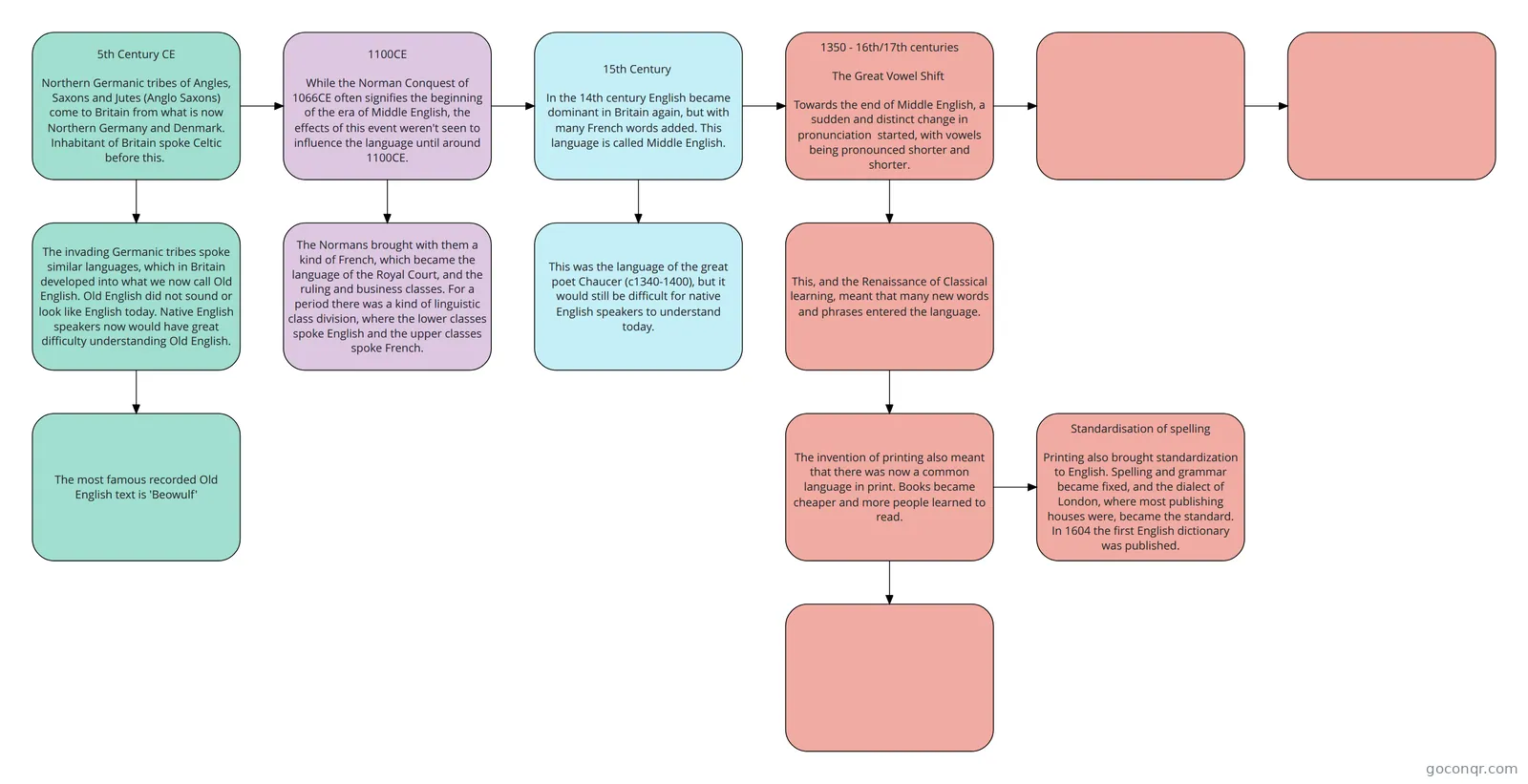 English Across Time A visual representation of the evolution of the English language (unfinished example)
-
Ranaissance Attitudes toword teaching English Ranaissance Attitudes toword teaching English
-
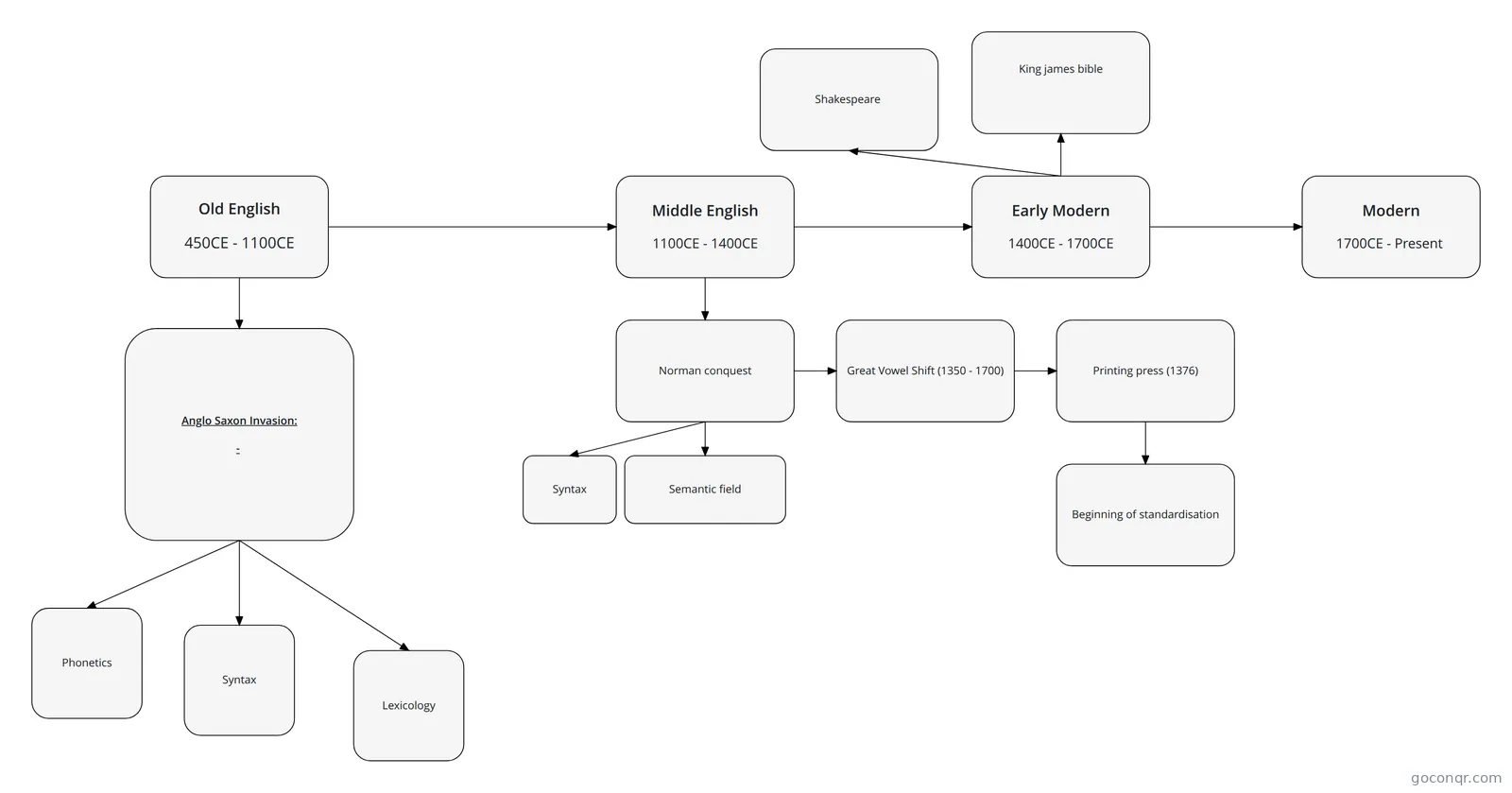 English timeline
Notes
-
English Language Activity Write Up #2 (completed) June 2012 English Language AQA Language Change Question: Texts F and G are both Inspection Reports written about Primary Schools. Text F is the full report written by a government Inspector in 1933. Text G is an extra...
-
ENGLISH Completely new words:COINAGE Words from other languages:BORROWINGAmericanisms, Prince (French), Lager (German), Alcohol(Arabic). Words formed from existing words: AFFIXINGThis involves adding prefixes or suffixes...
-
ENGLISH_1 Completely new words:COINAGE Words from other languages:BORROWINGAmericanisms, Prince (French), Lager (German), Alcohol(Arabic). Words formed from existing words: AFFIXINGThis involves adding prefixes or suffixes...
-
English Across Time Complete Table
Slides
More English language topics
About History and Varieties of English
GoConqr OriginalWhat this unit covers
The resources fall into two broad groups: how English has changed over time, and how it varies today. Much of the material is built around language change, with mind maps, flashcards and quizzes on theories, key terms and contextual factors.
Start with the timeline
Begin with the flowchart English Language Timeline, which moves from Old English, when Germanic tribes arrived in England, onwards. Then look at the mind map THREE MOMENTS OF ENGLISH (OLD, MIDDLE AND MODERN) and the Early Modern English (1476-1776) mind map. For dates to learn, the flashcard decks Important Dates for Language History and Language Change Timeline are useful.
Theories and attitudes
Once you have the periods in mind, move to ideas about why language changes. The Language change theories mind map covers language decay, Jean Aitchison and the damp-spoon syndrome. Language Change Theorists looks at Norman Fairclough and the idea that spoken language drives change in writing. The flashcards on Standardisation in the 18th century set prescriptivists and descriptivists side by side, including Dr Samuel Johnson and his dictionary. Related maps look at power and at political correctness as a kind of liberal prescriptivism.
Varieties of English
For variation, try the Language Variety flashcards, which include Peter Trudgill's Norwich study and migrants in Milton Keynes. The page also has maps and slides on regional and world Englishes, such as Hiberno-English, Sri Lankan English and Scottish English.
Using quizzes and maps together
- Read a mind map to get the overview.
- Take a quiz, such as American English vs. British English or Language change theorist, to see what stuck.
- Return to the flashcards for anything you missed.
Some resources mention A-level English Language and WJEC English Language LG4, so check them against your own course. This unit sits in the Linguistics, Culture and Language Teaching strand of English language. Choose one map today and see how far it takes you.
Frequently asked questions
Which resource should I open first?
Start with the English Language Timeline flowchart for a quick run through the periods of English. After that, the Language Change mind map gives an overview of change and theorists, and you can then test yourself with one of the language change quizzes.
What do the mind maps cover?
The mind maps cover the periods of English, language change theories, theorists such as Norman Fairclough, prescriptivism and descriptivism, and power. Others look at varieties such as Hiberno-English, Sri Lankan English and Scottish English, as well as English as a global language.
Are the resources free to use?
Yes. Every resource listed here is free to open, study and take, with no account needed. They were made by GoConqr users rather than by GoConqr itself, so it is worth comparing a few on the same topic.
Which exams do these resources suit?
Resources on the page mention A-level English Language and WJEC English Language LG4. The listings include school-level and university-level material, so check each resource against your own course before relying on it.
Can I save my quiz scores or make my own sets?
A free account saves your quiz scores and lets you make your own quizzes, mind maps, flashcards and notes. That is handy once you have found gaps and want to build a personal revision set.
What if I cannot find my topic?
Try searching under a different name, since the same topic appears as language change, language over time or history of English. Flashcards, flowcharts and slide sets often cover what a mind map does not.